
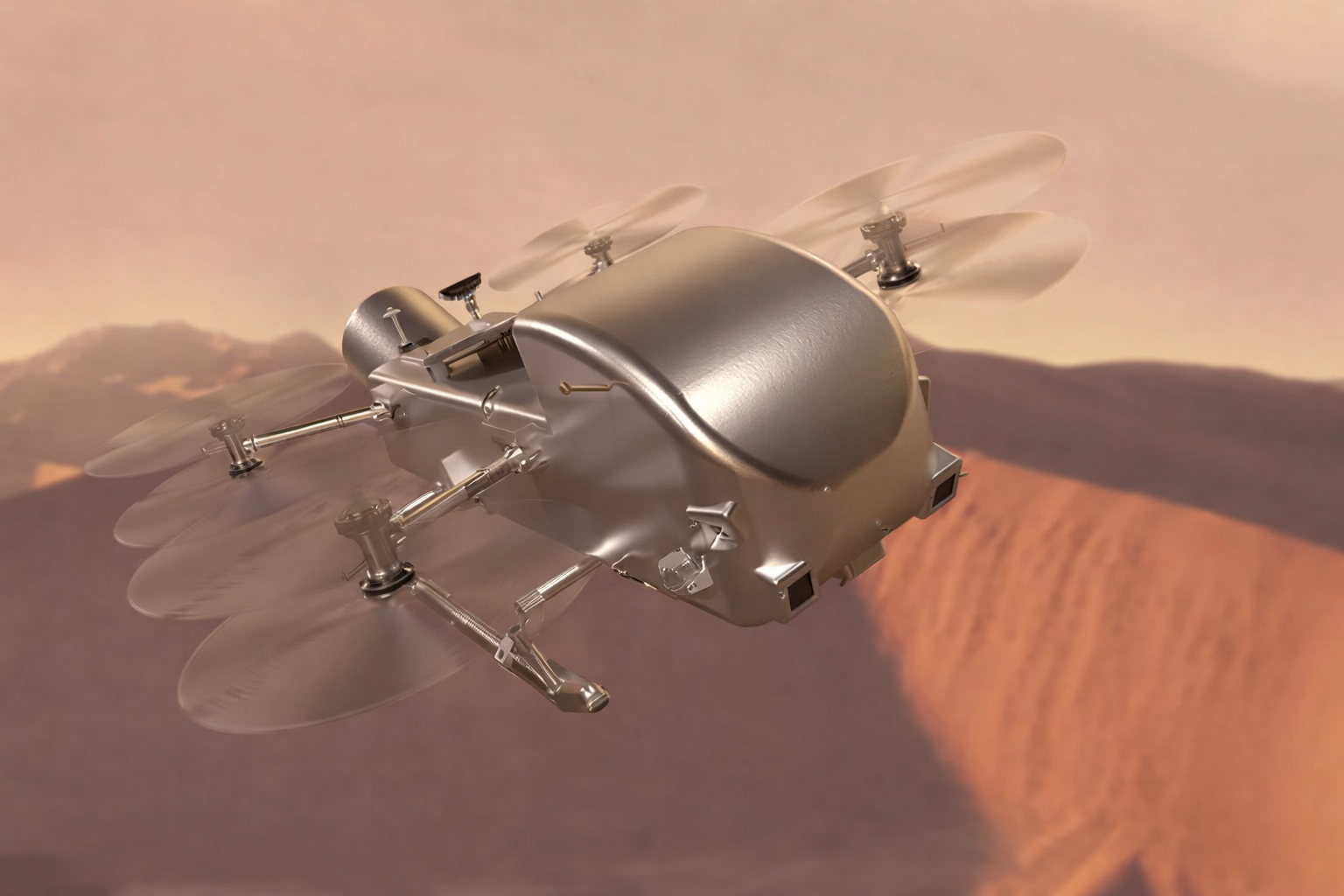
Nuclear-Powered Drone Begins Construction for Titan Launch in 2028
A fascinating new age in solar system exploration is about to begin. Scientists are currently working on a ground-breaking project that will launch a drone propelled by nuclear energy to investigate Titan, Saturn’s largest moon. NASA recently announced that engineers have officially started constructing the ground-breaking Dragonfly rotorcraft, which represents a significant turning point in humanity’s efforts to comprehend far-off worlds.
Launched in 2028, the ambitious project has the potential to revolutionize our knowledge of atmospheric chemistry, planetary science, and possibly the potential origins of life.
A Historic Step Toward Exploring Titan
The Dragonfly mission is being developed at the Johns Hopkins Applied Physics Laboratory in Maryland, where engineers have started assembling and testing key components of the drone.
According to Elizabeth Turtle, the mission’s principal investigator, this stage represents the beginning of the spacecraft’s physical construction after years of planning and design.
Dragonfly will be a car-sized rotorcraft capable of flying through the thick atmosphere of Titan. Titan is considered one of the most fascinating places in the solar system because scientists believe it contains organic molecules that may resemble the chemical ingredients that led to life on Earth.
By flying from one location to another, Dragonfly will analyze Titan’s surface, atmosphere, and chemical composition, helping researchers better understand how life might begin on other worlds.
Building on the Success of NASA’s Ingenuity Helicopter
The first flying vehicle to be sent to an other globe will not be Dragonfly. Ingenuity, the tiny aircraft that traveled with the Perseverance rover to Mars, is responsible for that milestone.
In April 2021, Ingenuity accomplished the first powered flight on a different planet, making history. The little aircraft was intended to make only a few test flights, but before its mission concluded in early 2024, it operated for almost three years and completed dozens of flights.
Dragonfly will be far bigger and more sophisticated, but it will draw on the lessons acquired from Ingenuity. Dragonfly will employ nuclear energy, which will enable it to function in Titan’s extremely cold climate and dim sunlight, whereas Ingenuity relies on solar power.
The Dragonfly mission also represents a much larger investment. The project is estimated to cost about $3.35 billion, compared with Ingenuity’s relatively modest $85 million budget.
Why Titan Is a Fascinating Target
Titan is the largest moon of Saturn and the second-largest moon in the solar system, after Ganymede, which orbits Jupiter.
Scientists consider Titan one of the most Earth-like environments beyond our planet. The moon has:
- A thick atmosphere rich in nitrogen
- Rivers and lakes made of liquid methane and ethane
- Complex organic chemistry in its atmosphere and surface
These conditions make Titan a prime candidate for studying prebiotic chemistry, the chemical processes that may lead to life.
So far, Titan has been explored up close only once—by the Huygens, which landed on the moon in January 2005 during the Cassini–Huygens mission. The probe transmitted data for only a few hours, leaving scientists eager for a more detailed exploration.
Testing and Integration Before Launch
Before Dragonfly can begin its journey, engineers must carefully test every part of the spacecraft.
Early testing at the Applied Physics Laboratory focuses on the integrated electronics module, which functions as the mission’s “brain.” This system manages critical tasks such as:
- Guidance and navigation
- Data processing
- Power distribution
Testing and integration will continue through early 2027. Afterward, the spacecraft will be shipped to Lockheed Martin Space in Colorado for additional system testing.
The mission’s protective shell, designed to safeguard Dragonfly during its long journey through space, has already undergone aerodynamic testing at NASA Langley Research Center.
Launching Toward Titan in 2028
If all development milestones are met, Dragonfly will be transported to Kennedy Space Center in Florida in spring 2028.
The spacecraft is scheduled to launch aboard a SpaceX Falcon Heavy rocket, beginning a multi-year journey across the solar system toward Titan.
Once it arrives, Dragonfly will hop from location to location, analyzing Titan’s surface chemistry, geology, and atmospheric conditions.
A Mission That Could Transform Planetary Science
The Dragonfly mission represents one of the most ambitious robotic exploration projects ever attempted. By combining nuclear power, drone flight technology, and advanced scientific instruments, Dragonfly will explore Titan in ways never before possible.
Scientists hope the mission will reveal crucial clues about how complex chemistry evolves in planetary environments—and perhaps even shed light on how life itself begins.
If successful, Dragonfly could redefine our understanding of habitability in the solar system and open the door to future aerial exploration missions on other distant worlds.