Terraforming Mars Isn’t a Climate Problem—It’s an Industrial Challenge
For many years, scientists, engineers, and authors of science fiction have been captivated by the idea of terraforming Mars, or making the Red Planet habitable. Although the idea is frequently depicted in films and books, the truth is much more nuanced. Scientists at NASA’s Jet Propulsion Laboratory have found that the biggest obstacle to transforming Mars into an Earth-like planet is not just changing the planet’s environment, but rather the enormous industrial and energy requirements required to do it.
The Stages of Making Mars Habitable
Scientists describe several potential milestones in the long process of making Mars suitable for human life. Each stage represents a significant leap in atmospheric pressure, temperature, and environmental stability.
1. Current Conditions on Mars
Today, Mars is extremely cold with a very thin atmosphere. Surface pressure is far below what humans can tolerate without full life-support systems. Water cannot remain stable on the surface for long, making long-term human settlement extremely difficult.
2. Reaching the Triple Point of Water
The first major milestone would be increasing Mars’ atmospheric pressure to about 6.1 millibars, known as the triple point of water. At this pressure and around 0°C, water can exist simultaneously as a solid, liquid, and gas. Achieving this state would allow liquid water to exist briefly on the surface.
However, even this modest step requires adding enormous amounts of gas—approximately 3.89 × 10¹⁵ kilograms—nearly equivalent to the mass of Mars’ small moon Deimos.
3. Building “Shirtsleeve” Greenhouses
Scientists think paraterraforming is a more practical strategy before completely terraforming Mars. This entails building enormous, sealed greenhouses where people might live without spacesuits and crops could be grown.
Inside these domes, atmospheric pressure could be maintained around 100 millibars, high enough for agriculture and human activity. Over time, these habitats could expand to cover large areas, eventually forming a massive enclosed “world house.”
4. Preventing Human Blood from Boiling
For humans to survive directly on the Martian surface, atmospheric pressure must reach about 62.7 millibars. At this level, human blood would not boil at body temperature. While still far from comfortable breathing conditions, it would represent a major milestone toward planetary habitability.
5. Creating a Fully Breathable Atmosphere
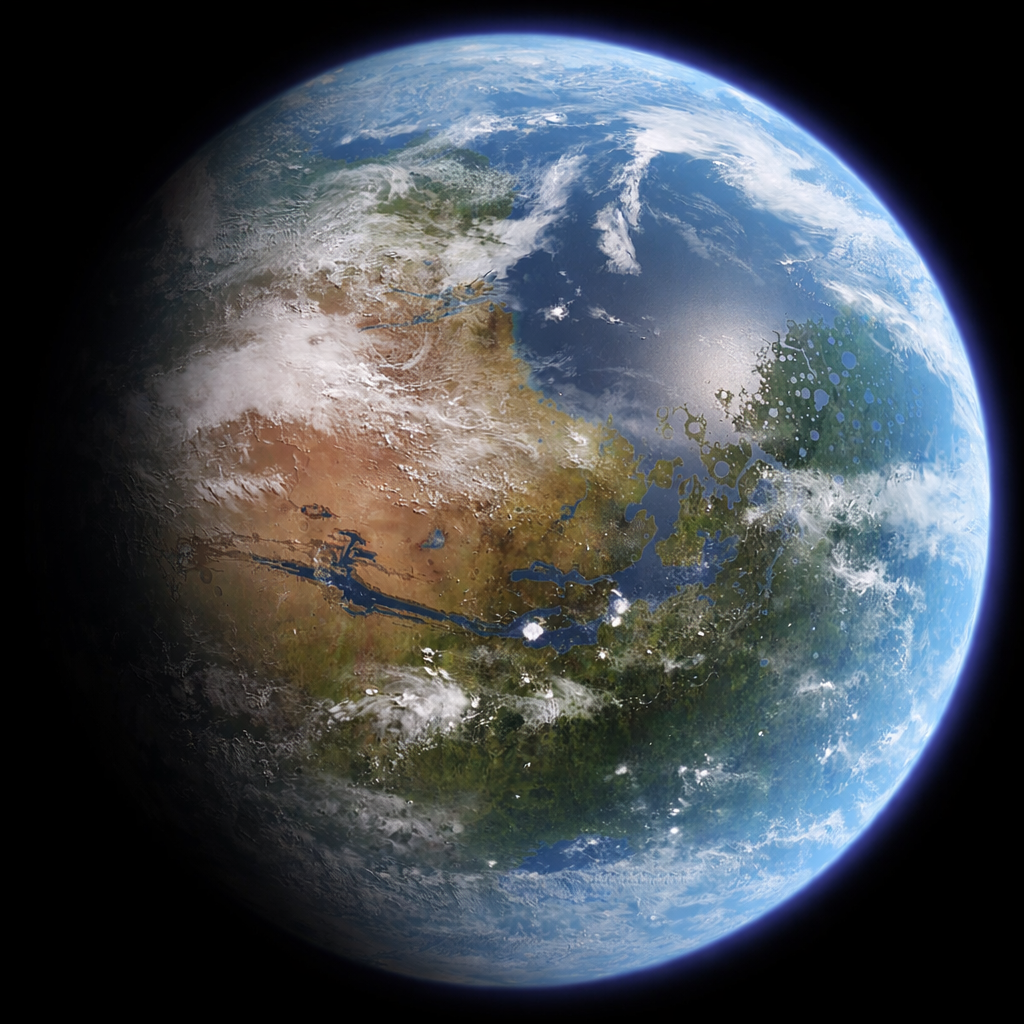
The ultimate goal of terraforming Mars would be an atmosphere similar to Earth’s, with around 500 millibars of total pressure and roughly 210 millibars of oxygen, supported by nitrogen as a buffer gas.
Reaching this level would require an astonishing 10¹⁸ kilograms of atmospheric gases, comparable to the mass of a small moon in our solar system.
The Energy Problem: Terraforming’s Biggest Barrier
Even if the necessary gases could be sourced, the biggest challenge remains energy production.
To generate the oxygen needed for a breathable atmosphere, scientists propose splitting water molecules into hydrogen and oxygen. This process alone would require roughly 1.2 × 10²⁵ joules of energy.
Even if spread across 1,000 years, this would demand a continuous power output of about 380 terawatts—nearly 20 times the total annual energy consumption of humanity today.
Raising Mars’ temperature is another massive challenge. Scientists estimate the planet would need to warm by around 60°C to sustain stable liquid water. Some proposed solutions include injecting heat-absorbing particles into the atmosphere or building gigantic orbital mirrors to reflect sunlight onto the surface. However, calculations suggest such a mirror system would require about 70 million square kilometers of reflective material, far beyond current industrial capabilities.
A More Realistic Path Forward
Despite these immense challenges, Mars still holds strong appeal as humanity’s next frontier. Rather than attempting immediate planetary transformation, scientists believe the best strategy is starting small—building localized habitats and greenhouses that provide stable living environments.
Over centuries or even millennia, advancements in energy generation, space industry, and planetary engineering could gradually make larger terraforming projects possible.
For now, the dream of making Mars habitable remains technically possible but industrially overwhelming. Terraforming the Red Planet isn’t just about changing its climate—it’s about building an infrastructure powerful enough to reshape an entire world.