Asteroids Exchanging Rocky Debris: First Direct Evidence Found in Binary Asteroid System
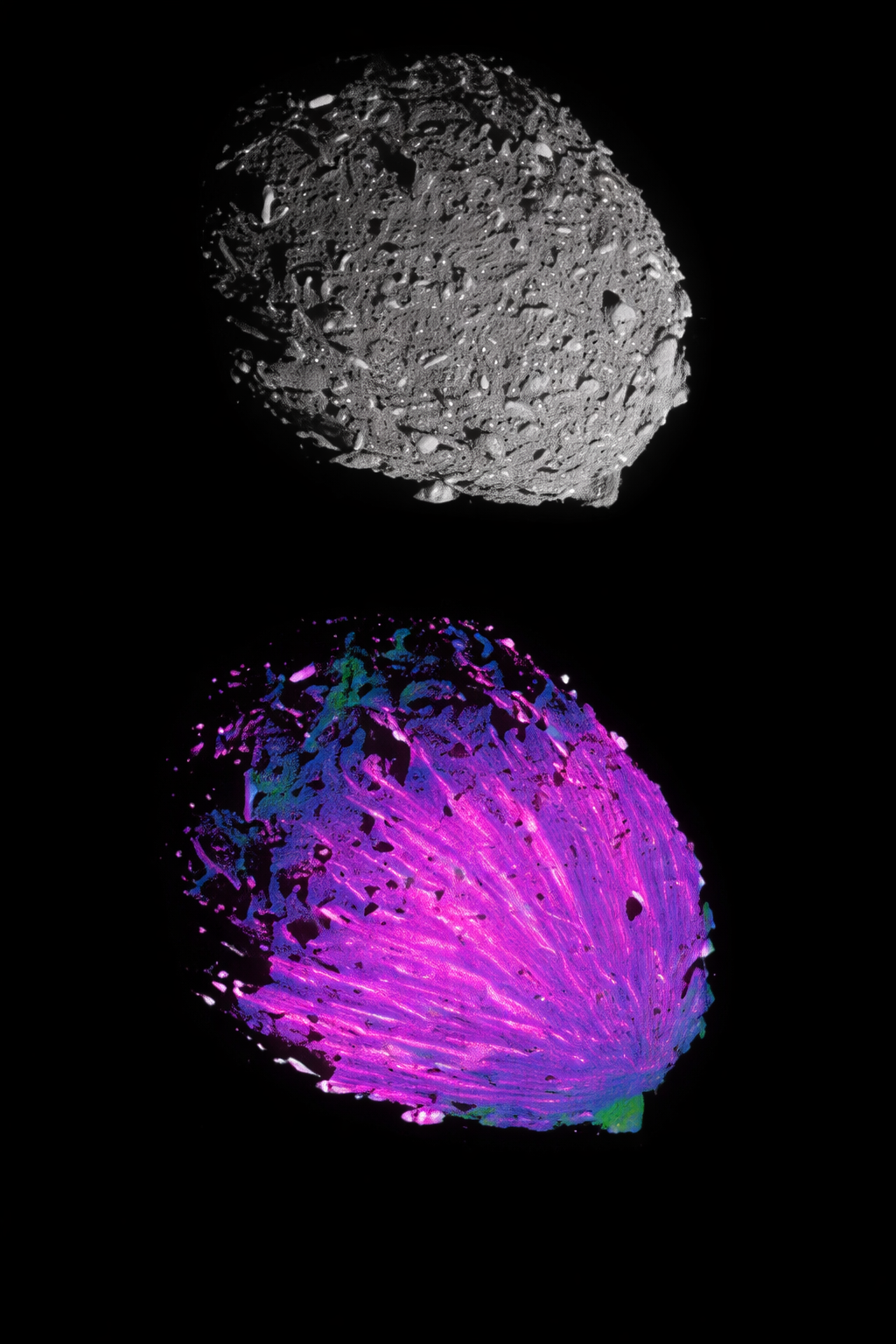
The first concrete proof that asteroids in a binary system can exchange material has been found by scientists, exposing an intriguing new mechanism influencing our solar system. Researchers found faint but noticeable patterns on Dimorphos’ surface using Double Asteroid Redirection Test (DART) photos, indicating that rocky debris from Didymos, the asteroid’s parent, has been traveling through space and resting on its smaller partner.
The finding sheds important light on how small celestial bodies change over time, planetary defense tactics, and the evolution of binary asteroids.
Unexpected Clues Hidden in DART Images
The discovery began when researchers at the University of Maryland, led by planetary scientist Jessica Sunshine, noticed unusual fan-shaped streaks while analyzing images of Dimorphos captured by DART.
Initially, scientists suspected technical issues with the camera or errors in image processing. However, after months of testing different lighting models and refining three-dimensional surface models, the mysterious streaks remained visible—and even became clearer.
According to research scientist Tony Farnham, improvements to the moon’s 3D model actually enhanced the streak patterns. This confirmed that the features were real and not imaging artifacts.
The process behind this cosmic exchange is surprisingly gentle. Scientists believe sunlight slowly increases the rotation speed of asteroids through a phenomenon called the Yarkovsky–O’Keefe–Radzievskii–Paddack effect, commonly known as the YORP effect.
Over millions of years, this effect causes an asteroid to spin faster and faster. Eventually, loose surface material is flung into space.
Tiny boulders can escape the gravity of Didymos, which is roughly 730 meters across, provided they move at a speed of only 30.7 centimeters per second, which is no quicker than a leisurely stroll. Some of this debris floats in the direction of Dimorphos once it is discharged.
The debris impacts the smaller moon at a speed of only 6 millimeters per second, which is much too slow to produce a crater. Rather, thin, brilliant coatings of detritus spread across the surface.
On March 6, 2026, the results were published in The Planetary Science Journal.
How Asteroids Transfer Material Between Each Other
Why the Surface Shows Fan-Shaped Rays
The distinctive fan-like patterns on Dimorphos appear because of its rocky surface. The moon is covered with large boulders, creating a rubble-like terrain.
To understand how these patterns formed, scientists conducted experiments using sand, gravel, and glass marbles. High-speed cameras captured how particles flowed around obstacles, producing ray-like streaks similar to those observed on Dimorphos.
Computer simulations at Lawrence Livermore National Laboratory confirmed that slow-moving debris interacting with scattered boulders can create the same types of deposits seen in the asteroid images.
These faint deposits are only about 25% brighter than the surrounding surface, making them extremely difficult to detect without detailed image processing.
Why This Discovery Matters for Planetary Defense
This discovery has major implications for planetary defense research. Around 15% of near-Earth asteroids are part of binary systems, meaning they have small moons orbiting them.
Understanding how these systems evolve is essential for predicting how asteroids might respond to potential deflection missions.
Dimorphos itself became famous when NASA intentionally crashed the DART spacecraft into it in 2022 to test asteroid deflection technology. Studying the natural processes shaping the asteroid before the impact helps scientists better understand how these bodies behave.
Hera Mission Will Continue the Investigation
The next chapter in this research will come from Hera Mission, led by the European Space Agency. Scheduled to arrive at the Didymos system in December 2026, the spacecraft will study both asteroids in detail.
Scientists hope Hera’s advanced instruments will determine whether the ancient debris deposits on Dimorphos survived the DART collision. If so, researchers will have the rare opportunity to compare two different types of impact records—one created naturally over time and another produced by a spacecraft strike.
This discovery not only confirms long-standing theories about asteroid formation but also provides new clues about how small bodies interact and evolve across our solar system.