Universe-Shaking Black Hole–Neutron Star Collision Could Rewrite Cosmic Merger Theories
A dramatic cosmic collision between a black hole and a neutron star is forcing astronomers to rethink long-standing theories about how these extreme systems form. Scientists studying gravitational waves from the event discovered that the two objects were orbiting each other in a highly unusual, oval-shaped path just before they collided — something that existing models struggle to explain.
The findings, published in The Astrophysical Journal Letters, suggest that some of the universe’s most violent mergers may form in environments far more chaotic than previously believed.
A Cosmic Collision That Sent Ripples Across the Universe
In 2020, scientists detected powerful ripples in spacetime from a distant cosmic catastrophe: a black hole consuming a neutron star.
The discovery was made using the Laser Interferometer Gravitational‑Wave Observatory (LIGO), one of the most advanced instruments designed to detect gravitational waves — distortions in spacetime first predicted by Albert Einstein in his theory of general relativity.
These waves were produced when a black hole merged with a neutron star, the ultra-dense remnant core of a once-massive star.
Although the event happened about one billion light-years away, its spacetime ripples traveled across the cosmos and reached Earth, where detectors were able to measure them.
The signal analyzed in the new research is known as GW200105 gravitational‑wave event.
Scientists Discover a Strange Orbital Dance
Astronomers found something surprising when they reexamined the data.
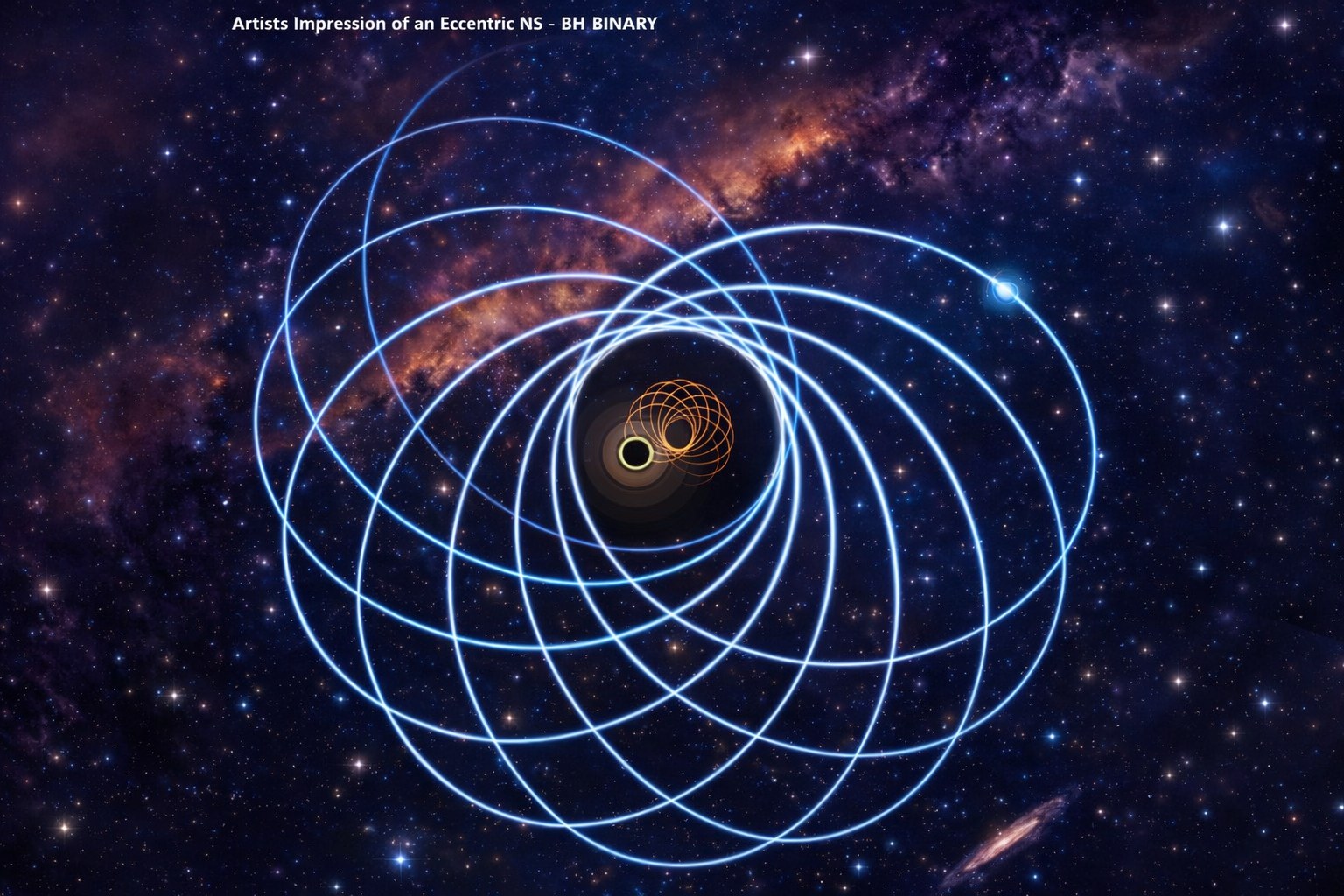
The two objects were spiraling toward one another in an erratic, oval-shaped orbit rather than traveling in a nearly perfect circular orbit as expected by conventional astrophysical theories.
Before the final impact, the path looped and swirled like the complex patterns made by a Spirograph.
The long-held belief that black hole–neutron star binaries must settle into circular orbits prior to merging is called into question by this research.
The eccentric orbit is a “smoking gun” showing complex systems can evolve in unexpected ways, according to Patricia Schmidt, a physicist at the University of Birmingham.
What Happens When a Black Hole Meets a Neutron Star?
Both black holes and neutron stars are born when massive stars run out of nuclear fuel and collapse under their own gravity.
- Neutron stars compress more mass than the Sun into a sphere about the size of a city.
- Black holes form when gravity becomes so strong that not even light can escape.
Sometimes, two such remnants become locked in a binary system, gradually spiraling closer together due to energy lost through gravitational waves.
Eventually, the pair collides in a catastrophic merger that releases enormous amounts of energy and creates a larger black hole.
In the GW200105 event, scientists estimate the resulting black hole had around 13 times the mass of the Sun.
Why This Discovery Challenges Existing Theories
Traditional astrophysical models suggest that binary systems form from two massive stars that evolve together over millions of years.
In that scenario, gravitational interactions gradually smooth out the orbit until it becomes almost perfectly circular by the time detectors like LIGO can observe it.
But the new analysis shows the orbit remained strongly elliptical even moments before the merger.
Researchers say they can rule out a circular orbit with 99% certainty.
This means the system likely formed in a different environment — perhaps in a crowded star cluster where gravitational interactions with other stars altered the orbit.
The Key Clues: Eccentricity and Precession
To understand the system better, researchers analyzed two critical orbital properties:
1. Eccentricity
Eccentricity describes how stretched or oval-shaped an orbit is.
The new analysis showed the orbit was highly eccentric, meaning the two objects followed a long, egg-shaped path instead of a circle.
2. Precession
Precession refers to the wobble in the orientation of an orbit over time.
Interestingly, the team found no strong evidence of precession, suggesting the unusual orbit was not caused by rotational changes.
Instead, the orbit was likely influenced by external gravitational forces earlier in the system’s life.
According to researcher Geraint Pratten, the elliptical orbit suggests the pair did not evolve quietly in isolation.
A New Window Into the Universe
This discovery marks the first time astronomers have observed an eccentric orbit in a black hole–neutron star merger.
It also suggests that cosmic mergers may occur in more diverse environments than previously believed.
Future research could reveal entirely new populations of exotic binary systems.
To detect them, scientists will rely on next-generation gravitational-wave observatories, including the upcoming Laser Interferometer Space Antenna (LISA), a space-based detector currently under development.
LISA is expected to be far more sensitive than current detectors, allowing astronomers to observe:
- weaker gravitational-wave signals
- more distant cosmic mergers
- entirely new types of astrophysical phenomena
The Future of Gravitational-Wave Astronomy
The discovery highlights how gravitational-wave astronomy is transforming our understanding of the universe.
Every new detection reveals more about how extreme cosmic objects form, evolve, and ultimately collide.
As instruments become more powerful, scientists expect to uncover many more surprises hidden in the ripples of spacetime.
These discoveries could reshape our understanding of:
- black hole formation
- neutron star evolution
- stellar dynamics in dense star clusters
- and the violent events that shape galaxies
In short, the universe still has many secrets — and gravitational waves are helping us hear them for the first time.