
A New Link Between Mathematics and Physics
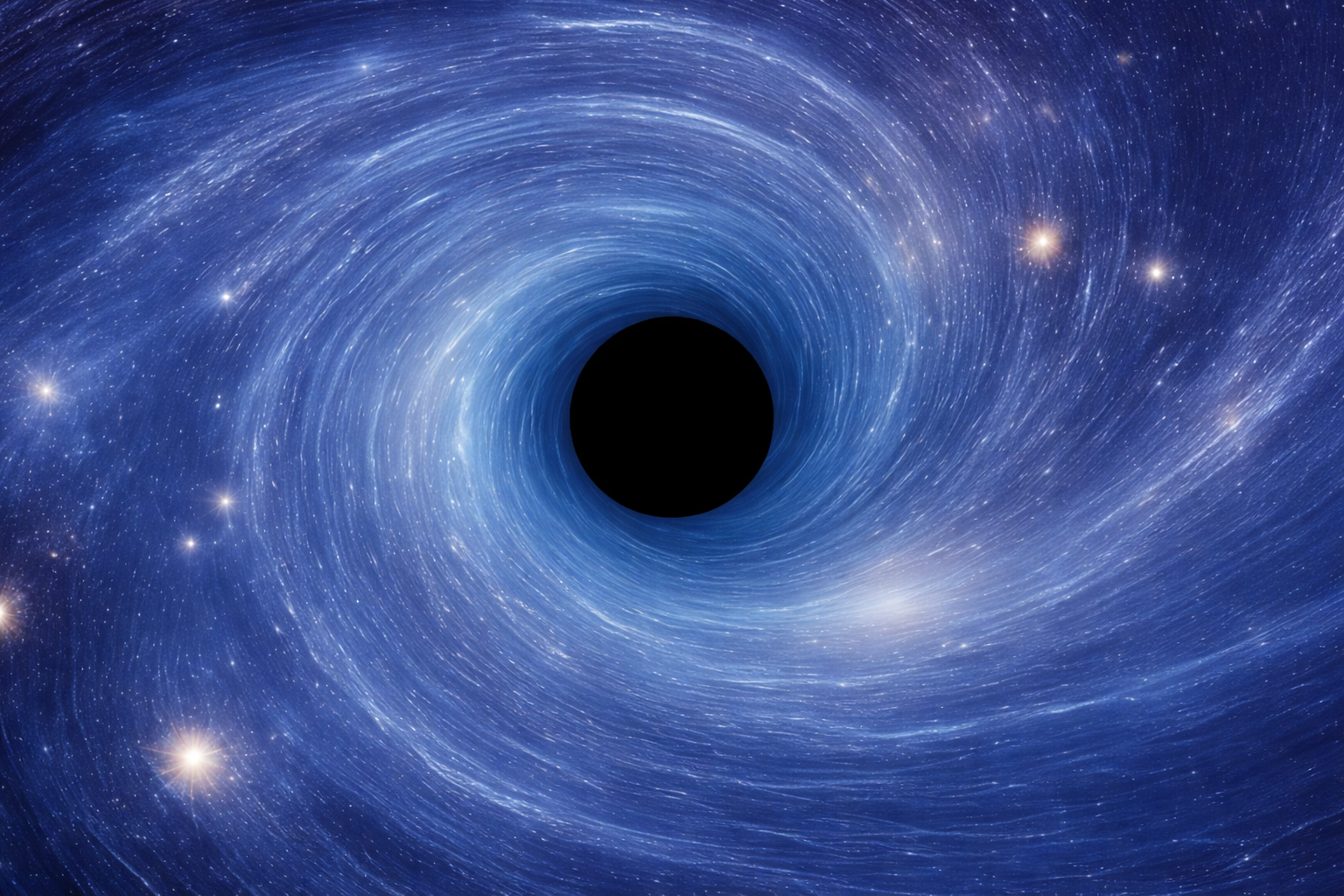
Prime numbers have fascinated mathematicians for millennia as the fundamental building blocks of arithmetic. A shocking discovery in theoretical physics suggests that these seemingly abstract numbers may also explain black holes, one of the universe’s most mysterious occurrences. Recent research suggests that the mathematical patterns governing prime numbers may potentially explain the physics of black hole singularities.
This new connection between number theory and quantum physics may provide new insights into some of the most challenging cosmic riddles.
Understanding Prime Numbers: Mathematics’ “Fundamental Particles”
Prime numbers are natural numbers greater than 1 that can only be divided by themselves and 1. Examples include 2, 3, 5, 7, and 11. Because they cannot be broken down into smaller natural numbers, mathematicians often describe them as the “fundamental particles of mathematics.”
For hundreds of years, number theorists have studied the properties and patterns of primes. One of the most famous unsolved problems in mathematics is the Riemann Hypothesis, proposed in 1859. This hypothesis focuses on the mysterious behavior of the Riemann zeta function, which helps estimate how prime numbers are distributed among natural numbers.
If proven, the Riemann Hypothesis would unlock a deeper understanding of prime number patterns and remains one of the most important open questions in mathematics today.
Black Holes and the Breakdown of Physics
As the basic building blocks of arithmetic, prime numbers have captivated mathematicians for millennia. Black holes, one of the universe’s most enigmatic phenomena, may also be explained by these seemingly abstract numbers, according to a startling theoretical physics study. According to recent studies, the physics of black hole singularities may be explained by the mathematical patterns regulating prime numbers.
This new relationship between quantum physics and number theory may offer fresh perspectives on some of the most difficult cosmic mysteries.
The “Primon Gas” Theory
In the late 1980s, physicist Bernard Julia proposed a thought experiment involving hypothetical particles called primons. These particles would have energy levels determined by the logarithms of prime numbers.
Julia imagined a system known as a “primon gas,” where the distribution of particle energies follows the same structure as the Riemann zeta function. At the time, this idea was considered purely theoretical and unlikely to exist in nature.
However, modern research has revived interest in the concept.
Recent studies suggest that near a black hole’s singularity, a quantum system may appear whose energy levels align with prime number patterns, resembling Julia’s primon gas.
Chaos, Symmetry, and Prime Numbers in Black Holes
In 2025, researchers studying black hole physics discovered that conformal symmetry emerges in the chaotic region close to a singularity. Conformal symmetry refers to repeating patterns that appear at different scales, similar to fractal structures.
This symmetry allowed scientists to identify a quantum system where energy states organize themselves according to prime numbers. In other words, the internal physics of black holes may follow mathematical rules similar to those governing primes.
Further research even suggests that higher-dimensional models of the universe may require Gaussian primes, a complex form of prime numbers involving imaginary values.
Why This Discovery Matters
The connection between prime numbers and black holes may open new pathways toward solving one of physics’ biggest challenges—quantum gravity, the theory that aims to unify Einstein’s general relativity with quantum mechanics.
Some physicists believe number theory could provide the mathematical language needed to describe the deepest structures of the universe.
Although the research is still developing, the idea that prime numbers may play a role in cosmic phenomena highlights the profound relationship between pure mathematics and physical reality.
The Future of Prime Physics
Scientists caution that these ideas are still being explored, and much more research is needed to confirm whether prime numbers truly govern black hole physics. However, the growing evidence suggests that the universe may be built upon elegant mathematical patterns far deeper than previously imagined.
If these connections continue to hold, prime numbers—once considered purely abstract mathematical objects—could become a key tool in understanding the nature of space, time, and gravity.
In the quest to decode the universe, it seems mathematics may once again provide the ultimate guide.