James Webb and Chandra Reveal a Monster Galaxy Protocluster That Defies Big Bang Theory
The universe has once again surprised astronomers. Using the combined power of the James Webb Space Telescope and the Chandra X-ray Observatory, scientists have captured the clearest image ever of a massive galaxy cluster in the making — and it’s rewriting what we thought we knew about the early universe.
This breathtaking discovery, known as JADES-ID1, could be the most distant confirmed galaxy protocluster ever observed. Even more astonishing? It formed when the universe was only about one billion years old.
Let’s explore why this “monster object” is shaking up modern cosmology.
What Is JADES-ID1? A Galaxy Protocluster From the Early Universe
JADES-ID1 is located an incredible 12.7 billion light-years away from Earth. That means we are seeing it as it existed shortly after the Big Bang. In cosmic terms, this was a very young universe.
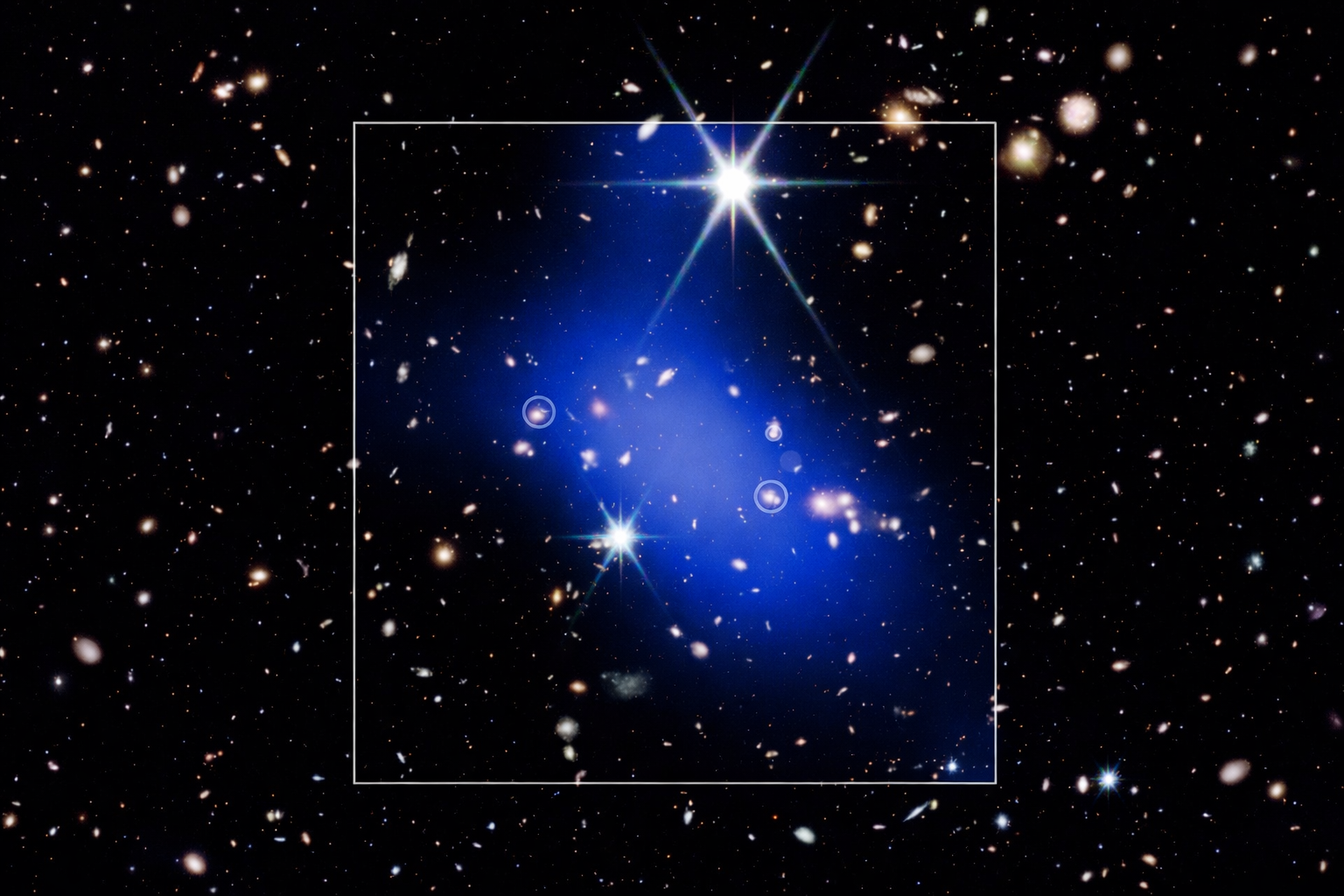
In the stunning deep-space image, JADES-ID1 appears as a group of glowing specks clustered within a vast blue cloud. Those glowing dots are galaxies — at least 66 of them — all bound together by gravity.
Astronomers classify JADES-ID1 as a galaxy protocluster, which is essentially a galaxy cluster in its infancy.
What Is a Galaxy Protocluster?
A protocluster is a region filled with young galaxies that are beginning to gather under the pull of gravity. Over billions of years, these structures grow into massive galaxy clusters containing hundreds or even thousands of galaxies.
However, protoclusters are extremely difficult to detect because:
Their galaxies are not yet tightly packed.
The surrounding hot gas is still developing.
They often don’t emit strong X-rays like mature clusters do.
That’s why JADES-ID1 is such an extraordinary find.
How James Webb and Chandra Made the Discovery
The discovery of JADES-ID1 was only possible because of the deepest observations ever taken by JWST and Chandra.
JWST’s Infrared Vision
The James Webb Space Telescope (JWST) specializes in detecting infrared light. This allows it to see extremely distant objects whose light has been stretched by the expansion of the universe — a phenomenon known as redshift.
Using its advanced infrared instruments, JWST identified at least 66 galaxies grouped closely together in the same region of space.
Chandra’s X-Ray Confirmation
While JWST spotted the galaxies, Chandra provided the missing piece of the puzzle.
Because JADES-ID1 is so massive, it heats the surrounding gas to extremely high temperatures. That hot gas emits X-rays — something Chandra is specifically designed to detect.
The X-ray glow, visible as a neon-blue cloud in the image, confirmed that these galaxies are not randomly aligned. They are part of a single, massive gravitational structure.
This dual confirmation makes JADES-ID1 one of the strongest candidates for the most distant confirmed protocluster ever found.
A Monster That Shouldn’t Exist (Yet)
Here’s where things get truly fascinating.
Astronomers estimate that JADES-ID1:
Has a mass equal to 20 trillion suns
Spans about 1.1 million light-years across
Formed when the universe was only 1 billion years old
According to standard cosmological models, a structure this massive should not have formed until 2 to 3 billion years after the Big Bang.
In other words, JADES-ID1 grew up far too fast.
Lead researcher Akos Bogdan of the Harvard & Smithsonian Center for Astrophysics described the discovery as potentially the most distant confirmed protocluster ever seen. He noted that this object suggests the universe may have evolved much more rapidly than scientists previously believed.
Why This Discovery Challenges Big Bang Models
Current models of cosmic evolution suggest that:
- Small galaxies form first.
- They gradually merge over billions of years.
- Large galaxy clusters emerge much later.
But JADES-ID1 seems to skip ahead in the timeline.
If such a massive structure existed so early, it raises important questions:
Did matter clump together faster than predicted?
Were there more early galaxies than expected?
Do we need to revise our models of dark matter and cosmic evolution?
This discovery doesn’t overturn the Big Bang theory — but it may force scientists to refine how structure formation happened in the early universe.
What This Means for the Future of Astronomy
The discovery of JADES-ID1 highlights the incredible power of next-generation space telescopes. Deep space exploration is still being pushed by the James Webb Space Telescope, while high-energy cosmic phenomena still depend on Chandra’s X-ray observations.
As JWST conducts deeper surveys of the early universe, astronomers expect to find even more surprising structures that could reshape our understanding of:
Galaxy formation
Dark matter distribution
Cosmic evolution
The first billion years after the Big Bang
If JADES-ID1 formed this quickly, what else is hiding in the distant universe?
Study Published in Nature
The groundbreaking findings were published on January 28 in the prestigious journal Nature, adding strong scientific credibility to the discovery.
With more observations planned, researchers hope to understand exactly how this enormous protocluster assembled so rapidly.
Final Thoughts: A Universe in a Hurry
JADES-ID1 is more than just a beautiful space photo — it’s a cosmic clue.
It tells us that the early universe may have been far more dynamic and efficient at building massive structures than we imagined. Seeing such a gigantic protocluster only one billion years after the Big Bang suggests that the universe was, as researchers put it, in a “huge hurry to grow up.”
As technology advances and telescopes peer even deeper into space and time, one thing is certain:
The universe still has many secrets left to reveal.