
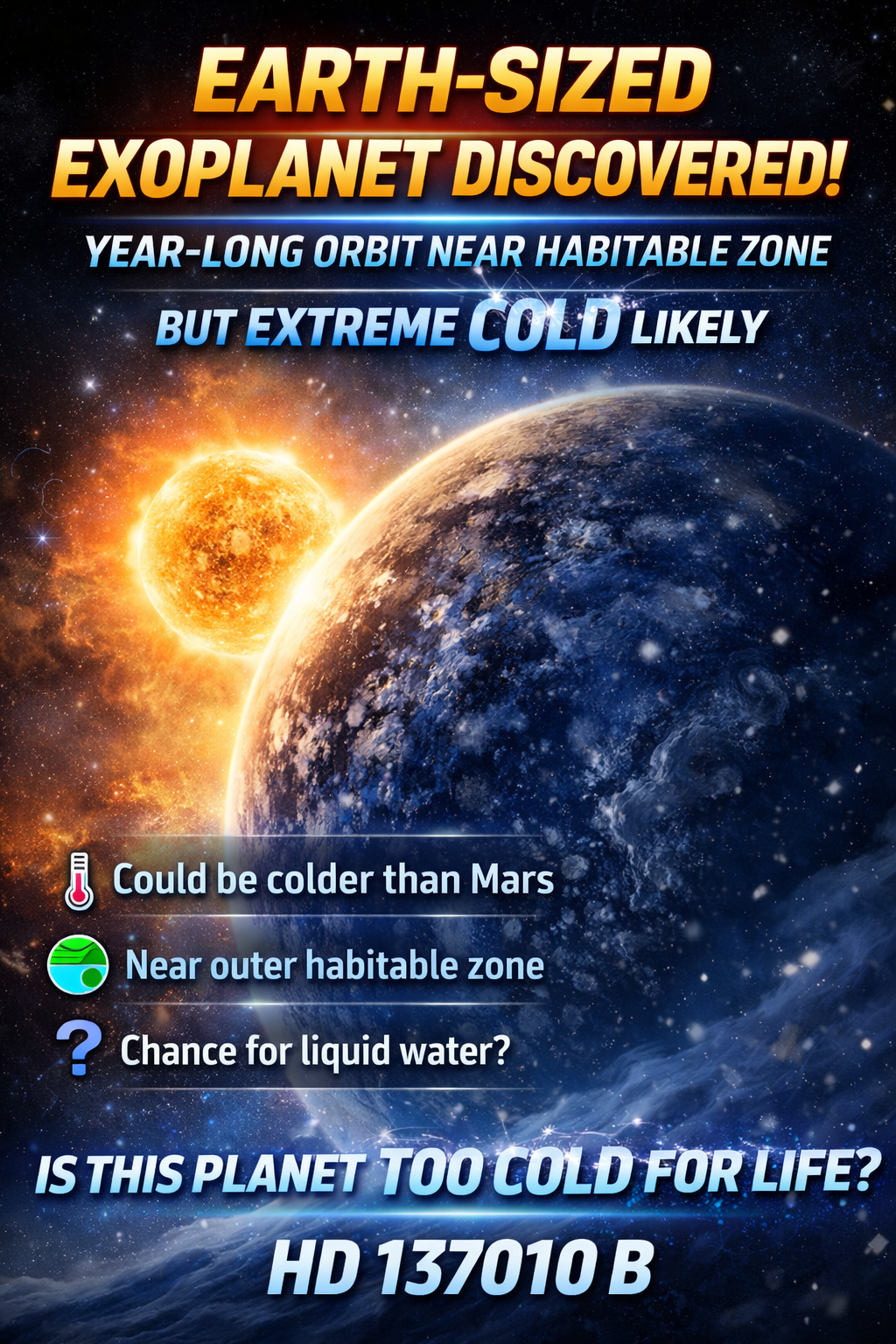
Astronomers have identified a newly found Earth-sized exoplanet that follows an orbit similar to our own planet’s year. While the discovery has sparked excitement, early data suggests this distant world may be far colder than Earth, potentially limiting its ability to support liquid water.
Meet HD 137010 b: An Earth-Like Planet With a Chilling Twist
The planet, named HD 137010 b, appears broadly similar to Earth in size and orbital period. However, despite these familiar traits, scientists believe it could be even colder than Mars, a planet already known for its harsh, frozen surface.
This temperature challenge places a big question mark over the planet’s potential habitability.
A Rare Earth-Style Orbit Around a Sun-Like Star
Researchers continue to uncover valuable findings from data collected by NASA’s Kepler Space Telescope, which stopped operations in 2018. One recent analysis highlights HD 137010 b as a standout discovery.
The rocky planet is slightly larger than Earth and orbits a Sun-like star located about 146 light-years away. What makes it especially interesting is its year-long orbit, closely matching the time Earth takes to circle the Sun.
Positioned Near the Star’s Habitable Zone
HD 137010 b appears to orbit near the outer edge of its star’s habitable zone—the region where liquid water could exist on a planet’s surface if atmospheric conditions are favorable. Although the planet is still classified as a candidate awaiting confirmation, its position alone makes it a compelling target for future study.
If confirmed, it could become the first Earth-sized exoplanet with a year-long orbit observed transiting a nearby, Sun-like star, making it unusually suitable for follow-up observations.
Why This Exoplanet May Be Too Cold for Life
Despite its promising orbit, HD 137010 b receives less than one-third of the energy Earth gets from the Sun. Its host star, while similar to our Sun, is both cooler and less luminous.
Because of this, scientists estimate the planet’s surface temperature could be as low as –90°F (–68°C). For comparison, Mars has an average surface temperature of around –85°F (–65°C), suggesting HD 137010 b could be even colder than the Red Planet.
Confirmation Challenges and Future Observations
At present, HD 137010 b has been detected through a single transit event, observed during Kepler’s second mission, known as K2. This transit—where the planet briefly passed in front of its star—lasted about 10 hours, compared to Earth’s 13-hour transit across the Sun.
While researchers were able to estimate the planet’s orbital period using this data, multiple repeated transits are needed to confirm the planet’s existence. Unfortunately, that won’t be easy.
Why Earth-Like Exoplanets Are Hard to Detect
Because HD 137010 b has a long, Earth-like orbit, its transits occur infrequently. This makes confirmation much more challenging than for planets that orbit closer to their stars.
Future confirmation could come from NASA’s TESS mission or the European Space Agency’s CHEOPS telescope. Otherwise, scientists may need to wait for the next generation of space telescopes to gather more data.
Could HD 137010 b Still Support Liquid Water?
Despite its frigid outlook, researchers say the planet is not entirely ruled out as habitable. With a thick atmosphere rich in carbon dioxide, HD 137010 b could potentially trap enough heat to support liquid water.
Based on atmospheric models:
- The planet has a 40% chance of falling within the conservative habitable zone
- A 51% chance of being within a broader, optimistic habitable zone
- And roughly a 50-50 chance of lying completely outside habitable conditions
Why This Discovery Still Matters
Even if HD 137010 b turns out to be frozen and lifeless, its discovery is a major step forward. Earth-sized planets with year-long orbits are extremely rare and difficult to detect, and this candidate provides scientists with valuable insight into how common Earth-like worlds may be across the galaxy.