Stunning Deep-Space Nebula Image Captivates Astronomers
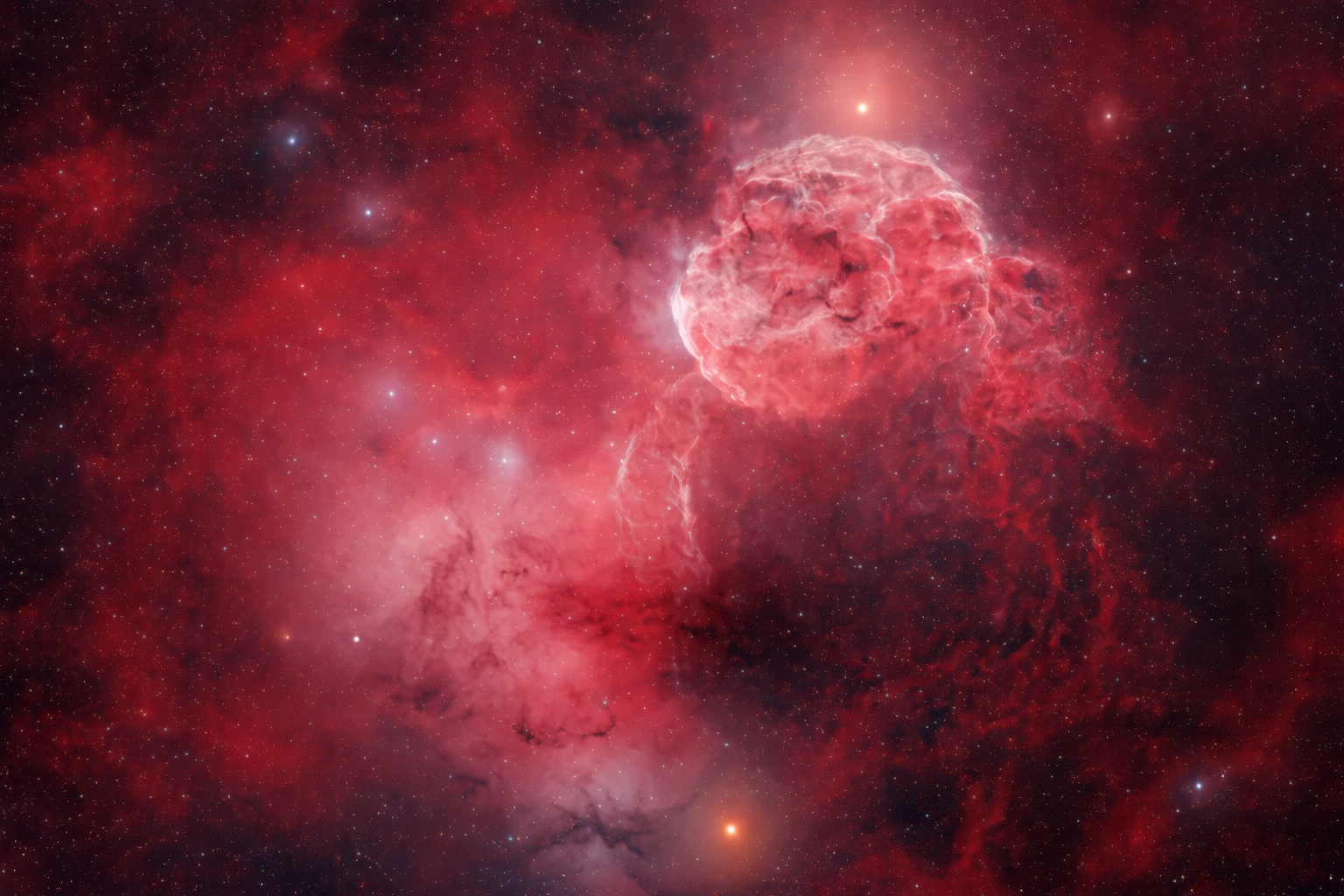
A breathtaking deep-space image captured by astrophotographer Ogetay Kayali is captivating astronomy enthusiasts around the world. The photograph reveals the mysterious IC 443, a glowing nebula located roughly 5,000 light-years from Earth. Depending on how you look at it, the cosmic structure appears either like a floating jellyfish or remarkably similar to a human brain.
This fascinating visual illusion highlights the beauty and complexity of the universe while demonstrating the power of modern astrophotography.
The Cosmic Story Behind the Jellyfish Nebula
The nebula in the image, IC 443, is actually the remnant of a massive stellar explosion known as a supernova. When a massive star reached the end of its life, it exploded violently, sending enormous clouds of gas and dust expanding into space.
What remains today is a vast shell of stellar debris interacting with surrounding interstellar material. The explosion didn’t completely destroy the original star. Instead, its core collapsed into an incredibly dense and rapidly spinning object known as a neutron star or pulsar.
Astronomers detected this pulsar using observations from Chandra X-ray Observatory, a powerful space telescope operated by NASA, which confirmed the dramatic history behind this celestial structure.
Located Near a Bright Star in Gemini
The nebula is located close to Propus, a brilliant star in the Gemini constellation that symbolizes the foot of one of the fabled twins. Astronomers and astrophotographers are familiar with this area of the sky due to its vivid star habitats and complex cosmic architecture.
The bright shell of the nebula is visible in the upper part of Kayali’s photo, encircled by vibrant background and foreground stars. A spectacular and incredibly realistic cosmic environment is created when dense filaments of interstellar gas and dust swirl through the area.
Why the Nebula Looks Like a Jellyfish — or a Brain
IC 443 has long been nicknamed the “Jellyfish Nebula” because of its distinctive shell structure and filamentary extensions that resemble the tentacles of a jellyfish drifting through space.
However, Kayali approached the image with a different artistic perspective. By carefully framing the surrounding environment and highlighting the nebula’s structure, he emphasized patterns that resemble the folds and curves of a human brain.
Interestingly, as Kayali humorously noted, jellyfish themselves do not actually have brains. Yet the nebula’s appearance allows viewers to interpret the cosmic scene in multiple ways.
A 17-Hour Astrophotography Effort
Capturing such an extraordinary image required patience and advanced equipment. Kayali spent 17 hours photographing the nebula from the skies above Texas.
To capture the image, he used a William Optics Redcat 51 III WFID telescope paired with a ZWO ASI2600MM and a specialized H-alpha filter. This setup allowed him to reveal the glowing hydrogen gas that appears as deep crimson in the final image.
These red emissions trace the powerful shock waves created when the expanding supernova debris collides with surrounding interstellar gas.
A Window Into the Violent History of the Universe
Images like this are more than visually stunning—they provide valuable insights into how stars evolve and die. Supernova remnants such as IC 443 help astronomers understand how heavy elements spread throughout the galaxy, eventually forming new stars, planets, and even the building blocks of life.
Kayali’s photograph captures not just a beautiful object in space, but a dramatic moment in the cosmic cycle of birth, death, and renewal.
For astronomy lovers and astrophotographers alike, it’s a powerful reminder that the night sky still holds countless wonders waiting to be discovered.