
Light-Based Computing Breakthrough Could Transform AI, Drug Discovery, and Cryptography
A groundbreaking innovation in light-based computing could redefine how scientists solve some of the world’s most complex problems. Researchers at Queen’s University have developed a new type of computing machine that uses light instead of traditional electronic signals to process extremely complicated calculations.
Led by Bhavin Shastri, Canada Research Chair in Neuromorphic Photonic Computing, the research demonstrates that photonic computing systems can perform billions of operations per second while consuming far less energy than many advanced computing technologies. The findings were recently published in Nature, one of the world’s most respected scientific journals.
This innovation could have major implications for fields such as drug discovery, cryptography, artificial intelligence, and logistics optimization.
What Is Light-Based Computing?
Conventional computers use electrical signals that travel through silicon chips to process data. On the other hand, light-based computing, also known as photonic computing, employs light pulses for computation.
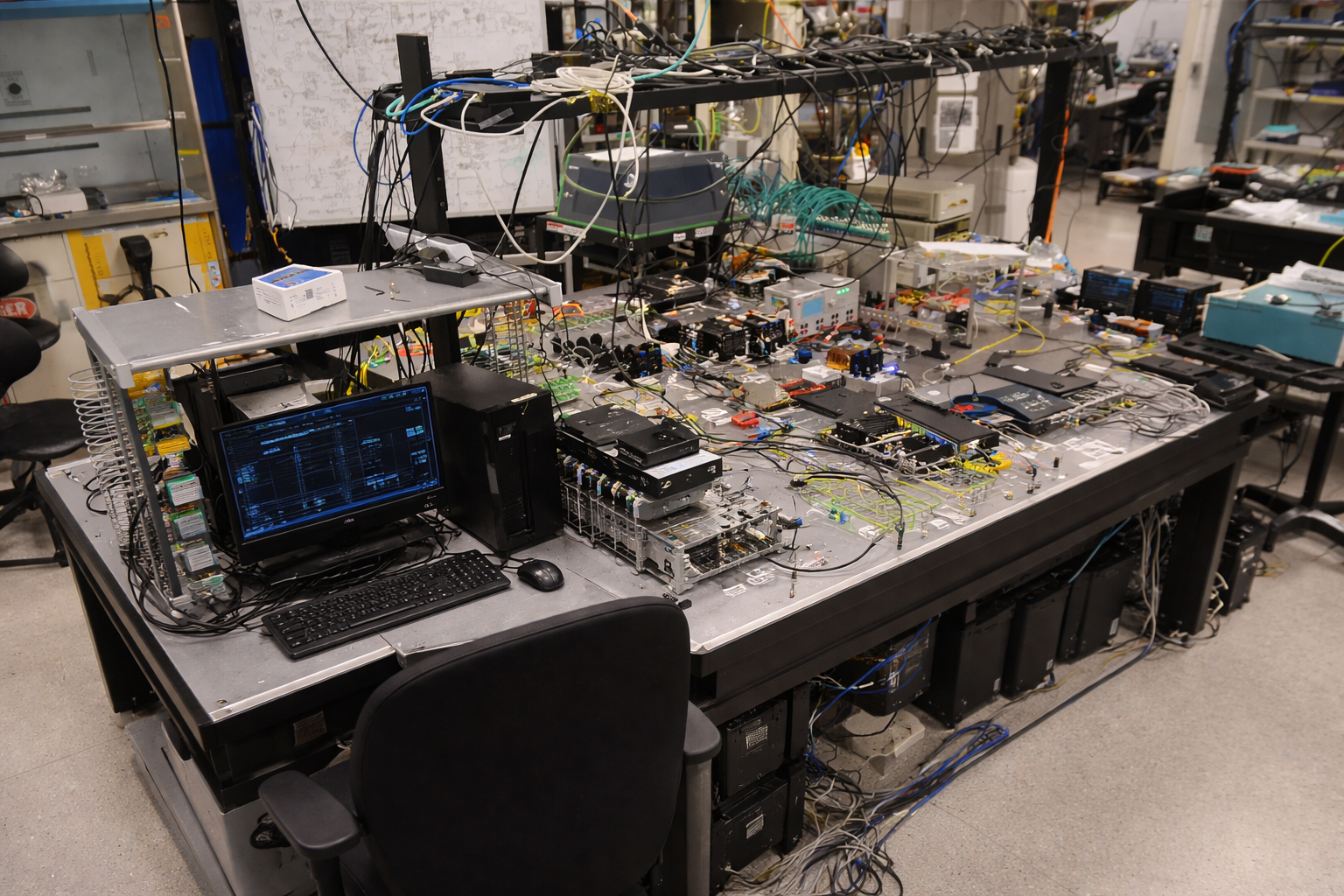
The study team employed commercially accessible parts, such as lasers, fiber optics, and modulators—technologies already extensively utilized in the world’s internet infrastructure—to construct their experimental computing machine.
The Queen’s University machine runs at ambient temperature, which makes it more useful and energy-efficient than some experimental computer devices that need intense cooling or specific materials.
In order to further the development of this novel photonic system, the study team worked with specialists from McGill University, such as researcher David Plant and graduate student Charles St-Arnault.
Solving Complex Optimization Problems
The light-based processor is designed to tackle a category of challenges known as optimization problems. These problems require finding the best solution among an enormous number of possibilities.
Examples include:
- Protein folding for drug discovery
- Cryptographic number partitioning
- Supply chain logistics and route planning
- Urban planning and transportation systems
Even relatively simple tasks can quickly become extremely complex. For example, planning delivery routes for multiple stops can result in trillions of possible combinations.
According to Dr. Shastri, increasing the number of delivery stops dramatically increases the number of potential routes. With enough variables, calculating every possible solution could theoretically take longer than the age of the universe.
How the Photonic Ising Machine Works
The Queen’s computing system is based on the Ising Model, a mathematical framework developed nearly a century ago.
Traditionally, the Ising model represents problems as interacting magnets whose spins can point either up or down. These spins interact until they reach a stable configuration that represents the best possible solution.
Instead of magnets, the new system uses light pulses traveling through an optical loop. Each pulse acts like a “spin,” representing either the presence or absence of light.
As these pulses interact repeatedly, the system naturally settles into a configuration that represents an optimal or near-optimal solution to a complex problem.
Dr. Shastri describes the concept as “turning light into a problem solver.”
Stability and Efficiency Advantages
One of the most impressive aspects of the system is its long-term stability. Many optical computing experiments struggle with stability and collapse after milliseconds.
However, the Queen’s University machine can operate continuously for hours, allowing it to analyze problems involving tens of thousands of variables.
The system achieved 256 spins, outperforming many competing systems developed with significantly larger budgets.
Operating at room temperature also means the machine uses less energy, making it a promising candidate for future large-scale computing systems.
The Future of Photonic Computing
Although still in the experimental stage, the research team plans to expand the system’s capabilities. Future work will focus on:
- Increasing the number of spins
- Improving energy efficiency
- Integrating the system into larger computing architectures
- Developing real-world applications with industry partners
If successfully scaled, photonic computing technology could provide a powerful alternative to traditional computing and even complement emerging technologies such as quantum computing.
As global demand for computing power grows—particularly in AI, machine learning, and scientific research—light-based processors may become a key part of the next generation of advanced computing systems.