Stunning Mars Image Reveals Ancient Secrets of Arabia Terra
Even with data gathered years ago, Mars continues to enthrall scientists and space fans with new discoveries. The European Space Agency (ESA) has unveiled an amazing new image of one of the Red Planet’s oldest regions, providing a closer look at Arabia Terra’s highly cratered terrain. The intricate photos show the enduring scientific relevance of ongoing space missions and offer insightful information about Mars’ geological past.
A Closer Look at One of Mars’ Oldest Landscapes
Arabia Terra is thought to be older than 3.7 billion years and is situated in Mars’ northern hemisphere. One of the oldest surfaces on the Red Planet, this enormous area is well-known for its rough terrain and high concentration of impact craters.
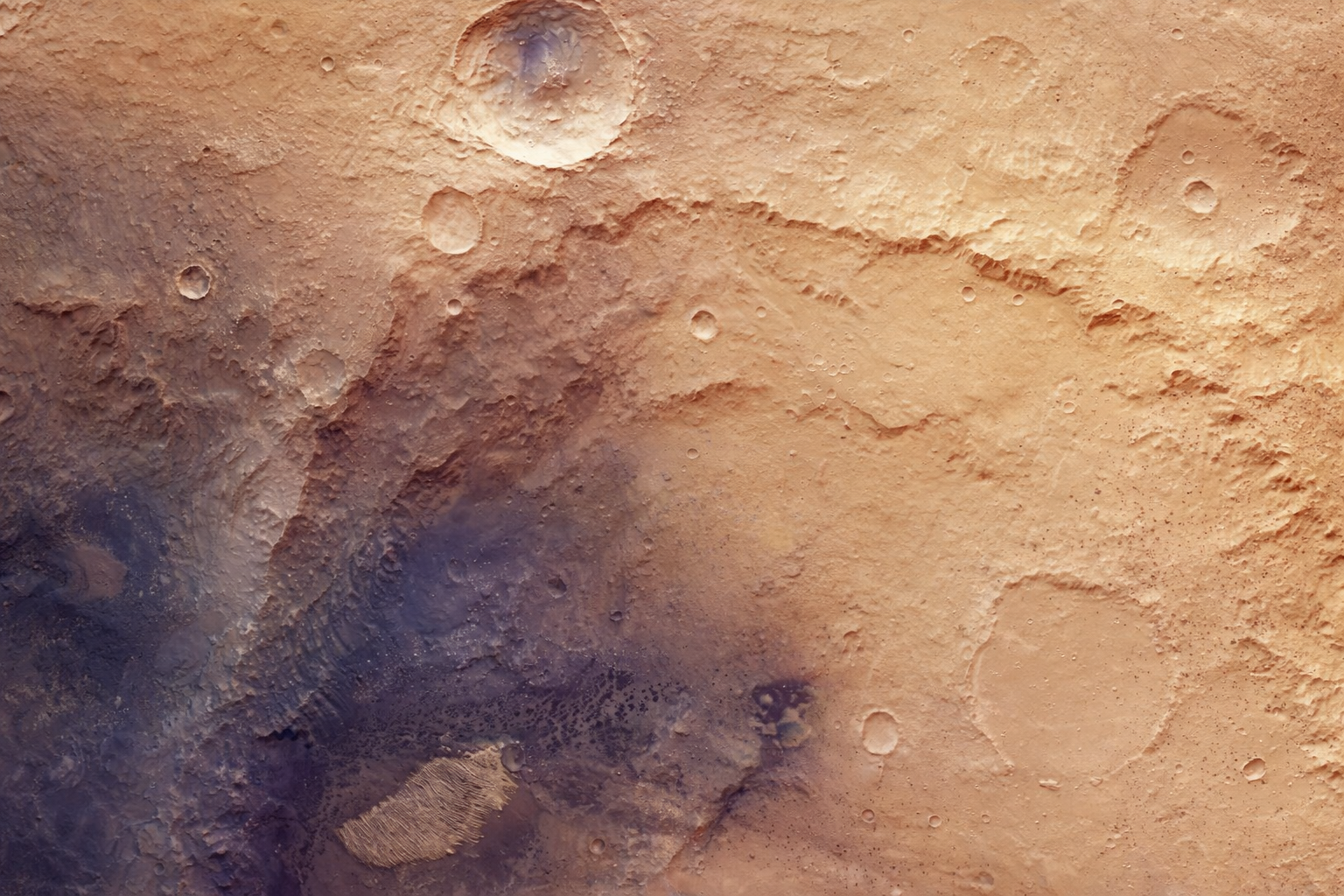
The Mars Express orbiter’s potent High Resolution Stereo Camera (HRSC) was used to take the recently processed photos. On October 12, 2024, the spacecraft captured the images while in its 26,233rd orbit of Mars. Scientists recently reprocessed the data to provide a detailed color and topographic depiction of the area, despite the fact that the photos were taken earlier.
Researchers can now find new details that were previously hard to find because to this sophisticated processing.
Trouvelot Crater: A Window Into Mars’ Violent Past
At the center of the newly released image lies the massive Trouvelot Crater, an enormous impact basin measuring about 81 miles (130 kilometers) across. The crater’s worn edges and partially filled interior indicate that it formed billions of years ago.
Interestingly, the crater floor contains many smaller craters, showing that the area continued to experience asteroid impacts long after the initial collision that created Trouvelot. This layered record of impacts helps scientists understand the timeline of bombardment that shaped the Martian surface.
Just beside Trouvelot Crater lies an even older basin whose rim has almost completely eroded away. Because Trouvelot overlaps this degraded crater, scientists believe the neighboring basin formed first, offering clues about the sequence of events in this ancient landscape.
Evidence of Volcanic Activity on Mars
One of the most intriguing aspects of the region is the presence of dark volcanic rocks covering much of the crater floor. These rocks are rich in minerals like magnesium, iron, pyroxine, and olivine, commonly found in volcanic formations.
Scientists believe that powerful impact events may have excavated this mafic material from deeper layers of Mars’ crust. Over time, wind and gravity likely redistributed these rocks across the crater floor, creating the dark patches visible in the images.
These volcanic materials provide evidence that Mars experienced both intense impact activity and volcanic processes during its early history.
Wind, Water, and the Changing Martian Surface
The image also shows barchan dunes, which are crescent-shaped sand formations that show the direction of Mars’s predominant winds. These dunes demonstrate how environmental factors continue to sculpt the Martian surface.
A light-toned mound that is roughly 12 miles (20 kilometers) long is another remarkable feature. This structure may contain minerals that were created or changed in the presence of water, according to scientists. These minerals frequently seem brighter than the surrounding landscape on Mars and may provide crucial information about the planet’s past environment.
Together, the water-altered minerals, volcanic rocks, and dunes show the intricate processes that have sculpted Arabia Terra over billions of years.
Mars Express Continues to Deliver New Discoveries
Launched in 2003, the Mars Express mission has spent more than two decades orbiting Mars, mapping the planet’s surface in remarkable detail. Even today, archived data from the spacecraft continues to reveal new scientific insights.
The latest images of Arabia Terra demonstrate how reprocessing older observations with modern techniques can uncover hidden details and deepen our understanding of Mars’ geological history.
As researchers continue analyzing data from Mars Express, this ancient and mysterious region may still hold many secrets about the Red Planet’s past—and perhaps even clues about whether Mars once supported life.