Why Officials Avoided Giving Clear Risk Numbers
An important turning point in space exploration is the impending Artemis II mission. Astronauts will be sent toward the Moon for the first time since the Apollo 17 era. However, NASA representatives seemed circumspect while outlining the mission’s hazards during a recent press briefing, avoiding precise figures regarding the likelihood of failure.
Their reluctance has nothing to do with secrecy; rather, it is a reflection of the immense complexity and uncertainty of a mission that would take people farther from Earth than they have gone in almost 50 years.
Artemis II: A Historic Return to the Moon
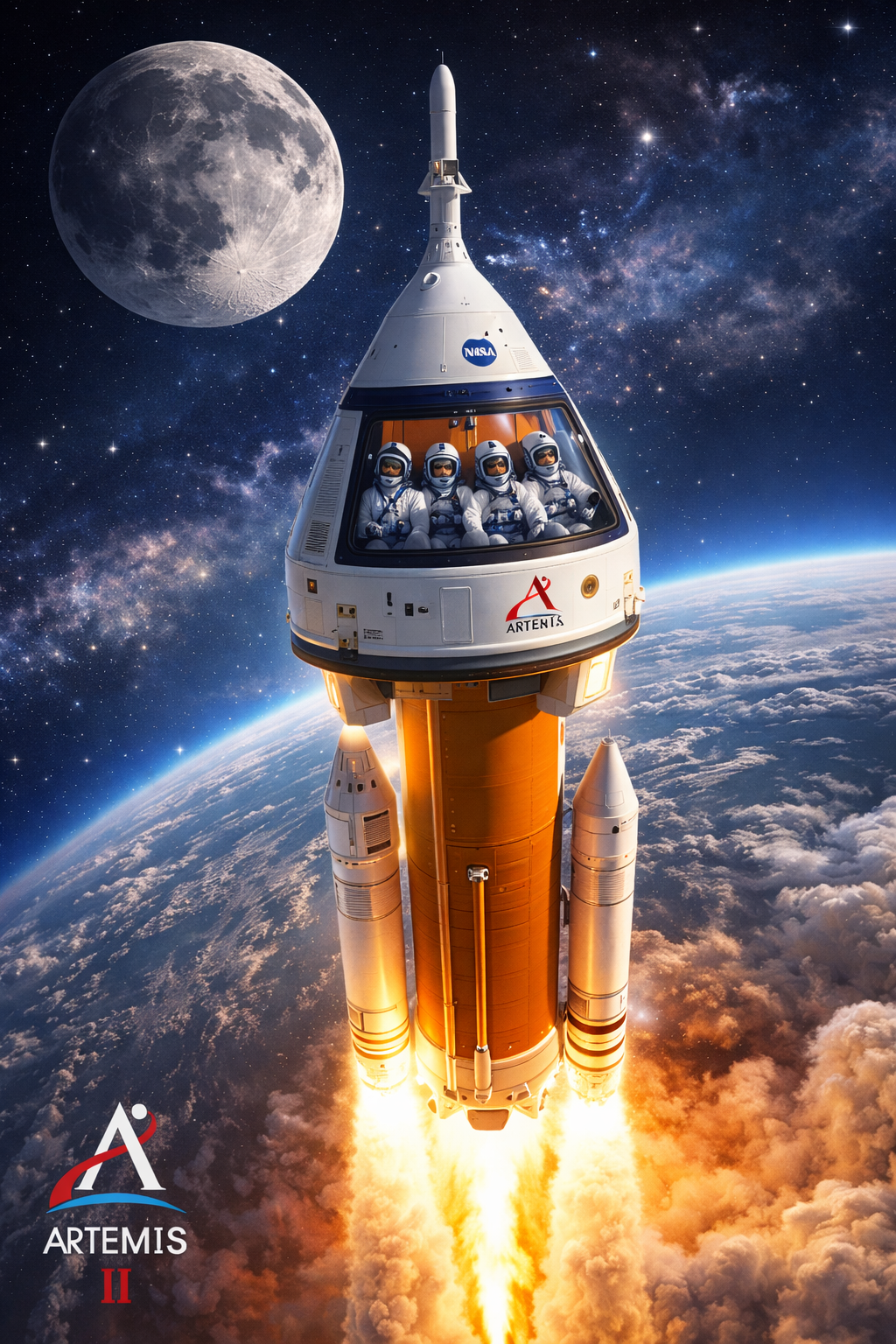
Artemis II will send four astronauts on a nine-day journey around the Moon aboard the Orion spacecraft, launched by the powerful Space Launch System.
Unlike missions to the International Space Station, which orbit only a few hundred miles above Earth, Artemis II will travel more than 1,000 times farther into deep space. The spacecraft will fly thousands of miles beyond the Moon’s far side before returning to Earth and splashing down in the Pacific Ocean.
This extreme distance, combined with the fact that the rocket and spacecraft have flown together only once before during the Artemis I mission, introduces significant uncertainty.
NASA officials say the mission is essentially a test flight with astronauts aboard, making it difficult to calculate precise risk levels.
Why NASA Avoids Exact Risk Numbers
NASA engineers use probabilistic risk assessments to estimate the likelihood of catastrophic failure or loss of crew. However, with limited flight data, those numbers can be misleading.
According to NASA leaders, risk estimates often rely heavily on assumptions rather than real-world performance. Lori Glaze, NASA’s acting associate administrator for exploration system development, explained that risk numbers should be viewed more as relative comparisons rather than exact predictions.
For example, historically, about 50–60% of new rocket designs fail during their first flights. While the Space Launch System performed successfully during Artemis I, NASA still lacks enough data to confidently calculate the risk of a crewed mission.
Mission managers have a long-term goal of reducing failure probability to less than 1 in 50 missions, but Artemis II may not yet meet that benchmark.
Technical Challenges and Recent Delays
The Artemis II launch was initially planned earlier in the year, but engineers encountered several technical issues. These included:
- A leaky hydrogen seal in the rocket’s fueling system
- A helium loading issue in the upper stage
Both problems forced NASA to roll the rocket back to the hangar for repairs.
Despite the delays, NASA officials confirmed that testing showed the new seals are performing better than previous versions. The next time the rocket will be fully fueled is expected to be during the actual launch attempt.
Currently, NASA is targeting early April launch opportunities from Florida’s Kennedy Space Center.
Lessons From Past Spaceflight Disasters
NASA’s careful approach to risk communication is shaped by hard lessons from the past. Two tragic accidents still influence how engineers evaluate mission safety:
- The Apollo 1 fire during a ground test
- The Space Shuttle Columbia accident caused by foam damage during launch
These events showed that even seemingly small issues can trigger catastrophic failures. As a result, NASA now focuses on understanding complete chains of failure, not just individual risks.
Astronauts Accept the Risks of Deep Space Travel
Despite the uncertainties, the Artemis II astronauts are fully aware of the risks involved. Mission commander Reid Wiseman shared that he has already spoken openly with his family about the dangers of the mission.
For astronauts, risk is an inherent part of exploration. The Artemis II crew understands that they will help gather critical data that will shape future lunar missions.
Their flight will pave the way for future Artemis missions, including Artemis III and Artemis IV, which aim to land astronauts near the Moon’s south pole later this decade.
The Road Back to the Moon
Artemis II represents a crucial step toward humanity’s long-term return to the Moon. The mission will test deep-space navigation, life-support systems, communication technologies, and the Orion spacecraft’s ability to safely reenter Earth’s atmosphere at extreme speeds.
While NASA officials remain cautious about assigning precise risk numbers, one thing is clear: Artemis II will push the boundaries of human spaceflight.
If successful, the mission will open the door for a new era of lunar exploration and eventually human journeys to Mars.