
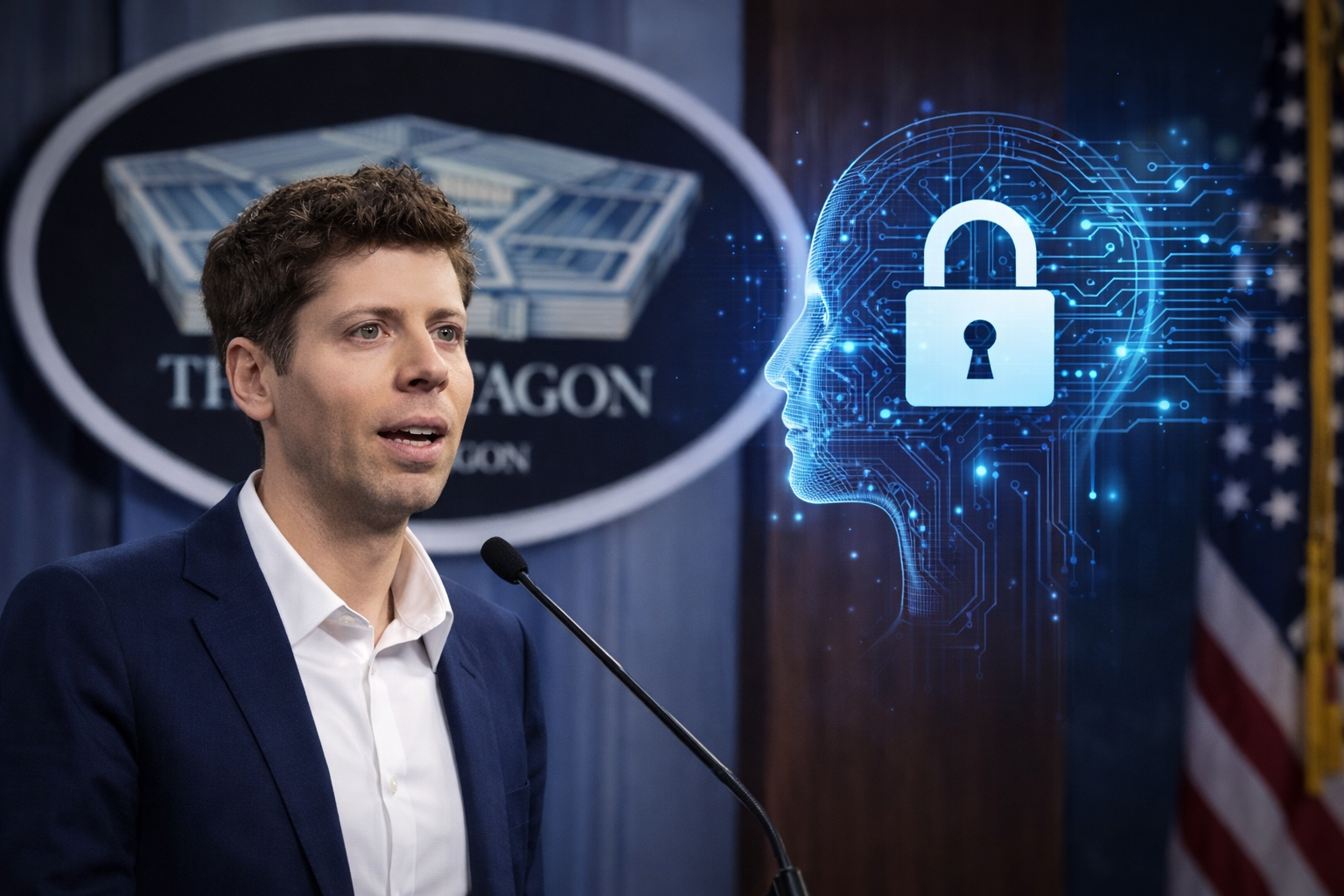
OpenAI’s Sam Altman Announces Pentagon AI Deal with Technical Safeguards
Sam Altman has revealed that OpenAI has negotiated a deal with the U.S. Department of Defense (DoD) to permit its AI models to function within the department’s classified network, which is a significant step forward for the future of AI in national security. In the continuing discussion over AI legislation, military applications of AI, and ethical protections in defense technology, the news represents a turning point.
OpenAI vs. Anthropic: A High-Stakes AI Policy Standoff
The agreement follows a high-profile standoff between the Pentagon and OpenAI’s rival, Anthropic. The Department of Defense — which some officials under the Trump administration have referred to as the Department of War — reportedly pushed AI firms to permit their models to be used for “all lawful purposes.”
Anthropic, led by CEO Dario Amodei, resisted certain conditions. Amodei emphasized that while his company did not object to specific military operations, it believed that in limited cases, AI could undermine democratic values — particularly in areas such as mass domestic surveillance and fully autonomous weapons systems.
Tensions escalated when more than 60 OpenAI employees and 300 Google employees signed an open letter urging their companies to support Anthropic’s ethical stance. The disagreement intensified after Donald Trump criticized Anthropic publicly and directed federal agencies to phase out its products within six months. Secretary of Defense Pete Hegseth further designated Anthropic as a supply-chain risk, barring military contractors from commercial engagement with the firm.
Anthropic has stated it has not received direct communication from the government and intends to challenge any such designation in court.
Technical Safeguards and AI Ethics in Defense
Altman maintains that OpenAI’s defense contract contains robust safeguards in line with hotly contested AI safety principles notwithstanding the uproar. Altman emphasized two important protections included in the accord in a statement published on X: a ban on widespread domestic surveillance and a demand for human accountability when using force, including automated weaponry.
According to Altman, OpenAI will create a special “safety stack,” a technical architecture intended to stop its AI models from being abused. Crucially, he pointed out that the government will not force OpenAI to override an AI model’s rejection to complete a task based on safety regulations. In order to guarantee appropriate model implementation and oversight, OpenAI also intends to send engineers to collaborate with Pentagon teams.
Altman also called on the Department of Defense to offer similar terms to all AI companies, advocating for standardized safety agreements across the industry to avoid legal escalation and policy fragmentation.
AI, National Security, and Global Tensions
The announcement comes at a time of heightened geopolitical tensions, with reports emerging that the U.S. and Israeli governments have launched military operations against Iran. The timing underscores the growing importance of artificial intelligence in defense strategy, cybersecurity, and battlefield intelligence.
As AI adoption accelerates across government agencies, the debate over ethical AI use, national security, and democratic accountability is likely to intensify. OpenAI’s Pentagon deal signals a new chapter — one where advanced AI models may play a central role in defense operations, but under increasingly scrutinized technical and ethical safeguards.
The future of AI in the military will depend not only on technological capability but also on transparent governance and enforceable safety principles.