
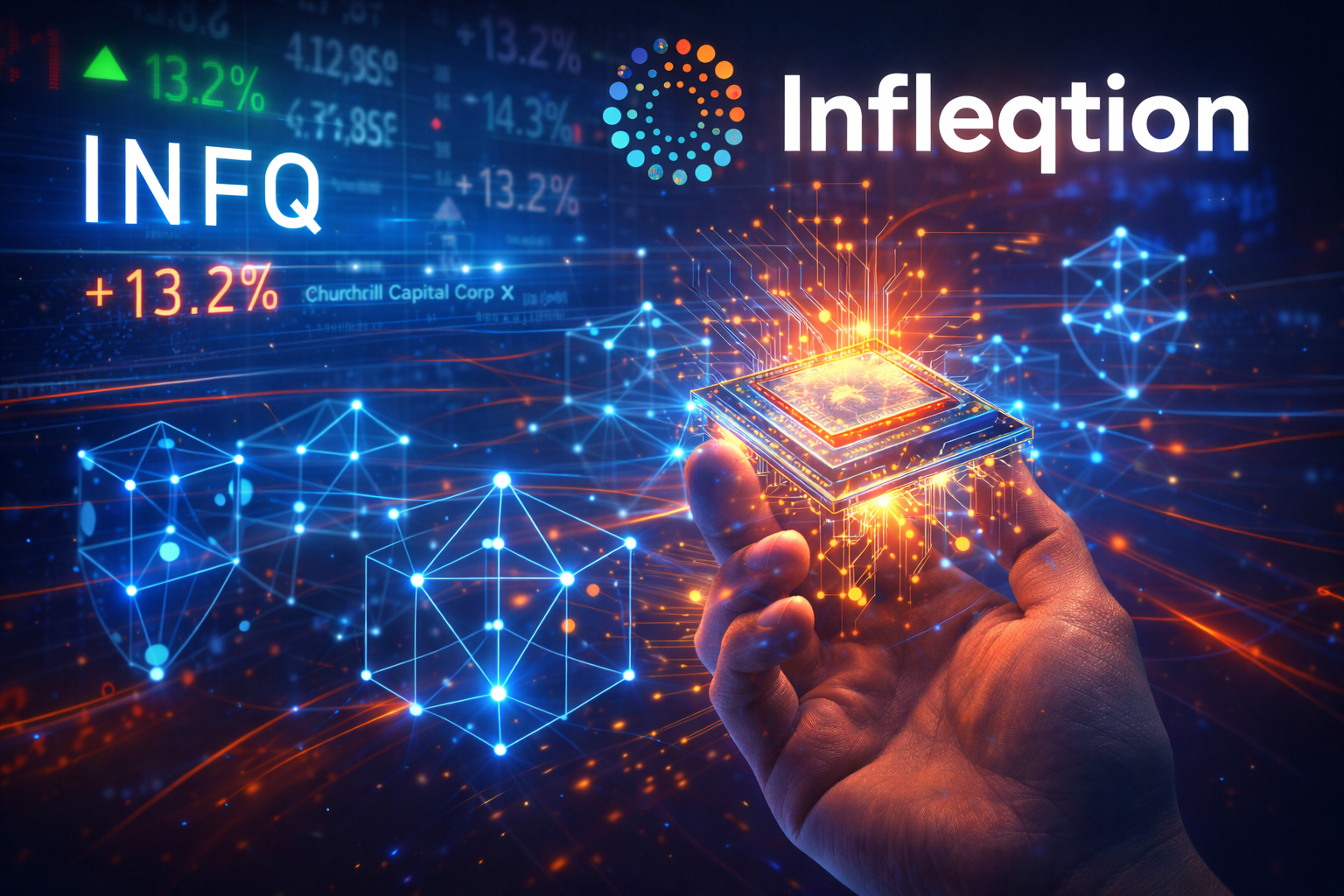
Infleqtion Pops in SPAC Debut as Sector Faces Volatility
Quantum computing stocks are back in the spotlight after Infleqtion surged in its first day of trading as a public company. The Colorado-based quantum firm began trading under the ticker INFQ following its merger with Churchill Capital Corp X, instantly reigniting investor interest in a sector that has struggled throughout 2026.
Despite this year’s general underperformance in quantum computing stocks, Infleqtion made a great start, rising more than 22% in early trade and closing up 13.2% at $15.46. For investors in quantum technology, who are keeping an eye out for indications of fresh impetus in one of the most disruptive upcoming technologies, the move is a critical time.
Infleqtion’s SPAC Merger: A Strategic Public Debut
Infleqtion went public through a SPAC (special purpose acquisition company) transaction — a route commonly used by early-stage quantum firms. SPACs, often called “blank-check companies,” raise capital via IPO with the purpose of acquiring private companies.
Several major quantum computing companies have taken this path in recent years, including:
- IonQ (IONQ)
- D-Wave Quantum (QBTS)
- Rigetti Computing (RGTI)
While the SPAC route offers faster market access, it has also contributed to volatility across quantum computing stocks — particularly amid ongoing concerns about commercialization timelines.
What Makes Infleqtion Different? The Neutral Atom Advantage
Infleqtion stands out in the quantum race thanks to its neutral atom quantum computing architecture.
Unlike many competitors that rely on superconducting qubits requiring ultra-cold environments, Infleqtion’s system:
- Operates at room temperature
- Uses cold atom arrays trapped in high-vacuum cells
- Manipulates qubits with precision lasers
- Avoids the need for complex freezer-based cooling systems
Because neutral atoms are not electrically charged, they can be packed closer together and arranged in scalable three-dimensional arrays. This architecture potentially makes Infleqtion’s hardware more portable and scalable compared to traditional superconducting systems.
Founded in 2007 at the University of Colorado Boulder (formerly known as ColdQuanta), Infleqtion combines quantum computing with quantum sensing and networking technologies. Founder Dana Anderson serves as chief science officer, while CEO Matthew Kinsella — formerly of Maverick Ventures — took leadership in 2024.
NASA Collaboration and Quantum Gravity Sensor
The company’s partnership with NASA is among its most noteworthy innovations. Infleqtion intends to launch the first quantum gravity sensor into orbit with the support of more than $20 million in mission funding.
With this milestone, Infleqtion may establish itself as a leader in space-based quantum sensing applications in addition to being a pioneer in computing, broadening its market reach beyond enterprise computing to include aerospace and defense.
The Broader Quantum Computing Market in 2026
Quantum computing stocks have underperformed so far in 2026:
- IonQ stock: Down 24% year-to-date
- D-Wave Quantum: Down 25%
- Rigetti Computing: Down 27%
- Quantum Computing Inc. (QUBT): Down 17%
The sector peaked in October 2025, when speculative enthusiasm drove sharp gains. D-Wave ended 2025 up 211%, while Rigetti climbed 45% and IonQ rose 7%. However, investor optimism cooled amid commercialization uncertainty and competitive pressure from large tech firms.
Meanwhile, Honeywell International (HON) recently confirmed that its majority-owned quantum unit, Quantinuum, plans to file for an IPO in 2026. Quantinuum raised approximately $600 million in 2025 at a $10 billion valuation, with backing from Nvidia’s venture arm and a long-term investment partnership involving Qatar’s Al Rabban Capital.
The steady stream of IPOs suggests institutional confidence remains strong, even if public market sentiment has fluctuated.
What Is Quantum Computing and Why Does It Matter?
Quantum computing leverages subatomic physics to process information in fundamentally new ways. Instead of classical bits (0s and 1s), quantum computers use qubits, which can exist in multiple states simultaneously.
Key quantum computing approaches include:
- Superconducting qubits
- Trapped-ion systems
- Quantum annealing
- Photonic quantum computing
- Neutral atom architectures
These systems aim to solve complex problems beyond the capabilities of classical computers — including chemical simulations, advanced materials research, cryptography, logistics optimization, and AI acceleration.
The commercialization timeline, however, remains uncertain — a factor contributing to stock volatility.
Investor Outlook: Opportunity Meets Uncertainty
Infleqtion’s successful debut suggests that investors are still willing to reward differentiated quantum architectures and real-world applications.
However, challenges remain:
- Long commercialization cycles
- Intense competition
- High R&D costs
- Market volatility tied to emerging tech sentiment
Even industry leaders have shifted tone. Nvidia initially suggested quantum computing would take decades to commercialize before softening that position amid rapid innovation.
For investors, the quantum sector represents a high-risk, high-reward frontier. Companies that demonstrate scalability, enterprise traction, and government partnerships may outperform as the industry matures.
Final Thoughts: A Turning Point for Quantum Stocks?
Infleqtion’s strong public debut may mark a turning point for quantum computing stocks in 2026. Its neutral atom technology and NASA collaboration provide tangible differentiation in a crowded and speculative market.
Still, the path forward will depend on execution — moving from laboratory breakthroughs to commercial deployment.
As the quantum race intensifies, investors should closely monitor scalability milestones, government contracts, and partnerships with major technology firms. While volatility is likely to persist, the long-term transformation potential of quantum computing remains immense.
The big question now: Will Infleqtion’s momentum spark a broader recovery across quantum computing stocks — or is this just a temporary pop in a still-maturing industry?