
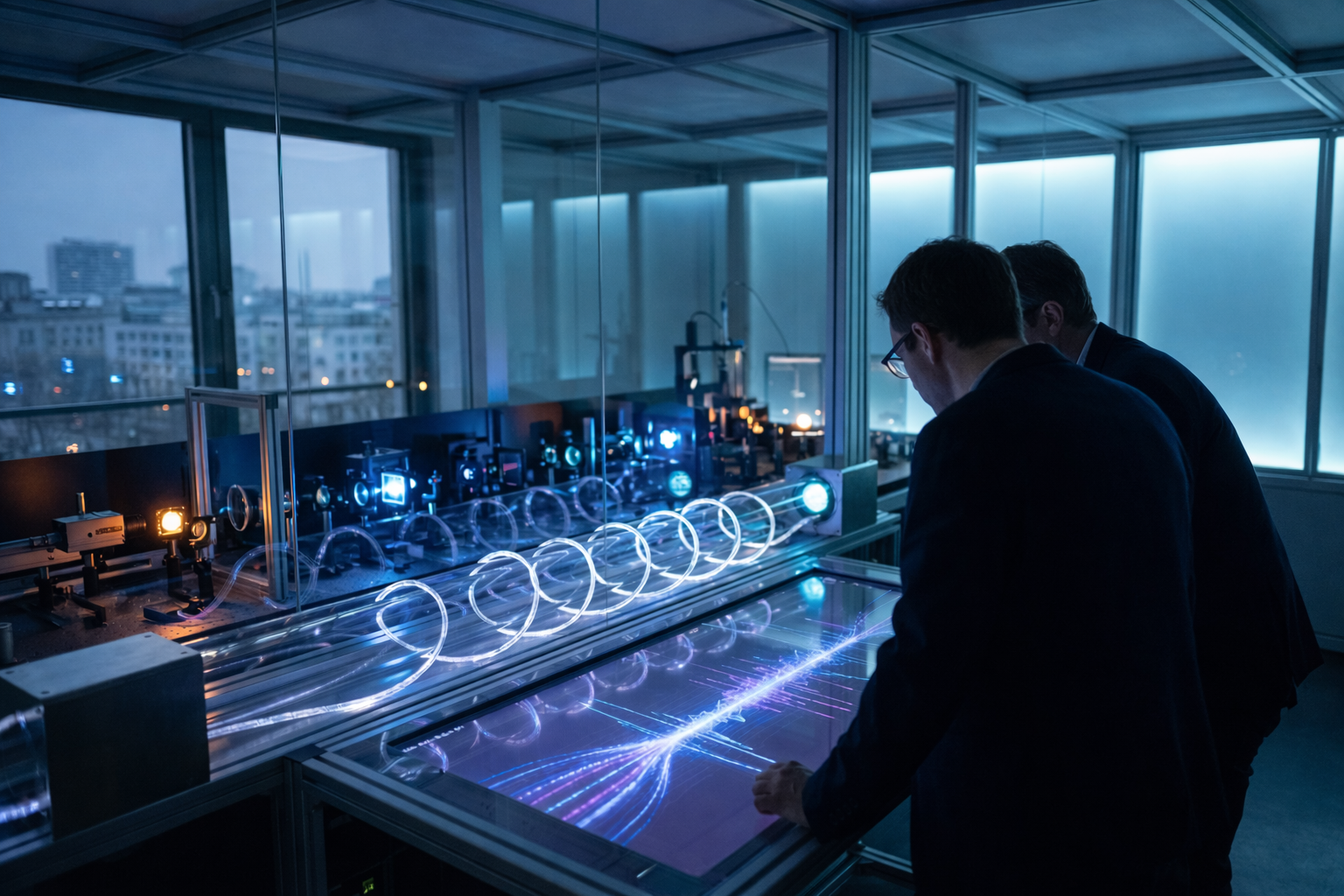
30-Kilometer Teleportation Over Commercial Fiber
For a long time, the quantum internet was thought to be a future idea only seen in physics labs. This impression is now being challenged by a ground-breaking experiment in Berlin. Researchers successfully demonstrated quantum teleportation over 30 kilometers of commercial fiber optic cable in a quiet but historic test, all while conventional internet traffic continued to flow on the same line.
This accomplishment is a critical step in the development of a scalable, secure, and practical quantum communication network.
Quantum Teleportation Moves From Lab to City Infrastructure
Quantum teleportation may sound like science fiction, but it is rooted in established physics. Importantly, it does not involve transporting physical objects. Instead, it transfers a particle’s quantum state using a phenomenon known as quantum entanglement.
Here’s how it works:
A pair of entangled photons are shared by two distant nodes. The quantum state is projected when the sender measures their photon in a particular way. The receiving node then receives a classical message that is moving at or slower than the speed of light. The qubit’s teleportation is essentially finished when the receiver uses this information to recreate the initial quantum state.
In Berlin, researchers achieved this process across a 30-kilometer urban fiber loop, proving that fragile quantum states can survive real-world conditions like vibrations, temperature fluctuations, and electromagnetic interference. Even more remarkable, the quantum signals coexisted with conventional internet data traffic without disruption.
Behind the 30-Kilometer Quantum Internet Breakthrough
The experiment was led by T-Labs, the research arm of Deutsche Telekom, in partnership with Qunnect using its Carina quantum networking platform. The team reached an impressive 95% fidelity in real time at 795 nanometers—a wavelength compatible with neutral-atom quantum systems.
It took constant stabilization to get this level of performance. Phase noise is produced in urban settings by regular infrastructure activities, traffic, and metro systems. In order to preserve exact temporal synchronization and phase alignment, the researchers made real-time corrections to this noise.
Crucially, the system operated using existing commercial fiber infrastructure. The quantum hardware was installed in standard telecom racks, and no dedicated fiber lines were required. This compatibility suggests that cities worldwide may not need entirely new networks to deploy quantum communication systems.
What This Means for Quantum Cryptography and Secure Communication
The implications of this success extend well beyond Berlin. A functional quantum internet could revolutionize cybersecurity through quantum cryptography, particularly Quantum Key Distribution (QKD). Such systems promise theoretically unbreakable encryption, making sensitive government, financial, and industrial communications far more secure against cyber threats.
Additionally, the breakthrough opens the door to distributed quantum computing, where quantum computers across different regions collaborate to solve complex problems. This could accelerate research in medicine, materials science, artificial intelligence, and climate modeling.
The experiment also carries strategic importance. Demonstrating quantum networking on carrier-grade infrastructure strengthens Europe’s position in developing sovereign, secure digital networks. As nations compete in emerging technologies, quantum communication may become a cornerstone of technological independence.
The Road Ahead for the Quantum Internet
While this milestone is significant, scaling remains the next challenge. Researchers aim to extend quantum links over longer distances, connect multiple nodes, and automate operations across diverse vendors and standards.
Encouragingly, running quantum signals over existing fiber reduces costs and simplifies deployment. Industry experts anticipate pilot projects across major European corridors within the next 24 to 36 months.
What was once considered too fragile for real-world conditions has now survived the complexity of a modern city. The Berlin experiment signals that the future of global communication may already be running beneath our streets—quietly, securely, and powered by quantum physics.
The quantum internet is no longer theoretical. It is materializing—one fiber strand at a time.