Canada’s Breakthrough for Artemis Astronaut Safety
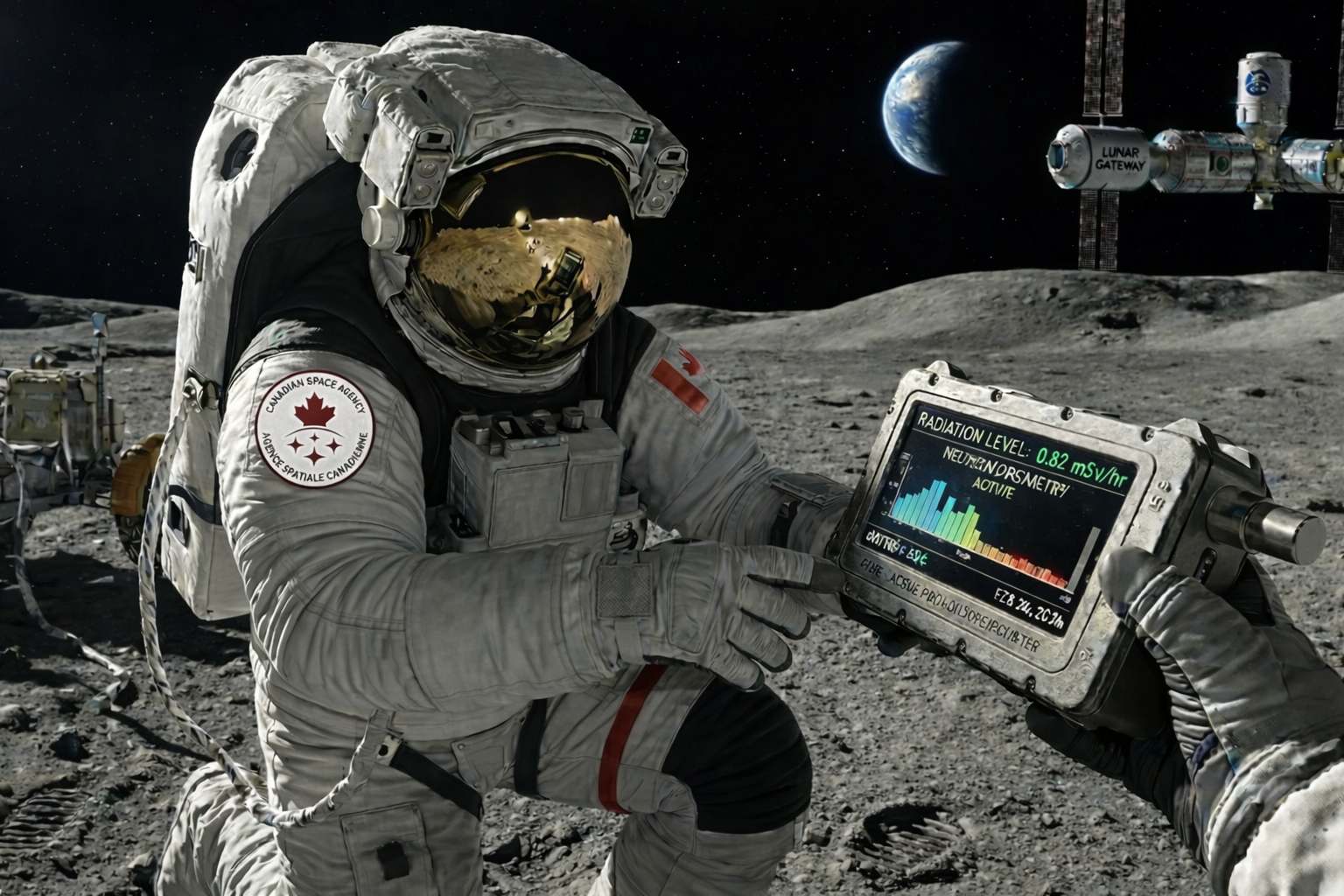
As the world prepares for humanity’s return to the Moon under Artemis program, Canada is stepping forward with cutting-edge innovation. The Canadian Space Agency (CSA) has invested $5.5 million in a next-generation radiation monitoring system designed to protect astronauts from one of deep space’s most dangerous threats: cosmic radiation.
CANS: Protecting Astronauts from Deep Space Radiation
The Canadian Active Neutron Spectrometer (CANS) development will be financed by the contract, which was given to Bubble Technology Industries (BTI), located in Ontario. Neutron radiation, a very dangerous type of space radiation that accounts for around 30% of all radiation exposure within spacecraft, is precisely measured by this real-time radiation tracking device.
Because the Moon doesn’t have a shielding atmosphere as Earth does, astronauts are exposed to powerful cosmic rays. In order to help scientists better understand long-term exposure hazards during protracted lunar missions lasting six months or longer, CANS will independently gather and transmit radiation data back to Earth.
Beyond Space: Medical and Safety Applications on Earth
CANS’s influence extends well beyond lunar exploration. The CSA said the information gathered might help detect nuclear threats, promote nuclear physics research, improve radiation protection for aircraft workers, and improve cancer radiation therapy.
BTI’s earlier Radi-N and Radi-N2 bubble detector technologies, which were tested on the International Space Station, are expanded upon by CANS. This innovative system, which protects astronauts while pushing life-saving innovations on Earth, places Canada as a major player in the global Moon race thanks to improved data collecting and automation capabilities.