
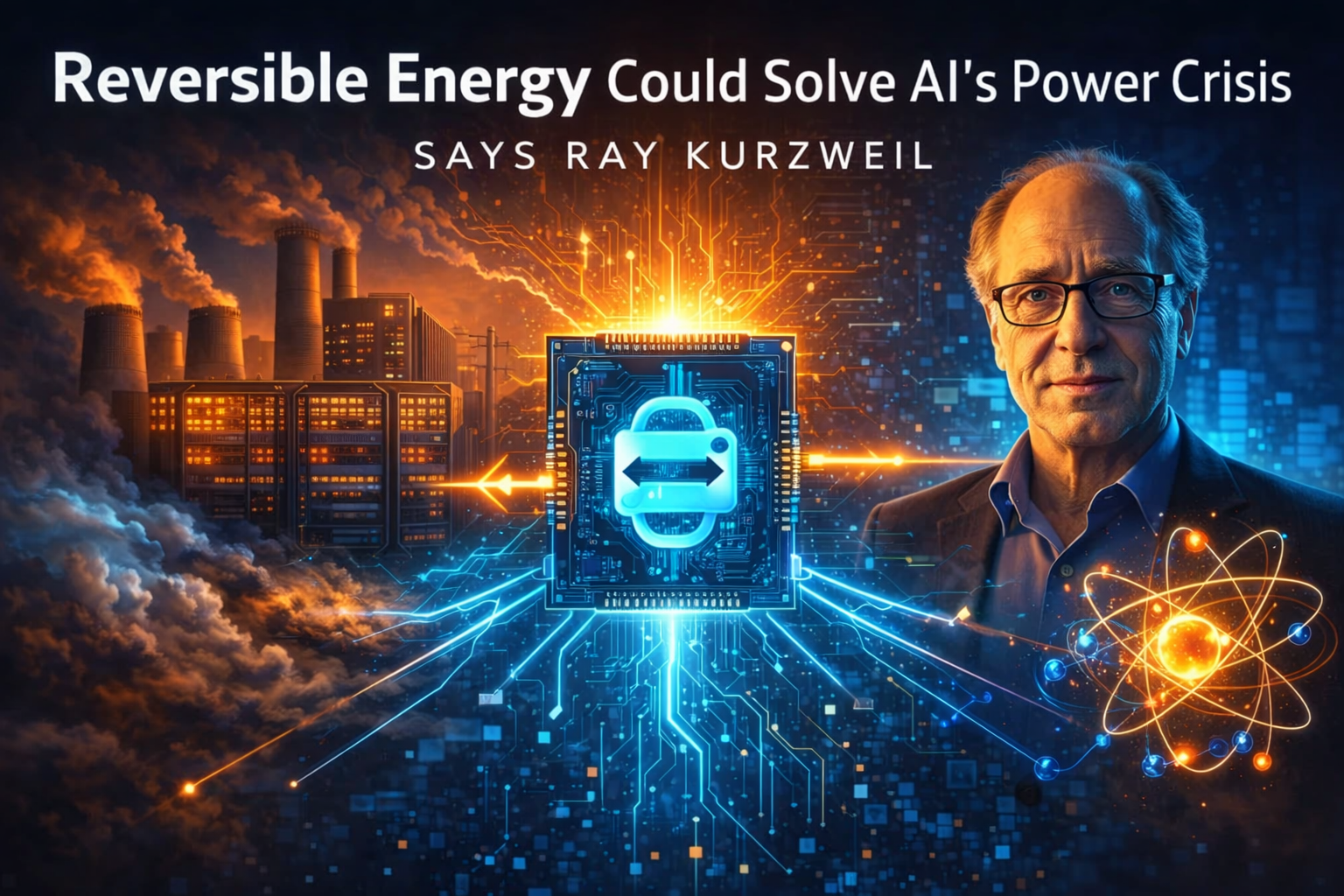
Ray Kurzweil claims that reversible energy could resolve AI’s escalating power crisis.
We are at a pivotal moment in human history. With its exponential growth, artificial intelligence holds promise for advances in human cognition, materials science, and medicine. However, a significant obstacle to this quick development is energy usage. The electricity needed to operate data centers is increasing to unsustainable levels as AI models get bigger and more intricate. Data centers currently use about 2% of the world’s electricity, and by 2030, that amount is predicted to triple.
Reversible energy in computers is a bold yet elegant approach that futurist Ray Kurzweil recently discussed on the Moonshots podcast. This solution has the potential to drastically alter the direction of artificial intelligence in the future.
The Artificial Intelligence-Fronting Energy Wall
Large quantities of electricity are used by contemporary AI systems. Megawatts of electricity, or the energy consumption of a small city, may be needed to train a single huge language model. This energy requirement becomes a significant bottleneck as Kurzweil projects the technological singularity by 2045 and the emergence of artificial general intelligence (AGI) by 2029.
The way conventional computers function is the problem. Every irreversible calculation, including erasing data, burns energy and generates heat. The Landauer limit, a fundamental law of physics that establishes a minimum energy cost for information erasure, governs this restriction. This cost multiplied by trillions of operations per second makes today’s enormous power use unavoidable.
Lessons from the Effectiveness of the Human Brain
A striking contrast can be found in the human brain. The brain uses only 20 watts of power, despite its remarkable cognitive powers. It accomplishes this efficiency by using huge parallelism—billions of neurons working at comparatively moderate speeds—rather than speed.
Even though parallel processing has been included into contemporary GPUs, high-speed, energy-intensive computation is still used. Reversible computation provides an advantage over biological efficiency in this situation.
In computing, what is reversible energy?
The foundation of reversible computing is the notion that information need not be destroyed during computation. Reversible logic gates, in contrast to ordinary logic gates, retain all inputs, enabling the reversal of processes and the recovery of energy.
According to Kurzweil, reversible computation can theoretically function with almost no net energy loss. Reversible systems recycle energy rather than releasing it as heat, much like a frictionless pendulum that swings endlessly. In the future, sophisticated designs that make use of nanotechnology, adiabatic circuits, and atomic-level computation may completely circumvent conventional thermodynamic constraints.
Advances in Reversible Computing in the Real World
The concept of reversible energy is no longer theoretical. With estimates of 4,000× efficiency gains, companies such as Vaire Computing are creating commercial reversible chips that can recover up to 70% of computational energy. Reversible designs for AI, blockchain, and high-performance computing are being investigated by research organizations including Sandia National Laboratories and universities throughout Europe.
The Future Is Changed by Reversible Energy
Kurzweil’s vision of the future—which includes seamless brain-cloud interfaces, AI-driven drug development, large-scale medical simulations, and nanobots functioning inside the human body—may be made possible by nearly zero-energy computing. These goals run the risk of overwhelming the world’s power infrastructure in the absence of reversible energy. It makes the growth of exponential intelligence sustainable.
Concluding remarks
Reversible energy involves a fundamental rethinking of computation itself, not just an improvement in efficiency. Reversible computing has the potential to eliminate one of the biggest barriers to humanity’s technological future as AI advances toward AGI. The singularity might not simply be close—it might be energetically inevitable if the physics matches engineering realities.