Scientists in Europe have introduced an innovative robotic mission concept for the Moon that could transform how humans explore underground environments on the Moon and Mars. According to researchers, teams of intelligent robots working together may soon unlock hidden lava tunnels, opening the door to safer exploration and even future space bases.
Smart Robots Take the Lead in Space Exploration
Robotic technology has already reshaped industries on Earth, and now it is being pushed further into deep-space exploration. In their latest breakthrough, European scientists unveiled a new mission design that relies on multiple autonomous robots cooperating to explore dangerous and hard-to-reach environments beyond our planet.
Researchers believe that advanced robotics will play a crucial role in making future space missions safer, faster, and more efficient.
European Researchers Test Robots in Volcanic Terrain
The project brings together experts from across Europe, including scientists from the Space Robotics Lab at the University of Málaga. The team recently tested and validated three robotic systems on the volcanic island of Lanzarote, Spain, whose rugged terrain closely resembles lunar and Martian landscapes.
These real-world tests helped researchers assess how well the robots can operate independently in extreme environments.
A Collaborative Robotic Mission Concept
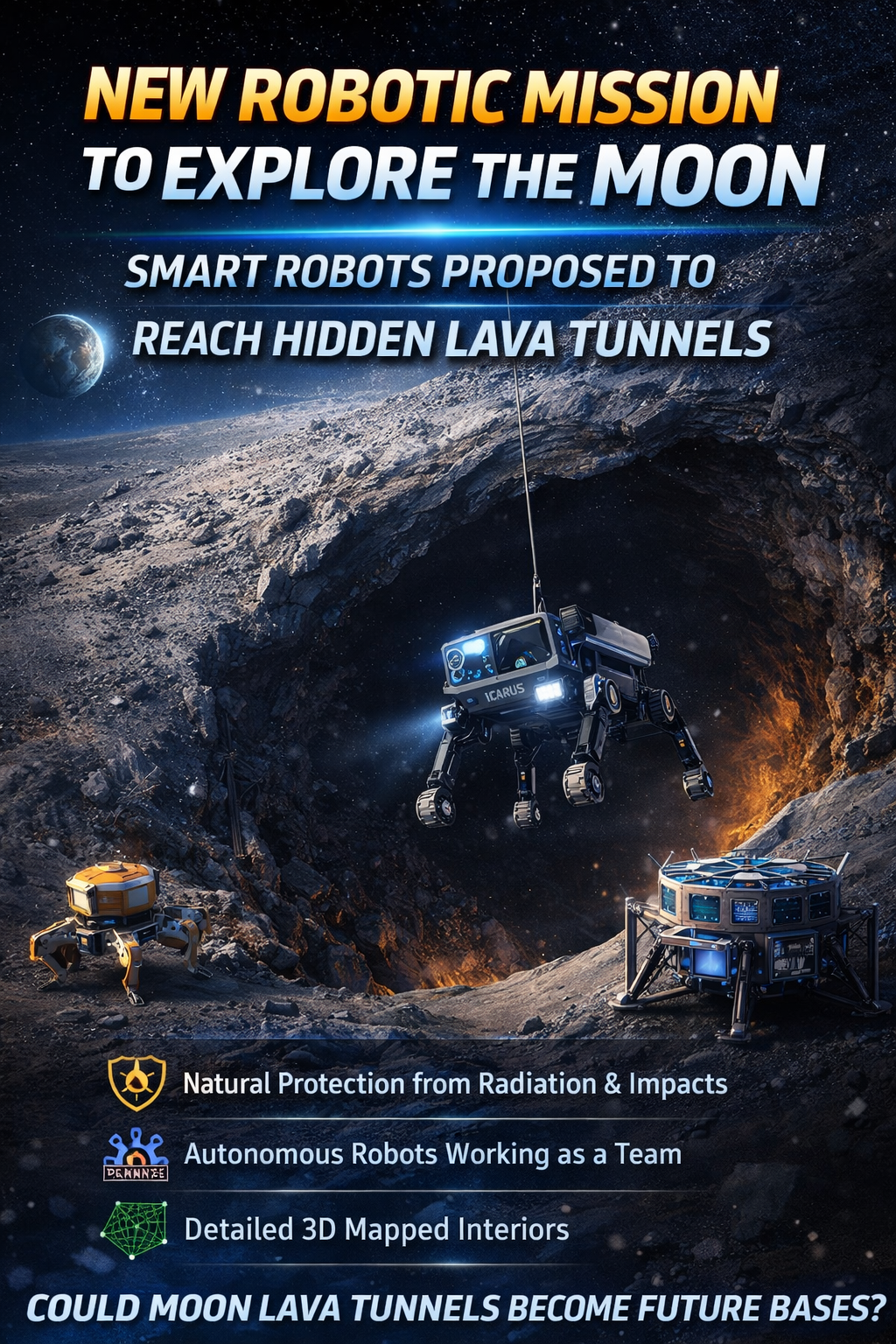
The newly proposed mission focuses on robots working as a coordinated team to explore underground lava tubes. According to scientists, this trio of smart robots could be the key to reaching locations that are too dangerous or inaccessible for human astronauts.
The system is designed to:
- Identify and map lava tunnel entrances
- Deploy scientific sensors
- Lower a scouting rover into caves
- Create highly detailed 3D maps of underground interiors
Why Lava Tunnels Matter for the Moon and Mars
Lava tunnels on the Moon and Mars are increasingly viewed as ideal locations for future human bases. These underground structures could naturally protect astronauts from harmful cosmic radiation, extreme temperatures, and frequent meteorite impacts.
However, studying these tunnels is extremely challenging due to rough terrain, narrow entry points, and unpredictable conditions—making robotic exploration essential.
Four Phases of Autonomous Exploration
Researchers outlined a four-stage robotic exploration strategy designed to handle these challenges efficiently:
Phase 1: Mapping the Cave Entrance
The robotic team begins by cooperatively mapping the area surrounding the lava tunnel opening.
Phase 2: Sensor Deployment
A sensor-equipped payload cube is dropped into the cave to collect early environmental data.
Phase 3: Scout Rover Descent
A specialized scout rover is lowered through the tunnel entrance to reach the interior safely.
Phase 4: Deep Exploration and 3D Mapping
Finally, the robots explore the tunnel in depth and generate detailed 3D maps of the underground environment.
Successful Trials Prove Mission Feasibility
The trials were led by the German Research Center for Artificial Intelligence (DFKI), with key contributions from the University of Málaga and Spanish technology company GMV. Results confirmed that the mission concept is technically feasible and highlighted the strong potential of collaborative robotic systems in space exploration.
Robots Could Shape the Future of Space Missions
The findings suggest that teams of autonomous robots may become essential tools for future missions to the Moon and Mars. By handling risky tasks and collecting crucial data, robots can pave the way for human explorers to follow more safely.
The study was recently published in the prestigious journal Science Robotics, reinforcing the importance of continued investment in advanced robotic technologies for planetary exploration.
What This Means for the Future of Space Exploration
As space agencies look toward long-term missions and permanent bases beyond Earth, scientists are exploring new ways to increase accuracy, reduce risk, and accelerate discovery. Intelligent robotic systems, like the ones tested in this mission, could be a major step toward making that future a reality.