How the Sun’s Journey in the Milky Way May Have Helped Life Begin on Earth
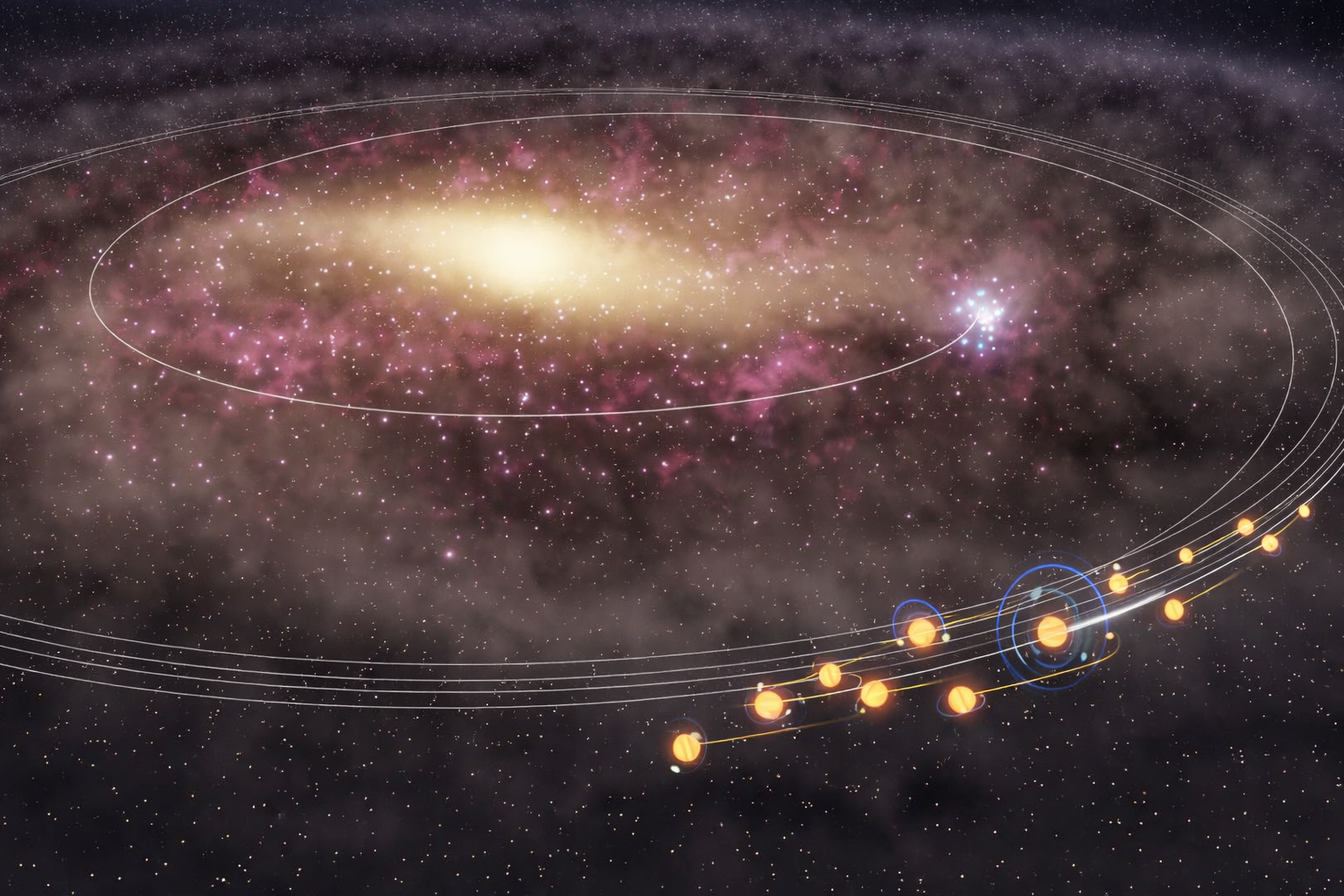
The Sun may not have formed in its current location, according to recent scientific studies. Rather, scientists think that our star and many other stars of a similar kind moved from the Milky Way’s inner regions billions of years ago. It’s possible that this enormous stellar migration was crucial in establishing a more secure cosmic environment where life may eventually emerge on Earth.
The discoveries offer intriguing new insights into the Milky Way galaxy’s formation, the history of our solar system, and the cosmic conditions that might support life.
Studying Solar Twins to Understand the Sun’s Past
Astronomers often study stars known as solar twins — stars that closely resemble the Sun in size, temperature, and chemical composition. By examining these stars, scientists can better understand how our own star formed and evolved.
In the new studies, researchers analyzed data from the Gaia (space observatory), a mission operated by the European Space Agency. Gaia has created the most detailed 3D map of the Milky Way galaxy, measuring the positions and properties of nearly two billion stars.
Using this dataset, scientists examined 6,594 solar twins located within about 1,000 light-years of Earth. This sample is roughly 30 times larger than previous studies, allowing researchers to investigate stellar populations in unprecedented detail.
A Surprising Cluster of Sun-Age Stars
The research team, including astronomers Daisuke Taniguchi of Tokyo Metropolitan University and Takuji Tsujimoto from the National Astronomical Observatory of Japan, analyzed the sizes, temperatures, and chemical compositions of these stars to estimate their ages.
They discovered a striking pattern: 1,551 solar twins appear to be between four and six billion years old — roughly the same age as our Sun, which formed about 4.6 billion years ago.
The concentration of stars with similar ages and positions suggests they may have shared a common origin within the galaxy.
Evidence of a Massive Stellar Migration
Earlier studies hinted that the Sun might not have formed where it is today. Astronomers previously noted that the Sun contains relatively high levels of heavy elements, a characteristic usually associated with stars born closer to the Milky Way’s core.
The new research strengthens this theory by suggesting that the Sun and many solar twins were likely born more than 10,000 light-years closer to the center of the galaxy. Over billions of years, these stars appear to have migrated outward together to the quieter outer regions of the galaxy.
Scientists believe this migration may have occurred four to six billion years ago, potentially triggered by changes in the galaxy’s internal structure.
The Role of the Milky Way’s Galactic Bar
At the center of the Milky Way lies a massive rotating structure known as the galactic bar. This enormous feature influences how stars and gas move throughout the galaxy.
Researchers suggest that when this bar formed, it may have concentrated gas toward the center of the galaxy, triggering intense periods of star formation. Later, gravitational forces linked to the bar could have pushed stars outward, causing the large-scale stellar migration observed today.
Understanding when this galactic bar formed is important because it helps astronomers reconstruct the dynamic history of the Milky Way.
Why This Migration May Have Helped Life on Earth
One of the most intriguing implications of the study relates to the origins of life on Earth.
The inner regions of the Milky Way are believed to be more dangerous for life, with frequent energetic events such as supernova explosions and intense radiation. These conditions could disrupt planetary systems or sterilize developing life.
If the Sun migrated away from this hostile environment relatively early in its history, the solar system may have spent most of its lifetime in the calmer outer regions of the galaxy. This quieter cosmic neighborhood could have provided a more stable environment for life to evolve on Earth.
Future Research and the Search for True Solar Twins
The scientists plan to continue their work using future data releases from the Gaia mission. They also aim to study the chemical compositions of solar twins in greater detail.
By doing so, researchers hope to identify stars that were born in the exact same place and at the same time as the Sun — what astronomers call “true solar twins.”
These discoveries could reveal even more about the Sun’s origins, the evolution of our galaxy, and the cosmic factors that may make life possible elsewhere in the universe.