SpaceX Dragon Cargo Capsule Returns After Historic ISS Reboost Mission
SpaceX Dragon Strengthens the Future of the International Space Station
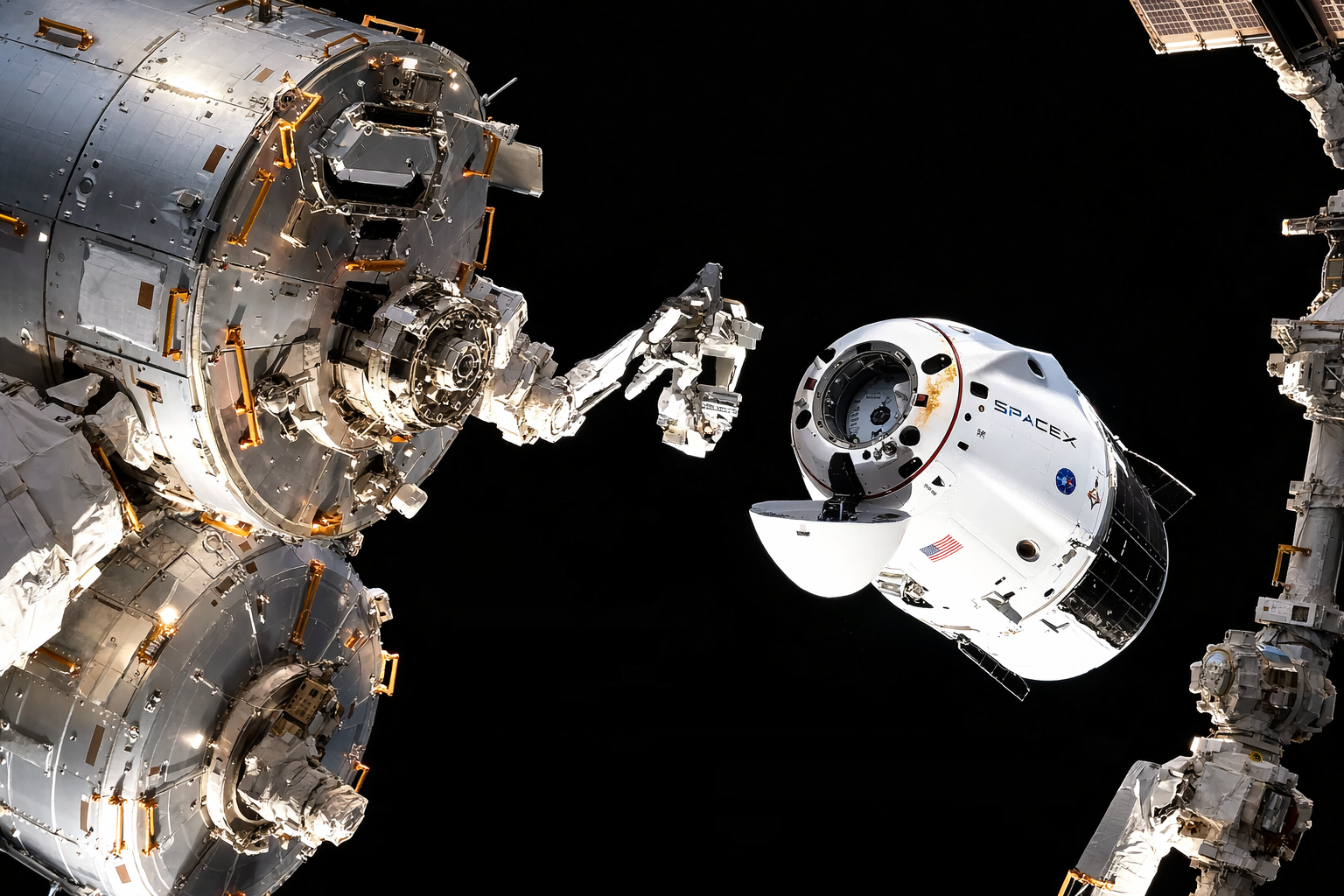
On February 26, 2026, the SpaceX Dragon cargo capsule successfully undocked from the International Space Station (ISS), concluding a groundbreaking six-month mission that began on August 25, 2025. While Dragon’s resupply missions have become routine in recent years, this flight marked a major milestone in the evolution of commercial space operations.
Beyond delivering supplies and scientific equipment, Dragon demonstrated a new and critical capability: performing ISS reboost maneuvers, a task historically managed by Russia’s Progress spacecraft. This development signals a major shift in how space station operations are handled and highlights the expanding role of private space companies in low-Earth orbit.
Reboosting the ISS: Why It Matters for Long-Term Space Operations
The ISS orbits Earth at approximately 400 kilometers above the surface. However, even at that altitude, it experiences atmospheric drag from the thin outer layers of Earth’s atmosphere. Over time, this drag slowly pulls the station closer to Earth. Without periodic altitude corrections—known as reboost maneuvers—the ISS could eventually re-enter the atmosphere prematurely.
Dragon completed six successful reboosts during its CRS-33 mission, including five in 2025 and a final one on January 23, 2026. The station’s altitude was raised and its orbital stability was guaranteed by these carefully managed thruster burns.
NASA officials emphasized that adding reboost capability to Dragon introduces essential redundancy to ISS operations. With potential changes in international partnerships and evolving responsibilities, having multiple spacecraft capable of maintaining station altitude is vital for long-term space station sustainability.
This achievement demonstrates Dragon’s versatility. Originally designed for cargo delivery and scientific returns, it has now proven capable of handling mission-critical orbital maintenance tasks—further solidifying its importance in NASA’s broader strategy for maintaining the ISS through the end of the decade.
Returning Critical Scientific Research to Earth
Apart from its reboost responsibilities, Dragon also played a crucial role in returning important scientific experiments to Earth. Researchers can perform experiments aboard the ISS that would be unfeasible in a typical gravity environment since it functions as a microgravity laboratory.
The Euro Material Aging experiment, which examined the degradation of 141 material samples under extreme space conditions, was one of the returned research. Building stronger spacecraft and enhancing next deep-space exploration missions depend on an understanding of material durability in space.
Thailand’s Liquid Crystals project was another noteworthy experiment that looked at the behavior of electronic materials in microgravity. The results of this study may have an impact on developments in consumer technology on Earth as well as space-grade electronics.
By transporting these experiments safely home, Dragon continues to support scientific innovation that benefits industries ranging from aerospace engineering to electronics manufacturing.
The Growing Role of Commercial Space Companies
The success of this mission reflects a broader transformation in space exploration. Historically, national space agencies managed most ISS logistics and maintenance tasks. Today, private companies like SpaceX are taking on increasingly complex responsibilities.
Dragon’s ability to perform reboosts shows that commercial spacecraft can handle high-stakes operational tasks once reserved for government programs. This shift provides greater flexibility, operational resilience, and cost efficiency—especially as the ISS approaches its planned deorbiting in 2030.
The collaboration between NASA and commercial partners represents a new model for public-private space partnerships. As missions become more ambitious—ranging from lunar exploration to Mars planning—this cooperative framework may define the next era of human spaceflight.
A Milestone for Low-Earth Orbit Operations
The return of the Dragon cargo capsule marks more than the end of a mission; it signals progress in the evolution of modern space operations. By combining cargo resupply, scientific returns, and orbital reboost capabilities, Dragon has demonstrated how commercial spacecraft can support the long-term sustainability of the ISS.
As low-Earth orbit becomes an increasingly dynamic environment filled with research, private ventures, and international cooperation, missions like this set the stage for a future where innovation, partnership, and reliability drive humanity’s continued presence in space.