Our knowledge of the Moon’s past has changed as a result of a significant scientific discovery.
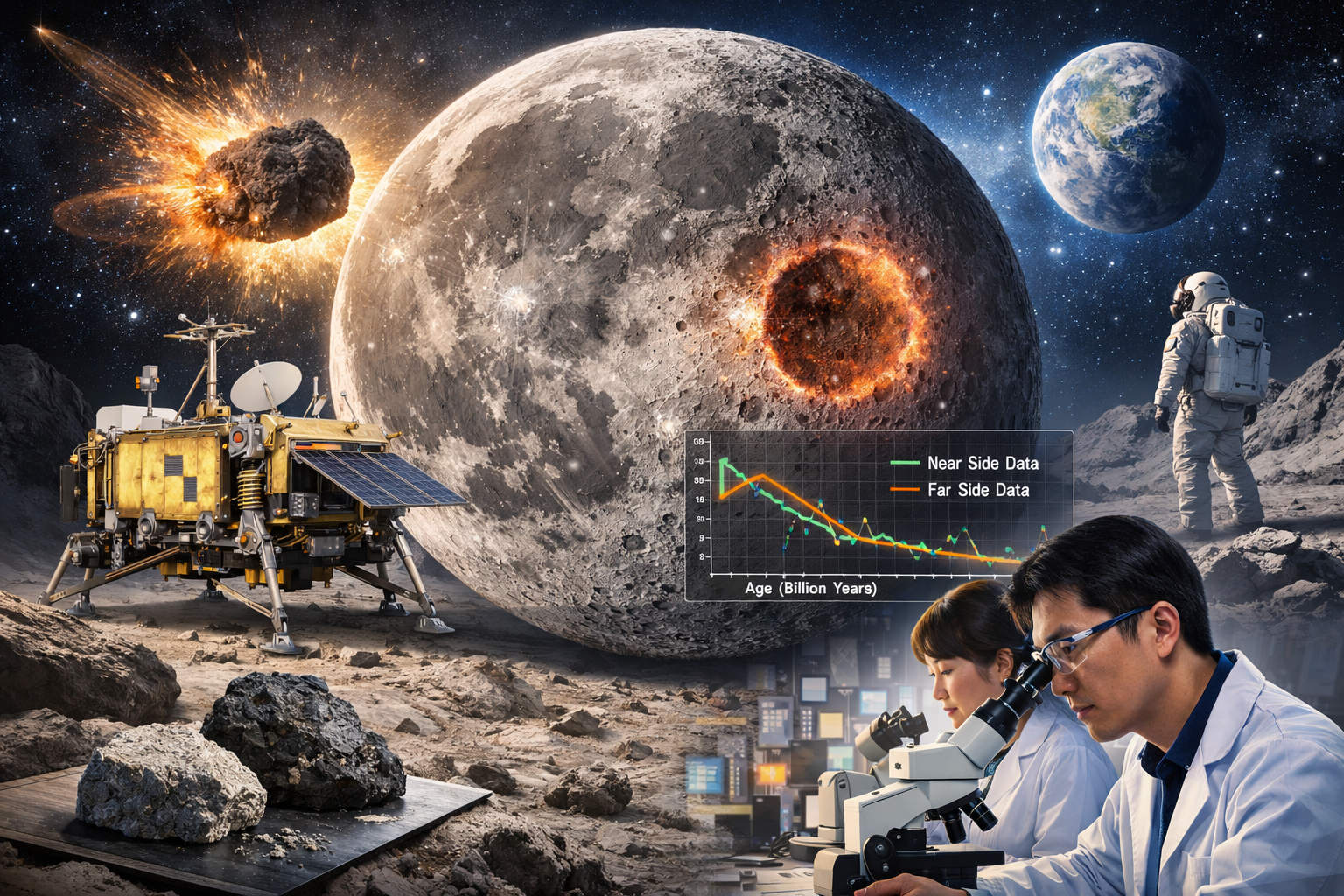
Scientists have verified that impact cratering rates are the same on the Moon’s near and far sides using samples brought back from the Moon’s far side by China’s Chang’e-6 mission. This finding puts an end to decades of planetary science controversy and establishes the framework for a universally accepted lunar chronology system.
The results, which were published in Science Advances, represent a paradigm shift in the way that geological evolution and lunar surface dating are understood.
The Significance of Lunar Chronology in Moon Science
Understanding the Moon’s formation and evolution requires knowing how old its surface is. Impact craters are used by scientists to determine the age of the surface; the more craters there are, the older the topography.
But for many years, this approach had a significant drawback: all calibration samples were taken from the Moon’s near side, mostly from the Apollo and Luna missions. Since the oldest of these rocks was only 4 billion years old, it is unclear how ancient the Moon was, which supports theories like the Late Heavy Bombardment.
The Chang’e-6 Mission Unlocks the Far Side of the Moon
A historic milestone was reached in June 2024 when China’s Chang’e-6 mission returned 1,935 grams of lunar samples from the Apollo Basin, which is inside the South Pole-Aitken Basin, the largest and oldest impact structure on the Moon.
This gave scientists long-missed geological data and was the first sample ever returned from the lunar far side.
Important Findings from Chang’e-6 Lunar Samples
Two crucial rock kinds were found through analysis of the returned samples:
• Young basalt, with an estimated age of 2.807 billion years The formation of ancient norite occurred 4.25 billion years ago.
The norite is particularly important. It was formed from solidified magma following the massive impact event that formed the South Pole-Aitken Basin, providing an essential anchor point for recreating the early history of the Moon.
The Lunar Impact Crater Chronology Model has been revised.
A study team headed by the Institute of Geology and Geophysics of the Chinese Academy of Sciences mapped crater density throughout the Chang’e-6 landing area and the larger South Pole-Aitken Basin using high-resolution remote sensing imagery.
The most complete lunar impact chronology model to date was then produced by combining this new data with previous samples from the Apollo, Luna, and Chang’e-5 missions.
Cratering rates on the near and far sides are the same.
A long-standing query was clearly addressed by the findings: the impact flux on the Moon has been consistent in both hemispheres.
Data on far-side crater densities were completely within the near-side models’ confidence range. Lead author Yue Zongyu claims that this proves the Moon had a uniform impact history instead of the sharp variations that previous hypotheses had suggested.
Implications for Planetary and Lunar Science
This innovation goes beyond improving lunar timeframes. A single lunar calendar: • Offers a trustworthy worldwide reference for dating lunar regions that have not been sampled.
• Enhances knowledge of the early history of solar system impacts
• Assists researchers in more precisely dating the surfaces of other planets, such as Mars and Mercury.
As a scientific cornerstone, the Chang’e-6 samples have significantly advanced planetary geology.
Conclusion: Moon Exploration Enters a New Era
Our knowledge of the Moon’s history has changed as a result of the Chang’e-6 mission. Scientists have now created a worldwide uniform lunar chronology system by verifying consistent impact cratering over the lunar surface.
This accomplishment not only puts an end to decades of doubt, but it also emphasizes how crucial international lunar exploration is becoming to learning more about the solar system’s deep past.