France’s Sophie Adenot Arrives at the International Space Station with NASA Crew-12
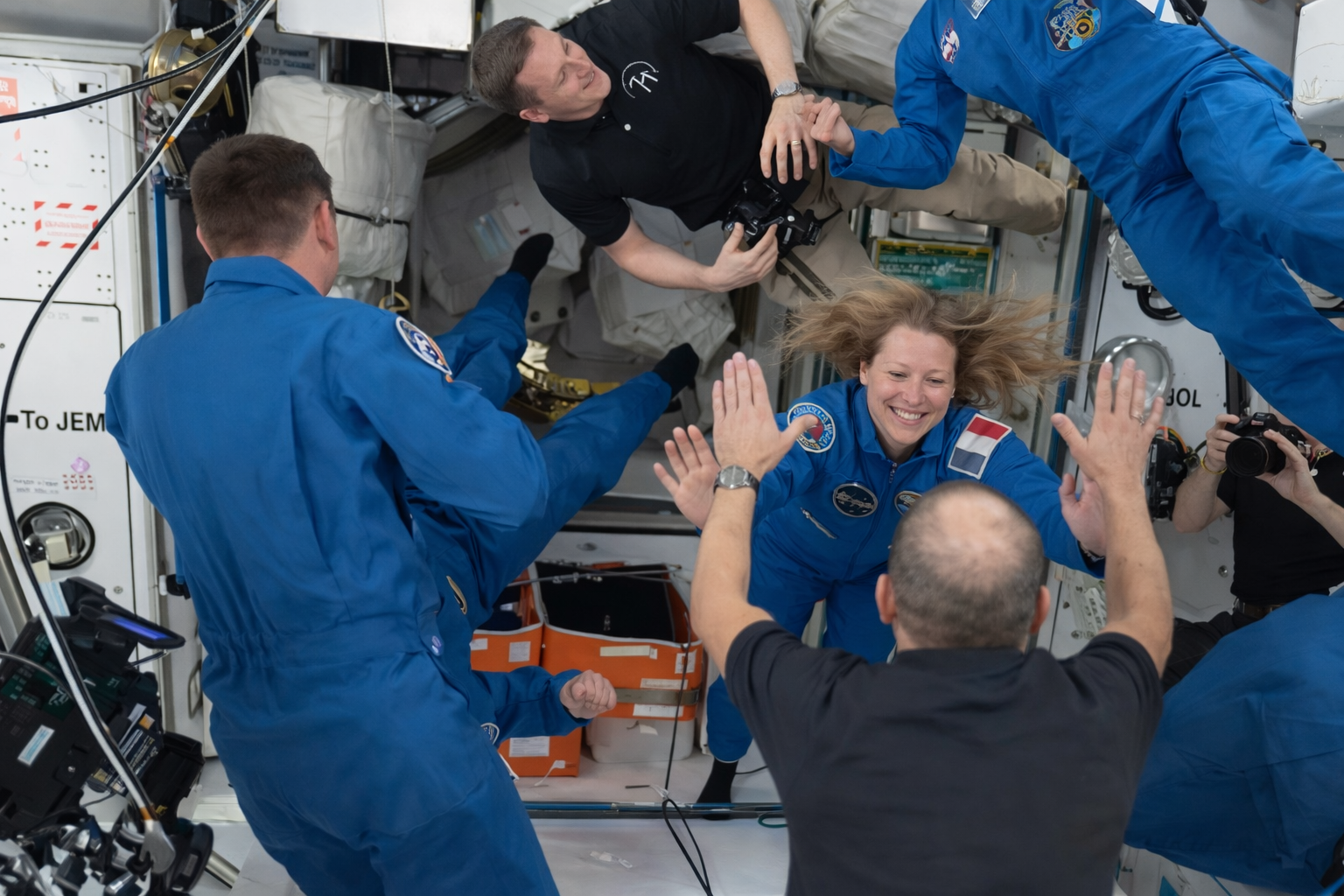
The International Space Station (ISS) has welcomed four new astronauts for a months-long research mission that highlights global cooperation in space. Among them is French astronaut Sophie Adenot, who is making history as only the second French woman to travel to space.
The team, known as NASA Crew-12, docked successfully at the orbiting laboratory after a 34-hour journey from Cape Canaveral, Florida. In addition to guaranteeing the ongoing existence of humans on board the ISS, their mission is one of the last extended journeys before the station’s scheduled retirement in 2030.
NASA Crew-12 Launches Aboard SpaceX Falcon 9
The four-member crew blasted off from Florida aboard a SpaceX Falcon 9 rocket, beginning a journey that symbolizes the future of commercial and international spaceflight. On Saturday, the spacecraft formally started an eight-month research mission by docking with the ISS.
Crew-12 includes:
American astronaut Jessica Meir (Commander)
American astronaut Jack Hathaway
French astronaut Sophie Adenot
Russian cosmonaut Andrey Fedyaev
Upon arrival, Commander Jessica Meir reflected on the significance of the mission, emphasizing that cooperation in space remains essential. With over 25 years of continuous human presence aboard the ISS, each new crew carries forward a legacy of scientific discovery and peaceful collaboration.
Sophie Adenot Makes History for France
Following in the footsteps of Claudie Haigneré, who previously spent time onboard the Mir, Sophie Adenot is now officially the second French woman to visit space.
Her mission is a source of pride for Europe and France. Adenot has shared her enthusiasm for inspiring the next generation and representing her nation. She intends to spread the word about her adventure so that people back home can learn more about the wonders of space travel.
Her inclusion on Crew-12 also enhances European involvement in international space missions, highlighting the value of international cooperation beyond national boundaries.
Replacing Crew-11 After Historic Medical Evacuation
Crew-12 replaces Crew-11, which returned to Earth in January one month earlier than planned due to a medical issue — marking the first medical evacuation in ISS history.
While NASA did not disclose details about the health concern, the early return left the ISS temporarily staffed by a reduced crew of three astronauts. The arrival of Crew-12 restores full operational capacity to the orbiting laboratory.
This transition underscores the challenges of long-duration space missions and the importance of crew health monitoring in space exploration.
ISS: One of the Final Long-Duration Missions Before 2030
For over 25 years, people have been living aboard the International Space Station, which is situated around 250 miles (400 kilometers) above Earth. Its operating life is coming to an end, though.
The ISS will be safely deorbited by NASA and its international partners in 2030, allowing it to crash into a distant area of the Pacific Ocean. Among the final astronauts to reside on the football-field-sized station will probably be Crew-12.
The ISS continues to be a vital platform for research and technical development as space agencies get ready for deeper missions to the Moon and Mars as well as new commercial space stations.
Microgravity Research and Human Health in Space
One of the most searched and discussed topics in modern space exploration is the effects of microgravity on the human body. During their eight months aboard the ISS, Crew-12 will conduct numerous experiments focused on:
Muscle and bone density loss
Cardiovascular adaptation
Immune system changes
Long-term health monitoring
Commander Jessica Meir, who previously worked as a marine biologist studying animals in extreme environments, brings unique expertise to the mission. Her experience studying life in harsh conditions provides valuable insight into how humans adapt to space.
Artificial Intelligence and Space Medicine
A particularly exciting part of Sophie Adenot’s mission involves testing an innovative medical system powered by artificial intelligence (AI) and augmented reality (AR).
The system is designed to allow astronauts to perform their own ultrasound examinations in space. This breakthrough technology could dramatically improve healthcare capabilities on long-duration missions — especially for future trips to the Moon under NASA’s Artemis program or even missions to Mars.
Space medicine is becoming increasingly important as agencies prepare for deeper exploration beyond low Earth orbit. AI-assisted diagnostics may become essential for astronaut safety during multi-year missions.
International Cooperation Despite Earthly Tensions
The ISS has long stood as a symbol of post-Cold War cooperation between global powers. Even amid rising geopolitical tensions following Russia’s invasion of Ukraine in 2022, collaboration aboard the ISS continues.
Originally, Russian cosmonaut Oleg Artemyev was scheduled to join Crew-12 but was removed from the mission in November. Reports from independent Russian media suggested concerns over classified information, though Roscosmos simply stated he was reassigned. He was replaced by Andrey Fedyaev, who previously served aboard the ISS during Crew-6 in 2023.
Despite political strain on Earth, space remains one of the few arenas where cooperation between Russia, the United States, and Europe continues.
A Mission That Transcends Borders
From Florida’s launchpads to orbit 400 kilometers above Earth, Crew-12’s journey reflects the shared human ambition to explore beyond our planet.
As Sophie Adenot said, this mission “transcends borders.” Looking down at Earth from the ISS windows, astronauts are reminded that national boundaries disappear from space — leaving only one shared home.
With the ISS approaching the end of its operational life, missions like Crew-12 represent both continuity and transition — honoring 25 years of discovery while paving the way for the next chapter in space exploration.
The world will be watching as Crew-12 conducts groundbreaking research, advances AI-powered space medicine, and continues humanity’s presence among the stars.