As Pico gets ready to present its next-generation headset, Project Swan, at the forthcoming Game Developers Conference 2026, the extended reality (XR) market is heating up once more. GDC 2026, which will take place from March 9–13 at the Moscone Center in San Francisco, will provide developers a preview of Pico’s ambitious foray into the premium spatial computing market.
As a direct rival to Apple Vision Pro, Android XR, and other high-end mixed reality platforms, Project Swan is anticipated to mark a significant strategic change for Pico.
A New Flagship XR Headset Powered by PICO OS 6
At the core of Project Swan is PICO OS 6, the latest version of Pico’s Android-based operating system. During its GDC session, Pico plans to demonstrate the headset’s graphics performance, multimodal interaction system, and developer toolchain, along with live demos and practical examples for adapting existing apps and games to spatial computing environments.
Pico describes a new paradigm where games and apps can coexist in a shared immersive environment, allowing a primary experience to run alongside companion applications. This aligns with the growing demand for mixed reality multitasking, spatial productivity tools, and immersive gaming workflows.
Slim Design, Compute Puck & Advanced Displays
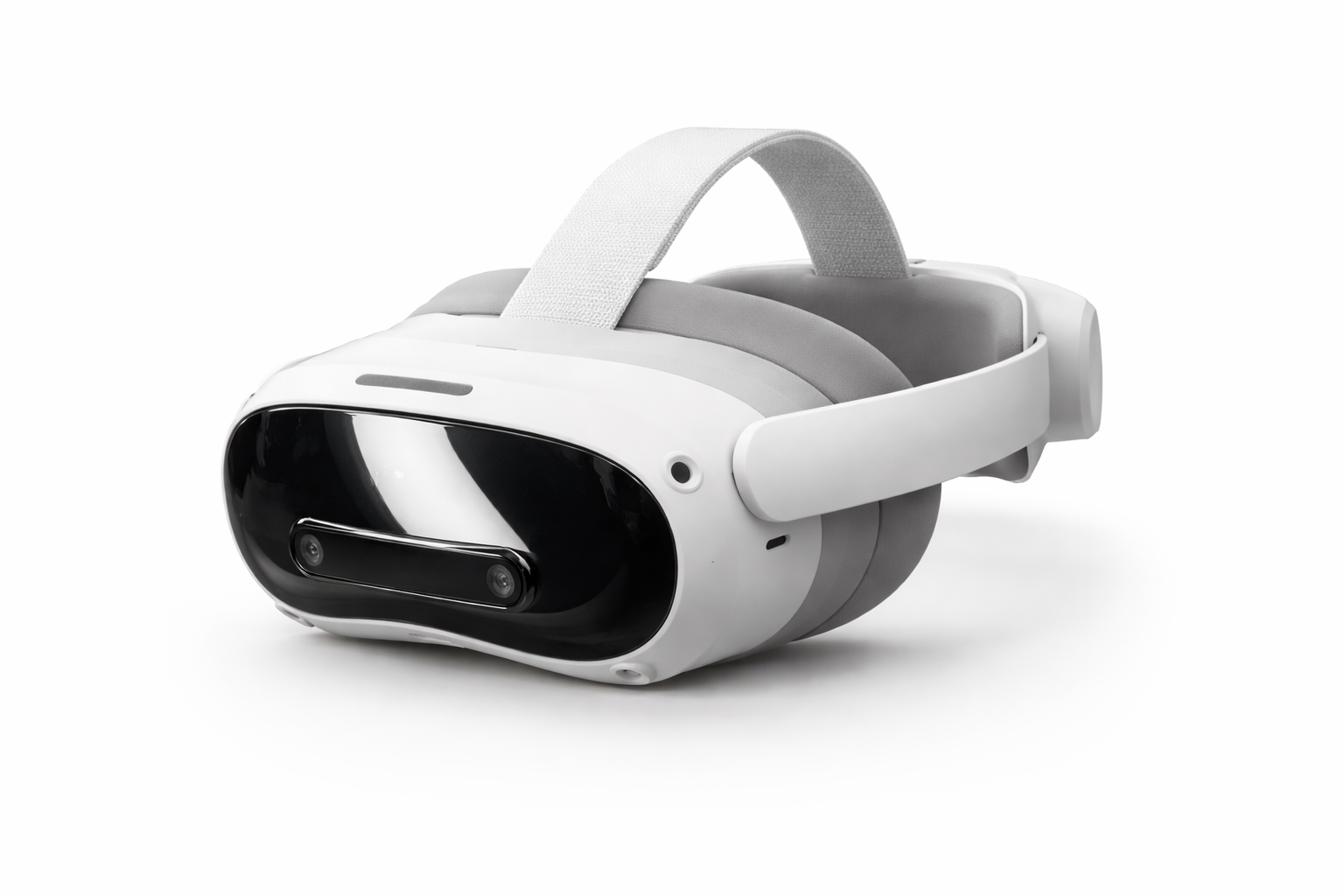
Reports suggest Project Swan will adopt a slim and lightweight design, weighing around 100 grams. Instead of housing all processing internally, the headset is expected to use a tethered compute puck, offloading heavy processing tasks for improved comfort and extended usage.
According to ByteDance executive Zhenyuan Yang, the headset will feature:
- A self-developed custom chip
- A microOLED display approaching 4,000 PPI
- Average 40 pixels per degree (PPD), exceeding 45 PPD at the center
- Microlens (MLA) technology for improved brightness
- Optical compensation for uniform color and luminance
For comparison, Apple Vision Pro features a 3,386 PPI display, placing Pico’s projected display density slightly ahead in raw pixel terms.
Hand tracking and eye tracking are also expected, reinforcing the trend toward controller-free XR interaction.
Competing in a Shifting XR Landscape
The XR competitive landscape has evolved rapidly. In 2024, Apple launched Vision Pro at $3,500, later refreshing it with upgraded hardware at the same price. Meanwhile, Google formally introduced Android XR, debuting alongside Samsung’s Galaxy XR headset at around $1,800.
Earlier, Pico’s Pico 4 Ultra competed directly with Meta’s Quest 3. However, market dynamics have shifted. Instead of focusing on mass-market affordability, companies are increasingly targeting the prosumer and enterprise segments, where margins are stronger and expectations around mainstream adoption have cooled.
Project Swan appears positioned to straddle this prosumer-enterprise category — unlikely to be budget-friendly, yet designed to leverage Pico’s existing ecosystem of XR apps and games.
A New Chapter for Pico and ByteDance
Backed by ByteDance, Pico once aggressively expanded into East Asia and Europe, challenging competitors in regional markets. However, investment strategies have reportedly become more measured, making Project Swan a crucial test for Pico’s long-term XR ambitions.
Rather than competing directly with Meta’s Horizon OS alone, Pico now seems aligned against visionOS and Android XR platforms in the premium spatial computing arena. With rumors that Meta may also launch a slim, puck-tethered headset next year, the industry could soon see Apple, Google, Meta, and Pico battling within the same high-end category.
What to Expect at GDC 2026
As developers gather in San Francisco next month, all eyes will be on Pico’s live demos and platform capabilities. If Project Swan delivers on its display quality, lightweight form factor, and robust developer ecosystem, it could mark a significant turning point in the evolution of mixed reality, spatial computing, and next-generation XR headsets.
Pico Project Swan XR Headset to Challenge VisionOS and Android XR at GDC 2026
As Pico gets ready to present its next-generation headset, Project Swan, at the forthcoming Game Developers Conference 2026, the extended reality (XR) market is heating up once more. GDC 2026, which will take place from March 9–13 at the Moscone Center in San Francisco, will provide developers a preview of Pico’s ambitious foray into the premium spatial computing market.
As a direct rival to Apple Vision Pro, Android XR, and other high-end mixed reality platforms, Project Swan is anticipated to mark a significant strategic change for Pico.
A New Flagship XR Headset Powered by PICO OS 6
At the core of Project Swan is PICO OS 6, the latest version of Pico’s Android-based operating system. During its GDC session, Pico plans to demonstrate the headset’s graphics performance, multimodal interaction system, and developer toolchain, along with live demos and practical examples for adapting existing apps and games to spatial computing environments.
Pico describes a new paradigm where games and apps can coexist in a shared immersive environment, allowing a primary experience to run alongside companion applications. This aligns with the growing demand for mixed reality multitasking, spatial productivity tools, and immersive gaming workflows.
Slim Design, Compute Puck & Advanced Displays
Reports suggest Project Swan will adopt a slim and lightweight design, weighing around 100 grams. Instead of housing all processing internally, the headset is expected to use a tethered compute puck, offloading heavy processing tasks for improved comfort and extended usage.
According to ByteDance executive Zhenyuan Yang, the headset will feature:
- A self-developed custom chip
- A microOLED display approaching 4,000 PPI
- Average 40 pixels per degree (PPD), exceeding 45 PPD at the center
- Microlens (MLA) technology for improved brightness
- Optical compensation for uniform color and luminance
For comparison, Apple Vision Pro features a 3,386 PPI display, placing Pico’s projected display density slightly ahead in raw pixel terms.
Hand tracking and eye tracking are also expected, reinforcing the trend toward controller-free XR interaction.
Competing in a Shifting XR Landscape
The XR competitive landscape has evolved rapidly. In 2024, Apple launched Vision Pro at $3,500, later refreshing it with upgraded hardware at the same price. Meanwhile, Google formally introduced Android XR, debuting alongside Samsung’s Galaxy XR headset at around $1,800.
Earlier, Pico’s Pico 4 Ultra competed directly with Meta’s Quest 3. However, market dynamics have shifted. Instead of focusing on mass-market affordability, companies are increasingly targeting the prosumer and enterprise segments, where margins are stronger and expectations around mainstream adoption have cooled.
Project Swan appears positioned to straddle this prosumer-enterprise category — unlikely to be budget-friendly, yet designed to leverage Pico’s existing ecosystem of XR apps and games.
A New Chapter for Pico and ByteDance
Backed by ByteDance, Pico once aggressively expanded into East Asia and Europe, challenging competitors in regional markets. However, investment strategies have reportedly become more measured, making Project Swan a crucial test for Pico’s long-term XR ambitions.
Rather than competing directly with Meta’s Horizon OS alone, Pico now seems aligned against visionOS and Android XR platforms in the premium spatial computing arena. With rumors that Meta may also launch a slim, puck-tethered headset next year, the industry could soon see Apple, Google, Meta, and Pico battling within the same high-end category.
What to Expect at GDC 2026
As developers gather in San Francisco next month, all eyes will be on Pico’s live demos and platform capabilities. If Project Swan delivers on its display quality, lightweight form factor, and robust developer ecosystem, it could mark a significant turning point in the evolution of mixed reality, spatial computing, and next-generation XR headsets.