‘City Killer’ Asteroid 2024 YR4 Will Safely Miss Earth and the Moon, James Webb Telescope Confirms
Regarding a potentially hazardous space rock that was previously thought to pose a threat to the Earth-Moon system, astronomers have provided comforting information. The asteroid known as 2024 YR4 will not strike Earth or the Moon during its close passage through the inner solar system in 2032, according to new findings from the potent James Webb Space Telescope.
Due to its magnitude and potential for destruction, the asteroid was formerly referred to as a possible “city killer.” However, more accurate orbital calculations now indicate that it will safely pass by, dispelling initial worries about a potential impact.
James Webb Telescope Refines the Asteroid’s Path
The breakthrough came after scientists analyzed infrared observations captured by the James Webb Space Telescope on February 18 and February 26. The advanced telescope allowed researchers from NASA and the European Space Agency to study the asteroid with exceptional precision.
These observations helped astronomers significantly improve their understanding of the asteroid’s trajectory. Earlier models suggested a 4.3% chance of the asteroid colliding with the Moon, but updated calculations have now reduced that probability to zero.
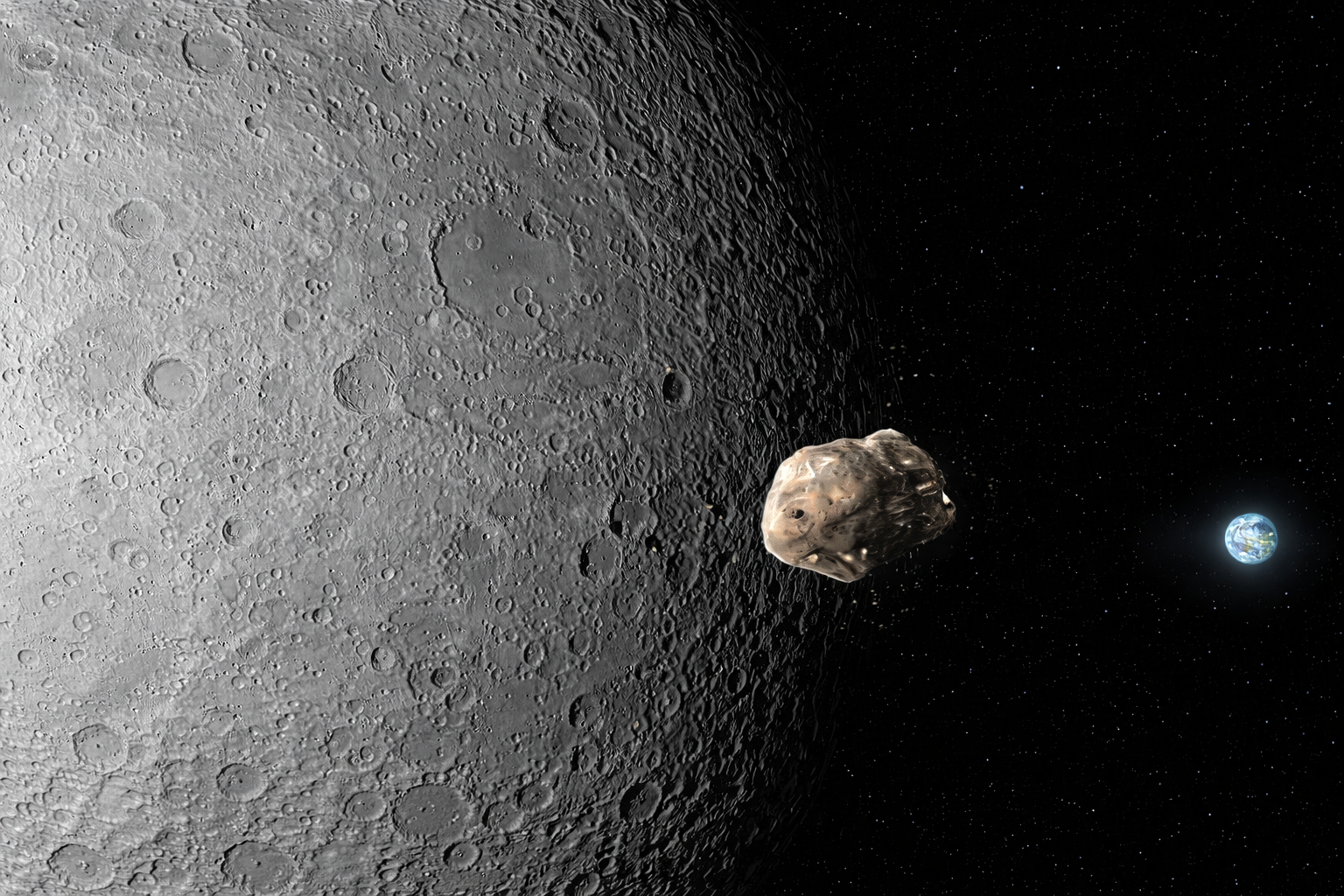
Instead of hitting the lunar surface, the asteroid will pass approximately 13,200 miles (21,200 kilometers) away from the Moon. While that distance might sound small on a cosmic scale, it is still considered a safe margin.
Meanwhile, when the asteroid makes its closest approach in 2032, it will remain hundreds of thousands of miles away from Earth, posing no danger to our planet.
Why Asteroid 2024 YR4 Was Considered Dangerous
Scientists initially paid close attention to asteroid 2024 YR4 because of its size. Current estimates suggest the asteroid measures between 174 and 220 feet (53 to 67 meters) wide, roughly comparable to the height of the famous Leaning Tower of Pisa.
If an asteroid of this size were to strike Earth, it could release energy equivalent to around 500 Hiroshima atomic bombs, enough to devastate an entire city. This potential destructive power is why objects of this scale are sometimes referred to as “city killer asteroids.”
At one point, early predictions estimated the asteroid had a 3.1% chance of colliding with Earth, the highest probability ever recorded for a newly discovered near-Earth asteroid. Fortunately, as more observational data became available, scientists were able to rule out any risk.
One of the Faintest Asteroid Observations Ever
Tracking asteroid 2024 YR4 was not an easy task. By early 2025, the asteroid had become too faint for most Earth-based telescopes to observe. The James Webb Space Telescope’s highly sensitive infrared instruments made it possible to detect and track the dim object when other observatories could not.
According to scientists, these images represent some of the faintest asteroid observations ever recorded. The ability to track such distant and dim objects highlights the extraordinary capability of the James Webb Telescope, one of the most advanced scientific instruments ever built.
What If the Asteroid Had Hit the Moon?
Astronomers had previously thought about what may happen if a huge asteroid struck the Moon, but the impact risk has now been eliminated.
A huge explosion that could have been seen from Earth—possibly even with the unaided eye—may have resulted from such a collision. Additionally, some scientists hypothesized that a brief meteor shower over Earth might have been caused by impact debris.
The study of asteroid 2024 YR4 is still very important for planetary science even though that dramatic situation won’t happen.
A Valuable Opportunity for Planetary Defense
Even though the asteroid poses no threat, it still offers a valuable opportunity for scientists studying planetary defense strategies. By analyzing its trajectory and behavior, astronomers can improve systems designed to detect and track hazardous asteroids.
NASA plans to observe asteroid 2024 YR4 again using the James Webb Space Telescope in 2028, when it becomes visible once more. These future observations will help researchers refine models that predict the paths of potentially dangerous space objects.
Ultimately, the case of asteroid 2024 YR4 demonstrates how advanced space telescopes and global scientific cooperation can help protect Earth from cosmic threats.