WhatsApp Launches Parent-Linked Accounts for Pre-Teens: A Safer Messaging Experience for Kids
WhatsApp has implemented parent-linked accounts for preteens under the age of 13, which is a significant step toward enhancing children’s online safety. Meta Platforms introduced the feature, which aims to give parents more control over their digital interactions while enabling younger users to maintain relationships with their families.
The new approach offers supervised messaging accounts, allowing parents to keep an eye on significant account activity while preserving WhatsApp’s renowned security and privacy. The action is a reflection of the growing concern throughout the world regarding children’s safety on digital platforms and the mounting pressure on tech corporations to put in place more robust safeguards for younger users.
Why WhatsApp Introduced Parent-Supervised Accounts
Although WhatsApp officially recommends its app for users aged 13 and older, many pre-teens already use the platform to communicate with parents, relatives, and close friends. According to Meta, the new feature was created after feedback from parents who wanted a safer way for their children to use messaging apps.
With more than 3 billion users worldwide, WhatsApp is one of the most widely used communication tools globally. As children increasingly gain access to smartphones at younger ages, tech companies are facing rising demands to build safer digital environments.
The new parent-managed account system aims to strike a balance between communication freedom for kids and oversight for parents.
How Parent-Linked WhatsApp Accounts Work
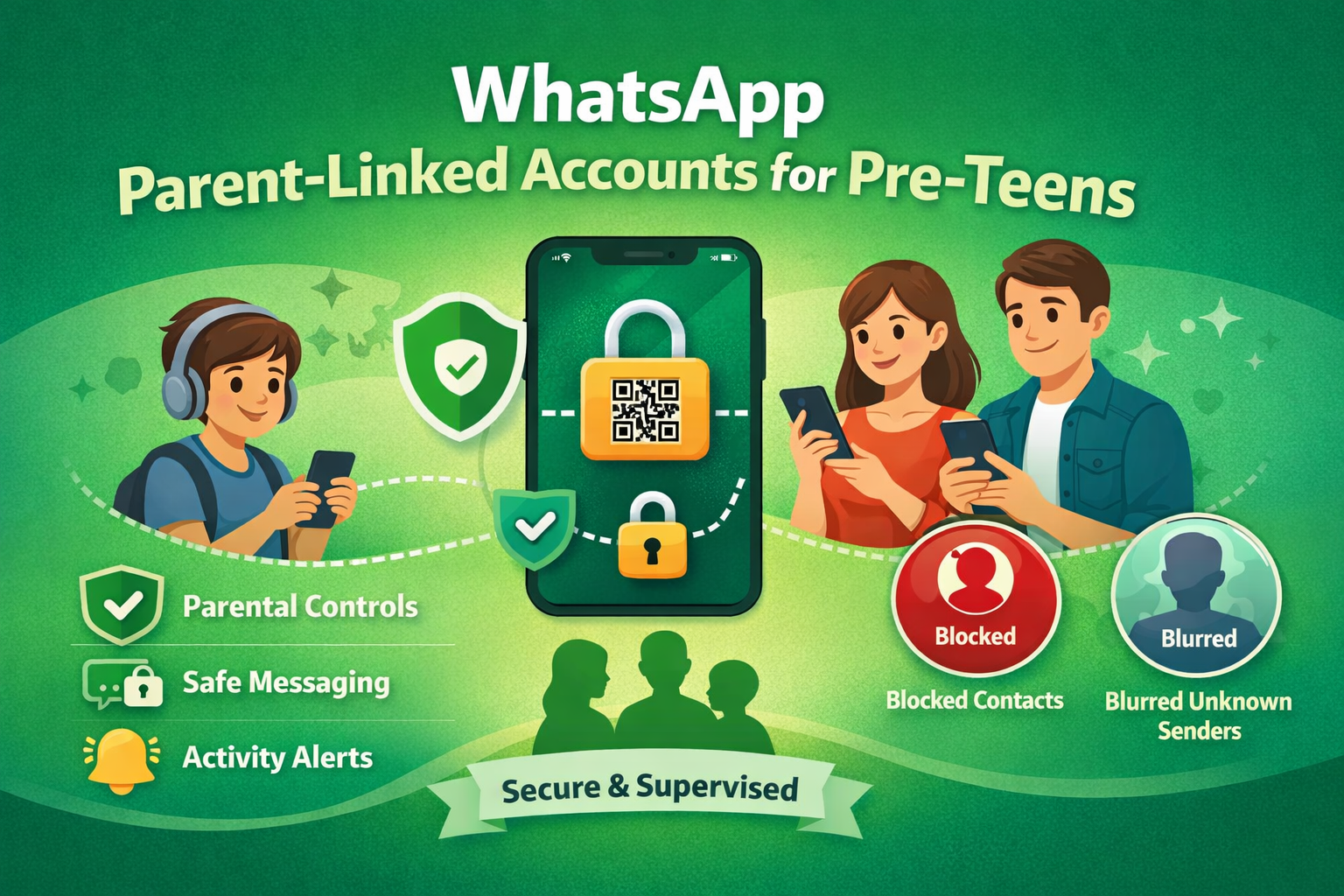
Setting up a pre-teen account requires both the parent’s device and the child’s device. During setup, the parent or guardian must authenticate the account using a QR code, ensuring that the account is properly linked and supervised.
Once the setup process is complete, parents can manage certain settings and receive alerts about their child’s activity.
Key Setup Features
- Parent authentication using QR code verification
- Device pairing between parent and child
- Secure parental control protected by a six-digit PIN
- Ability to adjust notification settings from the parent’s device
This approach ensures that only authorized parents or guardians can manage the account.
Activity Alerts Parents Can Monitor
One of the most important elements of the new system is activity alerts, which notify parents when certain actions occur on the pre-teen account.
By default, parents receive notifications when their child:
- Adds a new contact
- Blocks someone
- Reports a contact
Parents can also activate additional alerts for activities such as:
- Changing profile name or profile picture
- Receiving a new chat request
- Joining, creating, or leaving a group
- A group enabling disappearing messages
- Deleting a chat or contact
These alerts help parents stay informed without directly reading their child’s conversations.
Strong Privacy with End-to-End Encryption
Despite the added parental controls, WhatsApp confirmed that all chats and calls remain protected by end-to-end encryption.
This means that:
- Messages cannot be read by WhatsApp or Meta
- Conversations remain private between the sender and receiver
- Parents are informed about activities but cannot access message content
The company says this approach preserves privacy while still providing safety measures.
Features Pre-Teen Accounts Cannot Use
To make the platform safer for younger users, several popular features are restricted for pre-teen accounts.
These accounts do not have access to:
- Meta AI features
- WhatsApp Channels
- WhatsApp Status updates
Additionally, pre-teens cannot enable disappearing messages in one-to-one chats, preventing conversations from automatically deleting without parental awareness.
These limitations aim to reduce potential risks while keeping communication simple.
Protection Against Unknown Contacts
Another safety improvement focuses on interactions with unknown users.
When a pre-teen receives a message from someone not in their contacts, WhatsApp displays a context card explaining the request. The card may show:
- Whether the sender shares a mutual group with the child
- The country the sender is messaging from
Other safety features include:
- Ability to silence calls from unknown numbers
- Blurred images from unknown contacts by default
- Chat requests placed in a separate folder locked by the parent PIN
These tools help prevent unwanted communication and reduce exposure to strangers.
Extra Safety for Group Chats
Group chats are another area where parents often worry about safety. WhatsApp now requires parental approval for group invites.
Before accepting a group invitation, parents can see:
- The number of group members
- The group administrator
- Additional group details
Invite links are also locked behind the parent’s PIN, preventing children from joining unknown groups without permission.
Transition to a Standard WhatsApp Account
As children grow older, the platform will allow their supervised accounts to convert into standard WhatsApp accounts.
When the time comes, the user will receive a notification informing them that their account is eligible for conversion. However, Meta plans to introduce an option allowing parents to delay this transition by up to 12 months.
This gives families flexibility depending on a child’s maturity and digital readiness.
Global Push for Stronger Child Safety Online
WhatsApp’s new system comes at a time when several countries are pushing for stricter age limits and online protections for children.
Governments in places like:
- Denmark
- Germany
- Spain
- United Kingdom
are exploring or implementing rules that limit social media access for younger users.
While WhatsApp is primarily a messaging platform rather than a social network, its enormous user base means that child safety measures are increasingly important.
Gradual Global Rollout
Meta announced that the parent-linked accounts will initially launch in selected regions before expanding worldwide over the next few months.
This gradual rollout will allow the company to:
- Test the system
- Gather feedback from parents
- Improve safety tools before global release
What This Means for Parents and Families
The introduction of parent-supervised WhatsApp accounts is a significant step toward safer digital communication for younger users.
For parents, it offers:
- Greater visibility into their child’s online activity
- Tools to prevent unwanted interactions
- Confidence that communication remains private and secure
For children, it allows them to stay connected with family members safely, while gradually learning responsible digital behavior.
Conclusion
The launch of parent-linked accounts marks an important evolution for WhatsApp. By combining parental oversight, encryption, and restricted features, Meta aims to create a safer environment for younger users without sacrificing privacy.
As smartphones become more common among children, features like these may soon become standard across messaging platforms. For families navigating the digital world, WhatsApp’s new safety system could provide a much-needed balance between communication, privacy, and protection.