How Dying Stars May Eventually Destroy Their Planets
Astronomers are learning more about the long-term fate of planets by studying distant star systems across the galaxy. New research suggests that as stars age and expand, they may consume or destroy nearby planets, offering a glimpse into the distant future of our own solar system. While this dramatic event is still billions of years away, scientists are beginning to understand the processes that could ultimately reshape or even eliminate planets like Earth.
How Stars Like the Sun Evolve Over Time
At this point in its life cycle, the Sun is around halfway through. Like other stars, it spends most of its existence in the main sequence stage, where its core fuses hydrogen and helium to produce energy.
The Sun will eventually transition into a later stage of stellar evolution after running out of hydrogen fuel. The star will develop significantly during this phase, increasing in diameter by more than 100 times. When this occurs, the solar system’s inner planets may be reached by the Sun’s outer layers.
In about five billion years, according to astronomers, this transition will take place, possibly swallowing planets that orbit near the star.
Searching for Clues Using Exoplanets
To understand what happens when stars grow old, scientists analyze distant planetary systems. Researchers Edward Bryant from the University of Warwick and Vincent Van Eylen from University College London recently examined thousands of stars to see how planets behave as their host stars age.
Using data from Transiting Exoplanet Survey Satellite (TESS), the researchers compared two types of stars:
- Younger main sequence stars, similar to the Sun today
- Post–main sequence stars, which are older and beginning to expand
Their analysis included 456,941 older stars, among which they identified 130 planets or planet candidates with close orbits.
The results revealed a striking pattern: planets become significantly rarer around older stars.
Why Planets Disappear Around Aging Stars
Scientists believe the disappearance of planets around older stars is not simply due to formation differences. Instead, the evidence suggests that aging stars actively destroy nearby planets.
As stars expand into giant phases, several destructive processes can occur:
Stellar Expansion and Engulfment
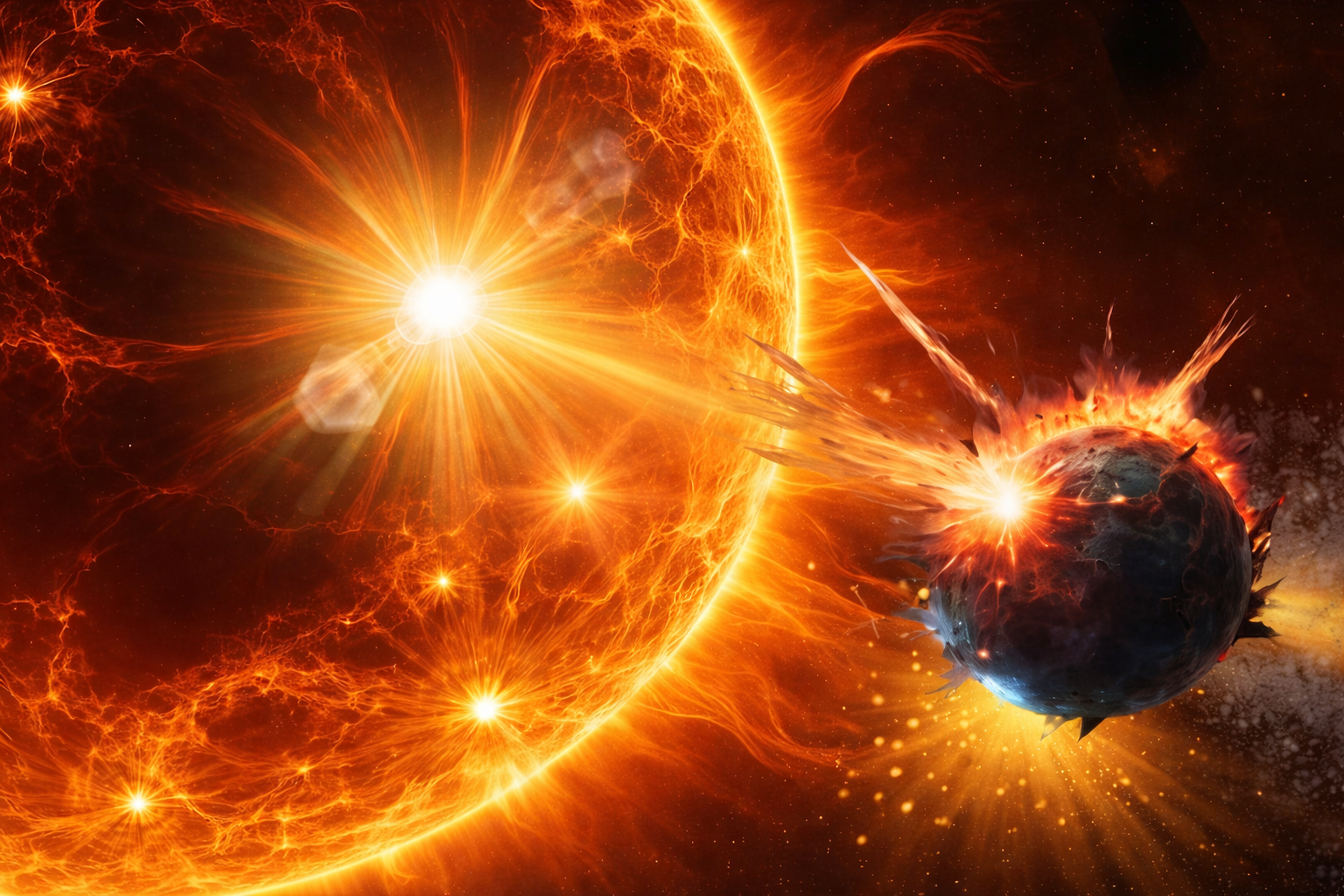
When a star grows into a red giant, its outer layers may extend far enough to swallow planets in close orbits.
Tidal Forces
Expanding stars also generate stronger gravitational tidal forces, which can slowly pull planets inward.
Orbital Decay
Over time, these tidal interactions cause a planet’s orbit to shrink — a process known as orbital decay — eventually bringing the planet too close to survive.
Atmospheric Stripping
Even before being engulfed, planets may lose their atmospheres due to intense radiation and gravitational effects.
These destructive interactions explain why researchers observe fewer planets around older stars.
The Challenge of Detecting Planets Around Giant Stars
Studying planets around aging stars is not easy. Astronomers usually detect exoplanets by observing tiny dips in starlight when a planet passes in front of its host star — a phenomenon known as a transit.
However, detecting these signals becomes harder when stars grow larger.
A planet passing in front of a giant star blocks only a small fraction of the star’s light, making the signal weaker and more difficult to observe. Despite these challenges, researchers continue to discover valuable clues about planetary evolution.
Future Missions Will Reveal More About Planetary Survival
The discovery of over 6,000 confirmed exoplanets during the past three decades has revolutionized astronomy. Yet scientists believe the most exciting discoveries may still lie ahead.
Upcoming missions, including the PLATO (space observatory) planned by the European Space Agency, will provide more precise data about stars and their planetary systems.
With improved observations, astronomers may even detect planets gradually spiraling toward their host stars, offering direct evidence of the processes that eventually destroy planetary systems.
A Glimpse Into Earth’s Distant Future
Although the Sun’s transformation into a giant star will not occur for billions of years, studying distant star systems allows astronomers to predict the eventual fate of our solar system.
While the end of Earth may seem like a distant cosmic tragedy, these discoveries represent an important step in understanding the co-evolution of stars and planets — and how planetary systems like ours change over time across the universe.