
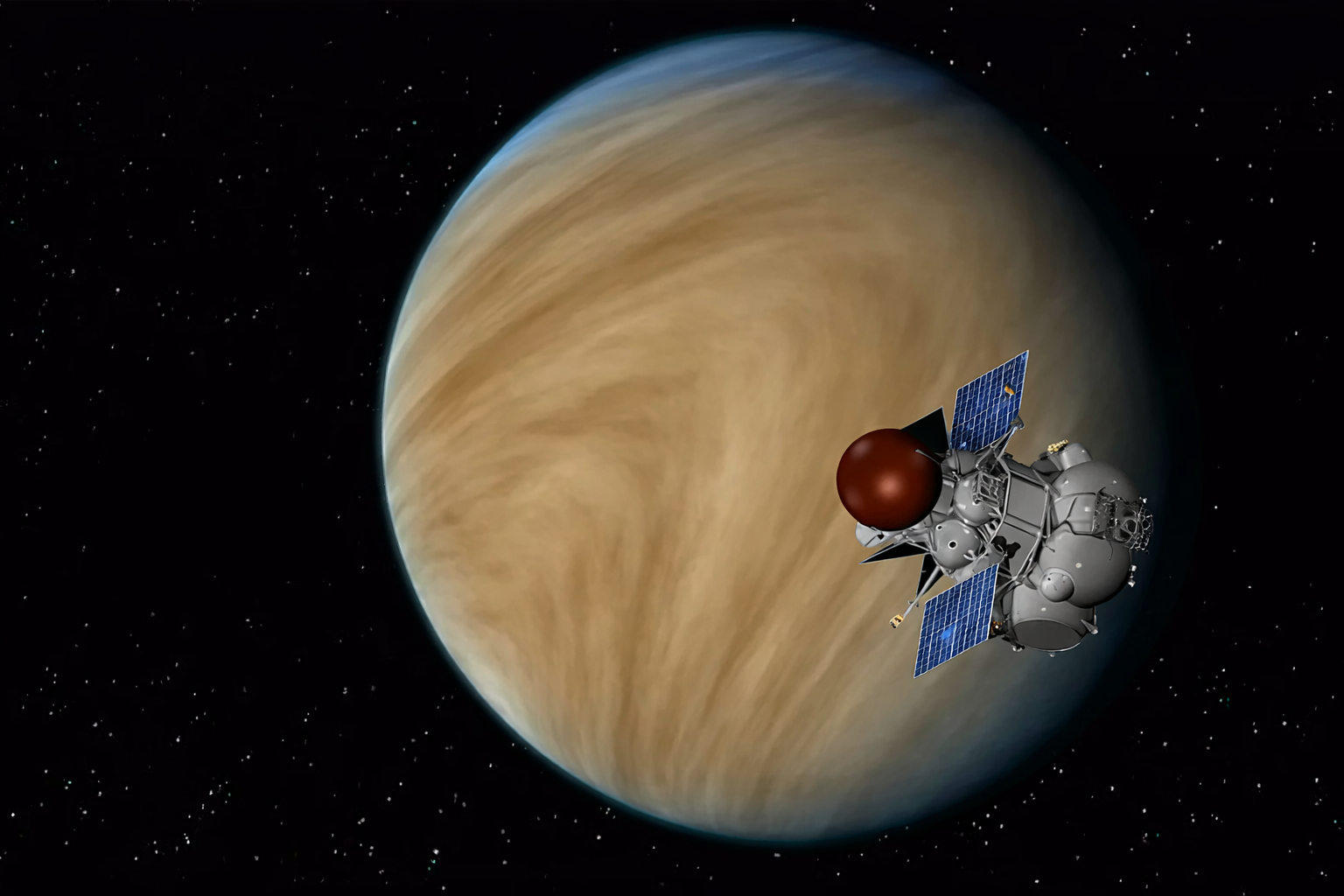
Russia Plans Ambitious Venera-D Venus Mission for 2036 to Revive Soviet Space Legacy
Russia is getting ready for a spectacular return to Venus, one of the solar system’s most inhospitable planets. The nation intends to resurrect its long history of planetary exploration and investigate the enigmatic “Earth’s twin” once more with the launch of the Venera-D expedition in 2036.
The mission, which will consist of an orbiter, lander, and atmospheric balloon, intends to investigate Venus in previously unheard-of detail and possibly look for evidence of microbial life in the planet’s clouds. It might be Russia’s largest planetary research effort in decades if it succeeds.
Russia’s New Venus Mission: What Is Venera-D?
The upcoming mission, known as Venera‑D, is a complex multi-vehicle spacecraft system designed to study Venus from orbit, in the atmosphere, and directly on the surface.
The planned spacecraft will include:
- Orbiter: To map the planet’s surface and atmosphere from space.
- Lander: Designed to survive the extreme conditions of Venus and send back data from the surface.
- Balloon Probe: Expected to float through the Venusian clouds, collecting atmospheric data.
The mission is currently targeted for launch in 2036 and is part of a broader planetary exploration strategy by Russia’s space agency Roscosmos.
Officials say robotic missions to the Moon and Venus now sit at the center of Russia’s future space ambitions.
Why Venus Is One of the Most Mysterious Planets
The planet Venus is often called Earth’s twin because of its similar size and composition. However, the similarity ends there.
Venus is an extremely hostile world with conditions that make exploration incredibly difficult:
- Surface temperatures: About 900°F (480°C)
- Atmospheric pressure: More than 90 times higher than Earth’s sea-level pressure
- Atmosphere: Thick clouds of sulfuric acid
Despite these extreme conditions, scientists believe Venus holds crucial clues about planetary evolution, climate change, and potentially life beyond Earth.
The Soviet Union’s Historic Venus Landings
Russia’s interest in Venus is rooted in the achievements of the Soviet Union, which remains the only nation in history to successfully land spacecraft on Venus.
The most famous mission was Venera 7, launched in 1970. It became the first spacecraft to successfully land on another planet and transmit data back to Earth.
Over a period of more than two decades, the Soviet Venera program launched numerous missions to Venus, including:
- Venera 1 and Venera 2 – early flyby attempts
- Venera 3 – first spacecraft to enter Venus’ atmosphere
- Venera 4, Venera 5, Venera 6 – atmospheric probes
- Venera 16 – radar mapping mission in 1983
Some Venera landers survived long enough to capture the first-ever images from Venus’ surface, revealing rocky terrain with a yellowish hue caused by the thick atmosphere.
Searching for Possible Life in Venus’ Clouds
One of the most exciting goals of Venera-D is the search for microbial life in Venus’ atmosphere.
In recent years, scientists have reported possible traces of phosphine and ammonia in Venus’ clouds—chemicals that on Earth are often associated with biological processes.
These findings remain highly debated in the scientific community, but they have sparked renewed interest in Venus exploration.
A balloon probe in the new mission could analyze the atmosphere directly and determine whether microbial life could exist in the planet’s upper clouds, where temperatures and pressures are more moderate.
Why NASA Is No Longer Part of the Mission
When the project was first proposed in the early 2000s, NASA considered collaborating with Russia on the mission.
However, international cooperation on planetary projects largely ended after Russia’s Russian invasion of Ukraine.
Since then, NASA has halted joint space missions with Russia—though cooperation continues aboard the International Space Station.
Despite the geopolitical tensions, Russia has decided to continue developing the mission independently.
The Global Race to Explore Venus
Russia is not alone in planning new missions to Venus. Several space agencies and private companies are preparing to explore the planet in the coming decade.
Major upcoming missions include:
NASA Missions
- VERITAS – a mission designed to map Venus’ surface using radar
- DAVINCI – an atmospheric probe that will study the planet’s chemistry
European Space Agency
The European Space Agency is planning the EnVision mission to examine Venus’ geology and atmosphere.
India
India’s Indian Space Research Organisation is developing Shukrayaan‑1, which could launch around 2028.
Private Space Missions
Private aerospace company Rocket Lab and researchers from Massachusetts Institute of Technology are working on a Venus Life Finder probe aimed at detecting biosignatures in Venus’ clouds.
Why Venus Exploration Matters
Studying Venus could help scientists answer some of the biggest questions in planetary science.
Researchers want to understand:
- Why Venus evolved into a runaway greenhouse world while Earth remained habitable
- Whether the planet once had oceans or a milder climate
- If microbial life could exist in extreme environments beyond Earth
Insights from Venus could also help scientists better understand climate change on Earth and the conditions that make planets habitable.
A New Era of Venus Exploration
If launched successfully, Venera-D would mark the first Russian Venus mission in more than 50 years and potentially revive a legacy that once defined Soviet space exploration.
With multiple missions from international agencies planned over the next decade, the 2030s could become the most active era of Venus exploration since the Cold War.
Scientists believe that by combining data from orbiters, atmospheric probes, and landers, humanity may finally unlock the secrets of our mysterious neighboring planet.
And perhaps, for the first time, we might discover whether life could exist in the clouds of Venus.