Solar System Moon Count Reaches 442
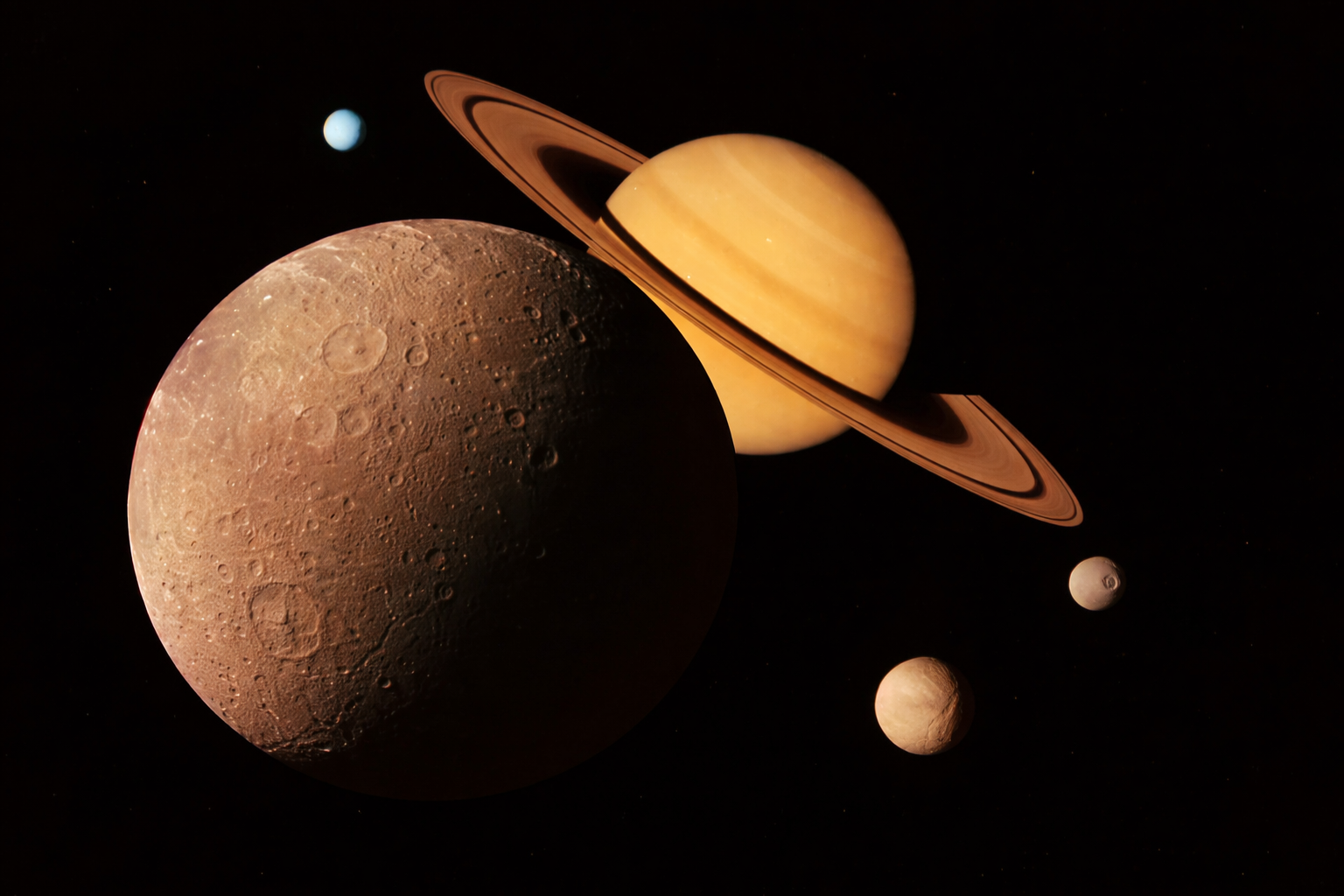
As scientists find more celestial objects circling far-off planets, the wonders of our solar system keep growing. Scientists have discovered additional moons surrounding Jupiter and Saturn in a recent discovery, increasing the total number of known moons in the solar system to an astounding 442.
These findings show how much is still unknown in our cosmic neighborhood while also expanding our knowledge of planetary systems.
New Moons Discovered Around Jupiter and Saturn
Astronomers recently confirmed:
- 4 new moons orbiting Jupiter
- 11 new moons orbiting Saturn
This brings the updated totals to:
- Jupiter: 101 moons
- Saturn: 285 moons
Saturn now firmly holds the title of the planet with the most moons in the solar system.
Why These Moons Are Hard to Detect
Unlike large and well-known moons, these newly discovered objects are:
- Extremely small (around 3 km in diameter)
- Very faint (magnitude 25 to 27)
- Located in distant, wide orbits
For comparison, Earth’s moon shines at a magnitude of -12.6, making these new moons billions of times dimmer.
Because of this, they cannot be seen with regular telescopes. Instead, astronomers rely on powerful observatories like:
- The Magellan–Baade Telescope in Chile
- The Subaru Telescope in Hawaii
- The Canada–France–Hawaii Telescope
These instruments allow scientists to detect faint objects at the edge of visibility.
The Scientists Behind the Discoveries
The discoveries were made by leading astronomers, including:
- Scott Sheppard and David Tholen, who identified Jupiter’s new moons
- Edward Ashton, who led the team that found Saturn’s moons
These researchers are among the most prolific moon discoverers, with over 200 discoveries each, showcasing decades of dedication to planetary science.
How These Discoveries Were Announced
The findings were officially reported by the Minor Planet Center, the global authority responsible for cataloging:
- Asteroids
- Comets
- Moons
- Other small celestial bodies
This ensures that every discovery is verified and recorded for scientific research.
Total Moon Count in the Solar System
With these new additions, here’s the updated moon count:
Planets
- Earth: 1
- Mars: 2
- Jupiter: 101
- Saturn: 285
- Uranus: 28
- Neptune: 16
- Mercury & Venus: 0
Dwarf Planets
- Pluto: 5
- Eris: 1
- Makemake: 1
- Haumea: 2
- Ceres: 0
This brings the total number of known moons to 442, excluding smaller moonlets orbiting asteroids.
What Makes These Moons Important?
Even though these moons are small, they provide valuable insights into:
- The formation of planetary systems
- Gravitational interactions in space
- The history of collisions and captured objects
Many of these moons are believed to be captured asteroids, offering clues about the early solar system.
Future Missions Could Reveal Even More
Exciting space missions are already on their way to explore Jupiter and its moons:
- Europa Clipper
- Jupiter Icy Moons Explorer
Expected to arrive in the early 2030s, these missions could:
- Discover even more moons
- Study icy surfaces and subsurface oceans
- Reveal conditions that might support life
These explorations may help Jupiter catch up with Saturn in the “moon count race.”
Why Saturn Has So Many Moons
Saturn’s massive lead in moon count is likely due to:
- Its strong gravitational pull
- Its complex ring system
- Frequent capture of passing objects
Its environment makes it easier for small bodies to become permanent satellites.
Final Thoughts
The discovery of new moons around Jupiter and Saturn is a powerful reminder that our solar system is still full of surprises. With advanced telescopes and upcoming space missions, astronomers are uncovering hidden worlds that were once invisible.
As technology improves, the number of known moons will likely continue to grow—bringing us closer to understanding the origins and evolution of our cosmic home.