The Strange Story of a Captured Moon
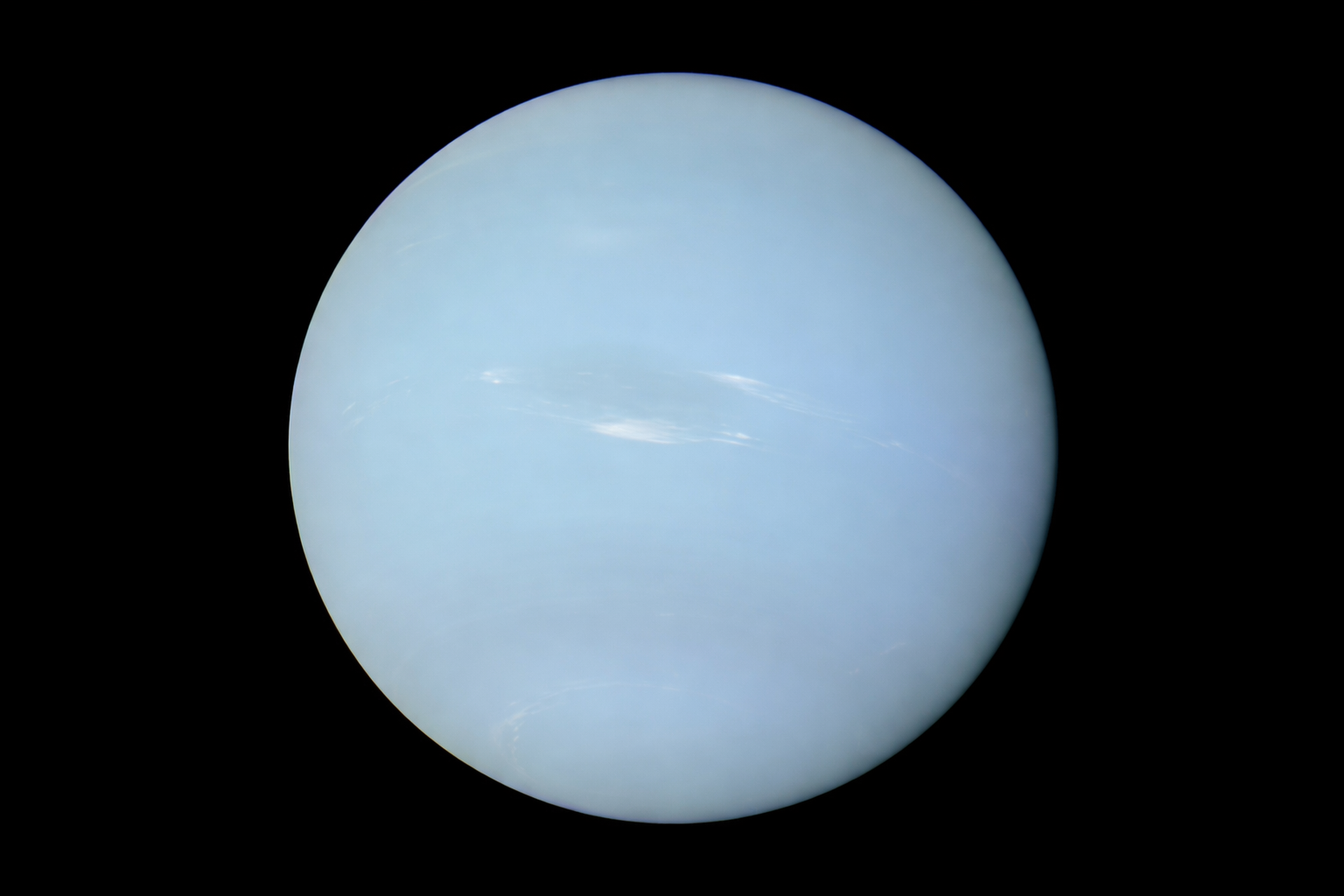
There are many mysteries in the outer reaches of our solar system, but few are as intriguing as the tale of Neptune and its peculiar moon Triton. According to recent study, a significant cosmic interaction with its own satellite may be responsible for this far-off, ice world’s current tilt.
Neptune: A Cold and Distant Ice Giant
Located nearly 30 times farther from the Sun than Earth, Neptune is one of the most extreme environments in our solar system.
- Temperatures drop to around –200°C
- Home to the fastest winds in the solar system
- A single year lasts 165 Earth years
Despite its distance and harsh conditions, Neptune continues to intrigue scientists with its complex dynamics—especially its 28-degree axial tilt.
The Mystery of Neptune’s Tilt
All planets in our solar system have some degree of tilt:
- Earth: 23° (responsible for seasons)
- Uranus: ~98° (tilted almost sideways)
- Neptune: 28° (unexpected and unexplained for decades)
For years, scientists have wondered how Neptune acquired this specific tilt. Now, new research by Rodney Gomes from São Paulo State University offers a compelling explanation.
Triton: The Moon That Doesn’t Belong
Triton stands out as one of the most unusual moons in the solar system.
Key Characteristics:
- Only large moon with a retrograde orbit (moves opposite to Neptune’s rotation)
- Believed to be a captured dwarf planet from the Kuiper Belt
- Likely captured billions of years ago
Unlike most moons that form alongside their planets, Triton appears to be a cosmic outsider, pulled into Neptune’s gravity.
How Triton May Have Tilted Neptune
According to the new study, Triton didn’t just settle quietly into orbit—it may have reshaped Neptune itself.
The Mechanism:
- Triton originally had a highly eccentric and tilted orbit
- Over millions of years, tidal forces caused its orbit to evolve
- This interaction created a gravitational “tug-of-war” with Neptune
As a result, Neptune’s rotation axis began to shift, eventually locking into a resonance known as s8—a specific frequency within the solar system.
Think of it like a spinning top being gently pushed until it tilts.
Simulation Results Support the Theory
Computer simulations conducted in the study revealed striking results:
- Some scenarios produced tilts exceeding 50 degrees
- About 25% of simulations resulted in tilts greater than 20°
- These outcomes align well with Neptune’s current 28-degree tilt
This strongly supports the idea that Triton played a major role in shaping Neptune’s orientation.
Triton’s Future: A Dramatic End
Triton’s story is far from over.
What Lies Ahead:
- Triton is gradually spiraling closer to Neptune
- In about 3.6 billion years, it will reach the Roche limit
- Possible outcomes:
- Collision with Neptune
- Break apart to form a new ring system
This means Triton could eventually create a spectacle similar to Saturn’s rings—but born from destruction.
A Moon That Changed a Planet
Triton is more than just a moon—it is a cosmic influencer. From its capture in the distant past to its ongoing gravitational effects, it has likely played a key role in shaping Neptune’s present state.
If the new research holds true, Triton didn’t just become part of Neptune’s system—it transformed it.
Final Thoughts
The story of Neptune and Triton highlights how dynamic and ever-changing our solar system truly is. Even billions of years after their formation, planets and moons continue to interact in ways that reshape entire worlds.
As research continues, we may uncover even more surprising connections—reminding us that space is not static, but a constantly evolving cosmic dance. 🌌