
How Robots Are Solving Labor Shortages, Not Replacing Jobs
Introduction: Robots as a Solution, Not a Threat
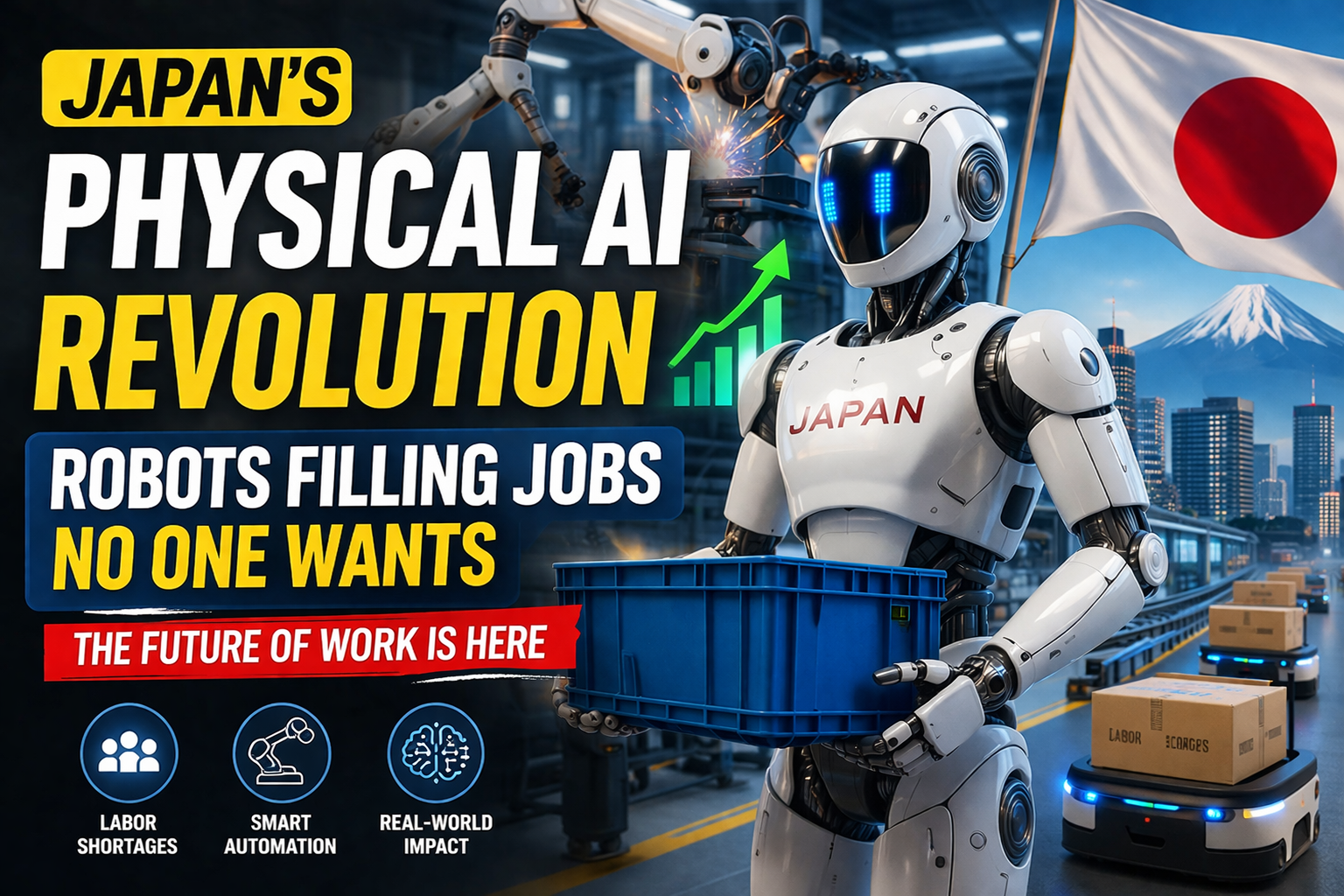
Robots are frequently viewed as job killers in many regions of the world. However, the situation is much different in Japan. Here, robots are filling positions where there aren’t enough workers, not to replace them.
Japan Physical AI is emerging as a potent option to preserve productivity and economic stability in the face of the nation’s growing aging population and declining workforce.
What Is Physical AI and Why It Matters
Physical AI refers to the integration of artificial intelligence into machines that interact with the real world—like robots in factories, warehouses, and infrastructure systems.
Unlike traditional software-based AI, physical AI combines:
- Sensors and perception systems
- Real-time decision-making
- Robotics and automation hardware
This allows machines to perform complex physical tasks autonomously, from sorting packages to inspecting industrial facilities.
The Real Driver: Japan’s Labor Crisis
The biggest reason behind Japan’s rapid adoption of physical AI is simple—there aren’t enough workers.
Key Challenges
- Declining population for over a decade
- Aging workforce reducing productivity
- Critical industries facing worker shortages
According to data from Japan’s Ministry of Economy, Trade and Industry, the country aims to capture 30% of the global physical AI market by 2040, highlighting how seriously it views this transformation.
What was once about efficiency has now become about survival.
From Efficiency to Industrial Survival
Industry experts emphasize that physical AI is no longer just about improving operations—it’s about keeping them running at all.
Businesses across Japan are using robotics to:
- Maintain factory output
- Keep logistics networks functioning
- Support essential services
This shift marks a major turning point where automation is not optional—it’s essential.
Japan’s Strength: Hardware Excellence
Japan has long been a global leader in industrial robotics. Its companies dominate the production of key components like:
- Actuators
- Sensors
- Precision control systems
In fact, Japanese manufacturers once accounted for around 70% of the global robotics market, giving the country a strong foundation in the physical AI race.
Major companies such as:
- Toyota Motor Corporation
- Mitsubishi Electric
- Honda Motor
continue to play a critical role in scaling and deploying robotic systems worldwide.
The Challenge: Catching Up in Software and Integration
While Japan excels in hardware, competitors like the United States and China are advancing rapidly in:
- AI software development
- Data integration
- Full-stack system design
This creates a key challenge: combining Japan’s hardware strengths with advanced AI systems.
Experts believe the future of physical AI will depend on how well companies integrate:
- Hardware
- Software
- Real-world operational data
Real-World Applications Already in Action
Japan is no longer experimenting—it’s deploying.
Industries Leading Adoption
- Manufacturing: Automated robots performing assembly and quality control
- Logistics: Smart warehouses and autonomous forklifts
- Infrastructure: Inspection robots in data centers and industrial sites
Companies like SoftBank are already integrating AI models with robotics, enabling machines to understand environments and perform complex tasks independently.
Startups Driving Innovation
Startups are playing a crucial role in Japan’s physical AI ecosystem.
Notable Innovators
- Mujin: Developing advanced robotics control platforms for automation
- Terra Drone: Using AI-powered autonomous systems for industrial and defense applications
- WHILL: Building smart mobility solutions for short-distance transportation
These companies focus on software layers, orchestration systems, and real-world deployment—areas where future value is expected to grow.
Government Investment and Strategic Vision
Under the leadership of Sanae Takaichi, Japan is investing heavily in AI and robotics.
Key Investments
- $6.3 billion in AI and robotics development
- Focus on industrial deployment and innovation
- Support for startups and ecosystem growth
This national strategy reflects a clear goal: to lead the global physical AI market.
A Unique Ecosystem: Collaboration Over Competition
Unlike the “winner-takes-all” model seen in many tech sectors, Japan is building a hybrid ecosystem.
How It Works
- Large corporations provide scale and infrastructure
- Startups bring innovation and agility
- Collaboration drives faster deployment
This balanced approach allows Japan to combine stability with innovation—an advantage in the complex world of robotics.
The Future of Japan Physical AI
Looking ahead, the biggest opportunities lie in:
- Integration platforms
- Simulation tools and digital twins
- Autonomous systems powered by real-world data
Experts believe that the companies controlling deployment, integration, and continuous improvement will dominate the market.
Conclusion: A Model for the World
Japan’s approach to physical AI offers a powerful lesson: technology doesn’t always replace humans—it can support them.
By addressing labor shortages and enhancing productivity, Japan is proving that robots can be partners, not competitors.
As the global race for AI dominance accelerates, Japan’s strategy could become a blueprint for other nations facing similar demographic challenges.