Record Profits Surge 750% as AI Boom Drives Chip Demand
Introduction
The global AI revolution is reshaping the tech industry—and Samsung Electronics is one of its biggest winners. The company has reported a massive surge in profits, fueled by skyrocketing demand for memory chips used in AI data centers and advanced computing systems.
Samsung’s latest earnings not only beat expectations but also set new records, signaling a powerful shift in the semiconductor market.
Samsung Reports Record-Breaking Earnings
In its latest quarterly results, Samsung delivered outstanding financial performance:
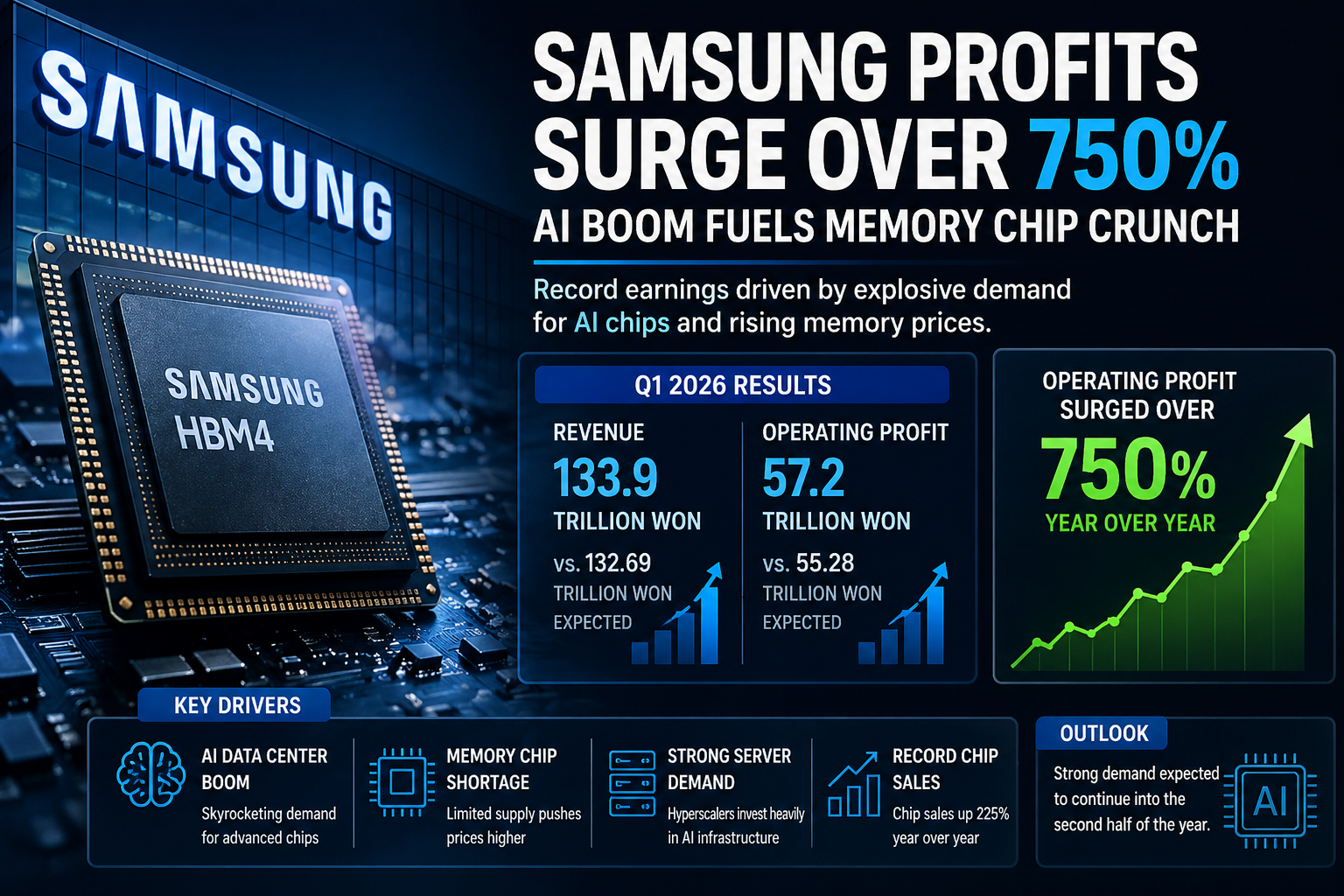
- Revenue: 133.9 trillion Korean won (≈ $89.96 billion)
- Operating Profit: 57.2 trillion Korean won
These figures exceeded analyst expectations and marked a more than 750% increase in profit year-over-year. Even more impressive, the company’s quarterly earnings surpassed its entire 2025 annual profit, highlighting the scale of growth.
AI Boom Fuels Memory Chip Demand
The primary driver behind Samsung’s explosive growth is the global surge in artificial intelligence. As companies invest heavily in AI infrastructure, demand for memory chips—especially high-performance variants—has soared.
Major tech players, including Nvidia, are pushing the limits of AI computing, requiring advanced memory solutions to power next-generation data centers.
This has created a supply shortage, driving up prices and boosting profits for chip manufacturers like Samsung.
Chip Division Dominates Earnings
Samsung’s Device Solutions (DS) division—its semiconductor arm—was the standout performer:
- Operating Profit: 53.7 trillion won (up from ~1 trillion last year)
- Total Chip Sales: 81.7 trillion won (up 225% year-over-year)
This division alone contributed over 90% of Samsung’s total earnings, making it the backbone of the company’s success.
High-Bandwidth Memory (HBM): The AI Goldmine
At the center of this growth is High-Bandwidth Memory (HBM), a critical component for AI workloads.
Samsung has been aggressively expanding its HBM business and recently announced a breakthrough—mass production of its latest-generation chips, HBM4 memory.
These chips are expected to play a key role in powering future AI systems, including advanced architectures designed for massive data processing.
Competition Heats Up with SK Hynix
Despite strong performance, Samsung faces intense competition from SK Hynix, which currently leads the HBM market.
- SK Hynix holds around 57% market share in HBM
- Samsung is rapidly closing the gap with improved HBM4 technology
While Samsung is catching up, industry analysts still see SK Hynix as the current leader in this high-stakes segment.
Supply Shortages and Rising Prices
The demand for AI memory chips is so strong that supply cannot keep up. Samsung revealed that:
- Demand fulfillment rates are at record lows
- Customers are already placing orders for 2027
- The supply-demand gap is expected to widen further
This imbalance is driving up prices across the memory market, benefiting chipmakers but creating challenges for other industries.
Challenges Ahead for Samsung
While rising chip prices boost profits, they also present risks:
- Higher component costs may impact Samsung’s smartphone and appliance divisions
- Ongoing geopolitical tensions could disrupt supply chains
- Increased competition in AI hardware markets
Samsung is closely monitoring global developments, especially factors that could affect raw materials and energy supply.
Market Reaction
Following the earnings announcement:
- Samsung shares initially rose by around 1%
- Later declined slightly during trading
- Overall, the stock is up nearly 90% this year
This reflects strong investor confidence, despite short-term market fluctuations.
Conclusion
Samsung’s record-breaking earnings highlight the transformative power of AI in today’s tech landscape. As demand for advanced memory chips continues to grow, the company is well-positioned to remain a dominant force in the semiconductor industry.
However, with rising competition and supply challenges ahead, the race for AI dominance is far from over.