Credit Card-Sized Computer With E Ink Display Could Change the Future of Portable Technology
Tiny Wallet Computer Packs Wi-Fi, NFC, and E Ink Display Into a 1mm-Thin Device
Technology keeps getting smaller, smarter, and more powerful. From smartphones and smartwatches to wearable AI gadgets, modern electronics are constantly evolving toward ultra-portable designs. Now, a new experimental project called the “Muxcard” is pushing the limits of miniaturization even further.
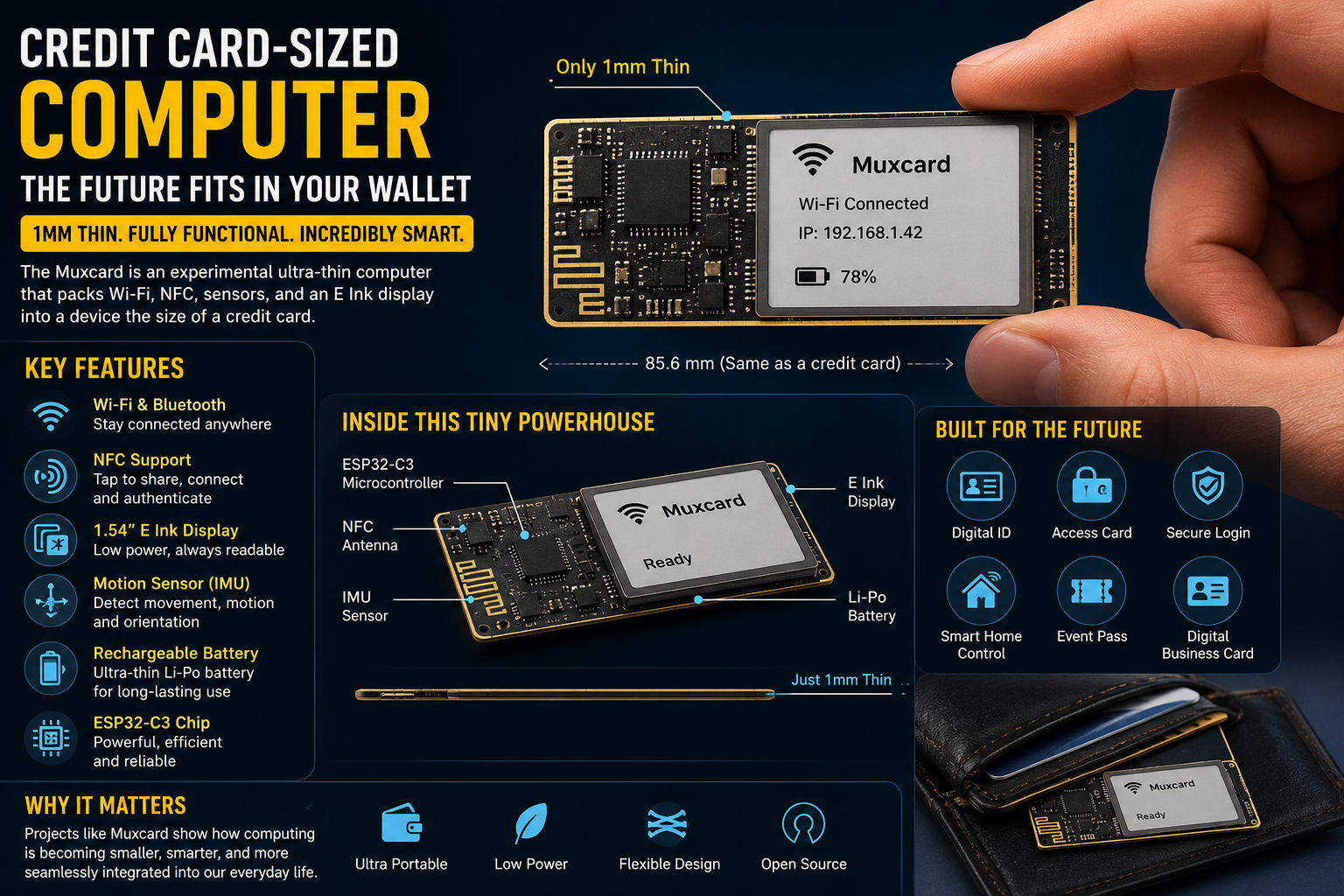
Created by hardware developer “krauseler,” this remarkable device is a fully functional computer that is almost the same size and thickness as a standard credit card. Despite measuring only around 1mm thick, the tiny computer includes wireless connectivity, NFC technology, sensors, a rechargeable battery, and even a flexible E Ink display.
The project has quickly captured attention across the tech community because it demonstrates how future computing devices could become nearly invisible in everyday life. Instead of carrying larger gadgets, people may eventually use smart devices integrated directly into objects already sitting in their wallets.
The Muxcard may still be an experimental prototype, but it offers an exciting glimpse into the future of ultra-portable computing technology.
What Is the Muxcard?
The Credit Card-Sized Computer Explained
The Muxcard is a compact open-source microcomputer designed to fit inside a wallet like a regular bank card. Unlike traditional computers or smartphones, the device focuses on extreme thinness and low-power efficiency while still delivering meaningful functionality.
At the heart of the Muxcard is the popular ESP32-C3 microcontroller, a low-power chip widely used in Internet of Things (IoT) devices and embedded systems. This tiny processor allows the card-sized computer to support Wi-Fi, Bluetooth, and wireless communication features.
The device also includes:
- A 1.54-inch flexible E Ink display
- NFC (Near Field Communication) support
- IMU motion sensors
- Bluetooth connectivity
- Wi-Fi networking
- Rechargeable lithium-polymer battery
- Flexible printed circuit boards (PCBs)
Combining all these technologies into a body only 1mm thick is an impressive engineering achievement. Most portable electronics require larger batteries, rigid components, and bulky connectors, making the Muxcard’s design especially innovative.
Why the E Ink Display Is So Important
E Ink Technology Helps Save Battery Power
One of the most interesting features of the Muxcard is its flexible E Ink display. Unlike traditional LCD or OLED screens, E Ink technology consumes almost no power while showing static information.
This makes E Ink displays perfect for ultra-thin devices with very limited battery capacity.
The same technology is commonly used in e-readers because the screen only consumes energy when changing content. Once an image or text appears on the display, it can remain visible without continuously draining the battery.
For a tiny computer like the Muxcard, this is critical.
Because ultra-thin batteries cannot store large amounts of energy, every power-saving feature matters. The low-energy design allows the device to stay functional for longer periods without frequent charging.
This combination of flexible electronics and low-power computing could influence the future of wearable technology, digital IDs, and smart authentication devices.
The Engineering Challenges Behind the Tiny Computer
Building a Flexible Computer Thin Enough for a Wallet
Creating a computer as thin as a credit card is far more complicated than simply shrinking components.
One of the biggest challenges involves durability. Wallets experience constant bending, pressure, twisting, and movement throughout daily use. Standard electronics can easily crack or fail under these conditions.
To solve this problem, the creator used flexible PCBs and separated delicate electronic components into small “islands” connected through bend-tolerant sections. This design reduces mechanical stress and helps protect sensitive hardware.
Another major obstacle involved integrating the E Ink display into such a thin frame. Traditional connectors were reportedly too large for the project, forcing the developer to hand-solder extremely small connections directly onto the display cable.
Battery limitations also created difficulties. Ultra-thin lithium-polymer batteries provide only limited power capacity, making efficient energy management essential.
These engineering breakthroughs show how flexible electronics and miniaturized hardware are advancing rapidly in the consumer technology industry.
Why Tiny Computers Could Become the Future of Smart Devices
The Rise of Invisible and Ambient Computing
Although the Muxcard is currently a DIY hardware project, it reflects a much larger trend in modern technology called ambient computing.
Ambient computing focuses on making technology blend seamlessly into everyday life. Instead of relying only on smartphones and laptops, future devices may exist quietly in objects people already use every day.
This could include:
- Smart wallets
- Digital ID cards
- Intelligent payment cards
- Secure authentication devices
- Interactive business cards
- Smart home access systems
- Wearable health trackers
The Muxcard demonstrates how computing power can become nearly invisible while remaining highly functional.
As electronics continue shrinking, people may carry multiple connected smart devices without even noticing them.
This shift could redefine how humans interact with technology over the next decade.
Potential Real-World Uses for a Credit Card-Sized Computer
How Ultra-Portable Computing Devices Could Be Used
The possibilities for a wallet-sized computer are surprisingly broad.
One practical application involves secure digital identification systems. Governments and organizations worldwide are increasingly exploring digital IDs and secure authentication tools. A low-power smart card with wireless connectivity could provide advanced identity verification while remaining extremely portable.
The Muxcard concept could also support:
Secure Two-Factor Authentication
Users could receive security codes or approval notifications directly on the E Ink display, improving cybersecurity and reducing reliance on smartphones.
Digital Business Cards
Professionals could share dynamic contact information through NFC technology instead of traditional paper cards.
Event Passes and Smart Tickets
Concert tickets, hotel access cards, conference badges, and transportation passes could become programmable and reusable.
Smart Home Controls
The device could act as a portable control panel for IoT-connected smart homes and automation systems.
Emergency Information Storage
Medical information, emergency contacts, or secure personal data could remain accessible even without internet connectivity.
These applications highlight how ultra-thin computing devices could eventually become part of everyday digital life.
Open-Source Hardware Is Driving Innovation
Developers Around the World Can Build Their Own Versions
Another reason the Muxcard project is attracting attention is because it is open-source.
The creator has reportedly published hardware files and firmware online for non-commercial use, allowing developers, makers, and electronics enthusiasts to experiment with their own designs.
Open-source hardware communities play a major role in driving innovation because they allow engineers worldwide to improve, modify, and test new ideas collaboratively.
Projects like this often inspire larger commercial technologies in the future.
Many modern innovations—including 3D printers, Raspberry Pi computers, and DIY smart home systems—began as enthusiast projects before evolving into mainstream technologies.
The Muxcard could follow a similar path as flexible electronics continue advancing.
The Future of Ultra-Thin Computing Technology
Flexible Electronics Could Transform Consumer Devices
The Muxcard is still an experimental prototype rather than a mass-market product, but it offers important insights into where the technology industry may be heading.
Several technologies are improving rapidly at the same time:
- Flexible circuit boards
- Ultra-thin batteries
- Low-power processors
- E Ink displays
- Wireless communication chips
- Internet of Things hardware
As these components become cheaper and more efficient, future consumer devices could become dramatically thinner and lighter than today’s smartphones and wearables.
Companies may eventually develop smart cards capable of handling payments, authentication, communication, and digital identity in a single ultra-portable device.
While widespread adoption may still take years, the foundation for that future is already being built today.
Conclusion
The Muxcard represents more than just a fascinating DIY electronics experiment. It demonstrates how modern engineering is pushing the boundaries of what portable computing can become.
By combining Wi-Fi, Bluetooth, NFC, sensors, battery technology, and an E Ink display into a device the size of a credit card, developers are opening the door to a new generation of invisible computing devices.
As flexible electronics and low-power hardware continue improving, wallet-sized smart devices could eventually become part of everyday life, transforming digital identity, authentication, communication, and personal technology.
The future of computing may not always involve bigger screens or more powerful phones. Instead, it could arrive in the form of tiny intelligent devices quietly sitting inside your wallet.