Why U.S.-Made Chips Still Travel to Taiwan Before Reaching You
Artificial intelligence is advancing at an incredible pace, powered by increasingly sophisticated microchips. But behind this progress lies a hidden challenge that most people rarely hear about—a critical step in chip production that could slow down the entire AI revolution.
This step is called advanced packaging, and it’s quickly becoming one of the biggest bottlenecks in the global semiconductor industry.
What Is Advanced Packaging and Why It Matters
When we think about chips, we usually imagine the process of manufacturing silicon wafers in high-tech factories. However, making the chip itself is only part of the story.
Once chips are created, they must be packaged into a usable form—something that can connect to computers, servers, smartphones, and AI systems. This process is known as advanced packaging, and it plays a crucial role in determining performance, efficiency, and scalability.
In simple terms, packaging is what allows chips to communicate with the outside world.
Today, as AI models grow larger and more complex, packaging is no longer just a final step—it has become a core part of chip design.
The Surprising “Round Trip” Problem
Even though the United States is investing heavily in chip manufacturing, there’s a major gap in the supply chain.
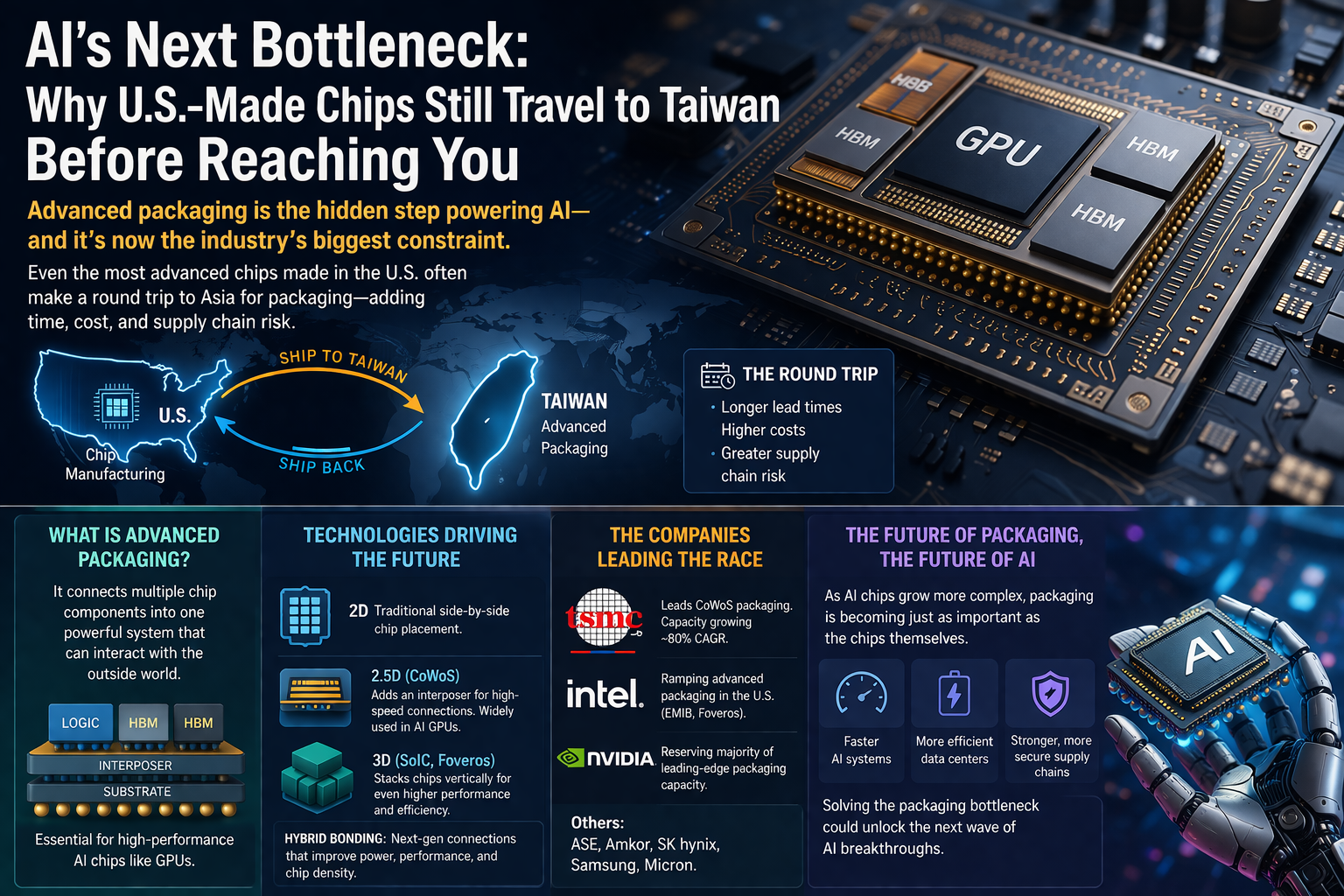
Most chips made in the U.S. still need to be sent to Asia—especially Taiwan—for packaging, and then shipped back again.
This “round trip” creates:
- Longer production times
- Higher costs
- Increased supply chain risks
The reason? Asia dominates advanced packaging capacity, and the U.S. is still catching up.
Why Advanced Packaging Is Becoming a Bottleneck
The demand for AI chips is exploding, and packaging capacity is struggling to keep up.
Industry experts warn that without massive investment, packaging could soon become a major constraint on AI growth.
Here’s why:
1. Rapid Growth in AI Demand
AI applications—from chatbots to autonomous vehicles—require powerful chips with high-speed memory and processing capabilities.
2. Increasing Chip Complexity
Modern AI chips are no longer single pieces of silicon. Instead, they combine multiple components such as:
- Logic chips
- High-bandwidth memory (HBM)
- Specialized accelerators
All of these must be tightly connected through advanced packaging.
3. Limited Global Capacity
Most advanced packaging facilities are located in Asia, and current capacity is already heavily booked.
The Rise of Technologies Like CoWoS
One of the most advanced packaging methods today is Chip-on-Wafer-on-Substrate (CoWoS).
This technology allows multiple chip components to be integrated into a single powerful unit—commonly used in GPUs designed for AI workloads.
Key benefits include:
- Faster data transfer between components
- Improved performance
- Reduced energy consumption
However, demand for this technology is so high that capacity is growing at an extremely rapid pace, yet still struggling to meet needs.
Why Big Tech Companies Are Racing for Capacity
Major players in the AI space are competing fiercely for access to advanced packaging.
- AI chip companies are reserving large portions of available capacity
- Cloud providers and tech giants are securing long-term partnerships
- New entrants are investing billions to ensure supply
This intense competition is making packaging just as important as chip manufacturing itself.
The U.S. Push to Build Local Packaging Facilities
To reduce reliance on Asia, companies are now expanding packaging capabilities in the United States.
Key Developments:
- New packaging plants are being built alongside chip fabrication facilities
- Investments are flowing into states like Arizona and Texas
- Companies are trying to integrate design, manufacturing, and packaging in one place
This shift could:
- Shorten production cycles
- Reduce shipping delays
- Strengthen supply chain security
However, these facilities will take time to become fully operational.
From 2D to 3D: The Future of Chip Packaging
Packaging technology is evolving rapidly, moving beyond traditional designs.
2D Packaging
- Chips placed side by side
- Suitable for simpler processors
2.5D Packaging
- Adds an interposer layer for better connectivity
- Enables high-performance GPUs and AI chips
3D Packaging (Next Generation)
- Chips stacked vertically
- Shorter connections = faster performance
- Higher density and efficiency
This transition to 3D packaging is often described as the next phase of Moore’s Law, pushing performance beyond traditional limits.
New Innovations: Hybrid Bonding
Another breakthrough in packaging is hybrid bonding, which replaces traditional connections with ultra-close copper-to-copper links.
Benefits include:
- Better electrical performance
- Lower power consumption
- Higher chip density
This technology is expected to play a major role in future AI hardware.
Why This Bottleneck Matters for the Future of AI
Advanced packaging may not get as much attention as chip design, but it is becoming one of the most critical factors in AI development.
If packaging capacity doesn’t scale fast enough, it could:
- Slow down AI innovation
- Increase costs of AI hardware
- Delay deployment of new technologies
On the other hand, solving this bottleneck could unlock:
- Faster AI systems
- More efficient data centers
- Breakthroughs in computing power
Final Thoughts
The global race for AI dominance is not just about designing better chips—it’s about building a complete and resilient supply chain.
Advanced packaging, once considered an afterthought, is now at the center of this transformation.
As companies invest billions to expand capacity and develop next-generation technologies, one thing is clear:
The future of AI depends not just on how chips are made—but on how they are put together.