
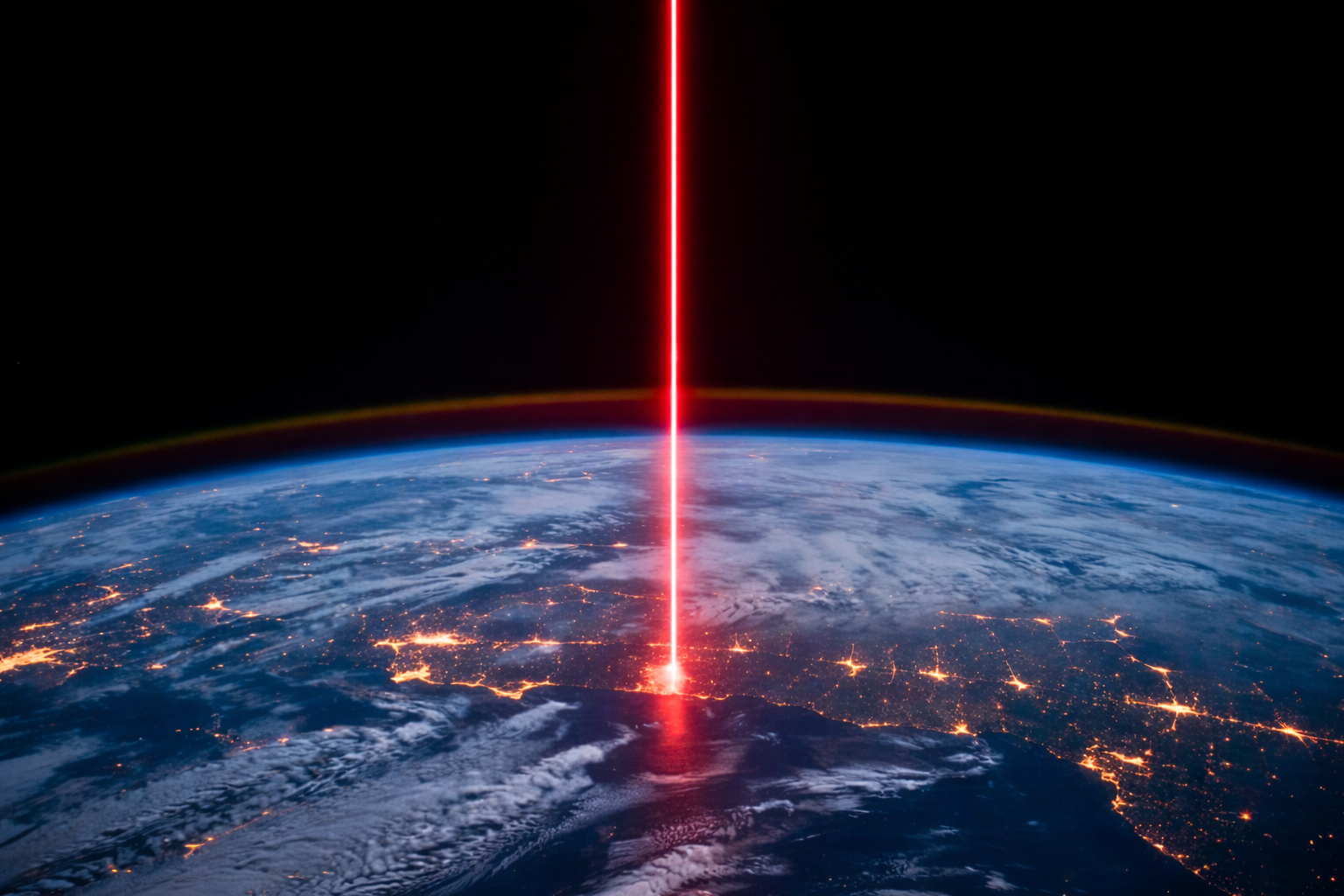
Astronomers Detect a Powerful ‘Mega-Laser’ Signal from 8 Billion Light-Years Away
An incredible cosmic signal that is much brighter than scientists anticipated has been found by astronomers traversing over 8 billion light-years. The signal appears as a razor-thin radio emission that, despite its great distance, does not fade, according to the powerful MeerKAT Radio Telescope.
This extraordinary detection has led scientists to describe the phenomenon as a cosmic “mega-laser”, though technically it is a maser, a naturally occurring amplifier of radio waves in space. The discovery could reshape our understanding of distant galaxies, molecular clouds, and powerful cosmic amplifiers.
The Mysterious Signal from a Distant Galaxy
HATLAS J142935.3–002836, a far-off galaxy system with a redshift of 1.027, was identified as the source of the unique signal.
This indicates that the radio waves started their journey when the universe was much younger than it is now, placing the galaxy more than 8 billion light-years away. The signal contained
important details on the state of galaxies billions of years ago by the time it reached Earth.
The signal’s intensity and sharpness were what most perplexed researchers.
Radio transmissions that reach very great distances typically become incredibly weak and fuzzy. Rather, this signal was narrow, clear, and surprisingly bright, indicating that it was being amplified by something strong.
The 18-Centimeter Clue: Hydroxyl Molecules in Space
Scientists quickly noticed a crucial detail about the signal — its wavelength of about 18 centimeters.
This specific radio wavelength is strongly linked to hydroxyl (OH) molecules, which consist of oxygen and hydrogen atoms. In large molecular clouds, hydroxyl molecules can behave in a unique way: they amplify radiation at specific frequencies.
This amplification process is similar to how lasers work.
However, instead of visible light, the phenomenon occurs in microwave or radio wavelengths, creating what astronomers call a maser — short for Microwave Amplification by Stimulated Emission of Radiation.
When this effect occurs on a massive scale inside distant galaxies, it is known as a hydroxyl megamaser.
In this case, the signal appears even more powerful, leading researchers to suggest a new classification: gigamaser.
What Is a Cosmic Maser?
A cosmic maser works in a way similar to a laboratory laser but at radio frequencies.
The process occurs when:
- Molecules such as hydroxyl become energized in dense gas clouds
- These molecules emit radiation at very specific frequencies
- The radiation stimulates other molecules to emit identical waves
- The signal becomes amplified and highly focused
The result is a bright, narrow radio emission that can travel across enormous cosmic distances.
The newly detected signal includes the classic hydroxyl lines near:
- 1667 MHz
- 1665 MHz
These are the standard spectral fingerprints astronomers use to identify hydroxyl megamasers in distant galaxies.
A Violent Galaxy Merger Powers the Signal
The galaxy system producing the signal is believed to be undergoing a massive galactic merger.
When galaxies collide, several extreme processes occur:
- Gas clouds become compressed and turbulent
- Massive star-forming regions ignite
- Molecular gases accumulate in dense dusty clouds
These conditions are ideal for creating powerful masers.
According to researchers studying the system, the merging galaxies are forming stars at an exceptionally high rate. This intense activity likely provides the energy needed to pump hydroxyl molecules into an amplified emission state.
As one researcher described it, the observation is essentially the radio equivalent of a laser shining across half the universe.
The Role of Gravitational Lensing
Another reason the signal appears so bright is due to a fascinating cosmic phenomenon called gravitational lensing.
Between Earth and the distant galaxy lies another massive galaxy that bends space-time through gravity. This effect acts like a natural magnifying lens, bending and focusing light from the distant source toward us.
This cosmic magnification makes the signal appear far brighter than it would normally be.
Gravitational lensing can:
- Increase the apparent brightness of distant objects
- Distort galaxy shapes
- Reveal objects that would otherwise be too faint to detect
In this case, the foreground galaxy essentially acts as a cosmic telescope, allowing astronomers to detect the distant maser signal.
A Discovery Made Possible by the MeerKAT Telescope
The discovery was made using the MeerKAT Radio Telescope, located in South Africa.
MeerKAT is one of the world’s most advanced radio telescope arrays and is operated by the South African Radio Astronomy Observatory.
The system consists of dozens of dishes working together as a single instrument, allowing astronomers to detect extremely faint radio signals from deep space.
Surprisingly, scientists were able to confirm the signal with only a few hours of observation time.
This suggests that similar discoveries may be waiting to be found in future surveys.
Additional Clues from Hydrogen Gas
Alongside the hydroxyl emission, researchers also detected absorption from neutral hydrogen gas.
Neutral hydrogen, often abbreviated H I, is one of the most common elements in the universe and is widely used to trace the structure of galaxies.
The presence of hydrogen absorption indicates that the galaxy system contains multiple layers of gas, including both molecular and atomic components.
Together, these observations provide a clearer picture of how galaxies evolve during major mergers.
Why This Discovery Matters
This detection is significant for several reasons.
Understanding Early Universe Galaxies
The signal comes from a time when the universe was much younger, providing a window into galaxy evolution billions of years ago.
Studying Extreme Cosmic Amplifiers
The discovery may represent one of the most powerful hydroxyl masers ever observed, possibly belonging to a new class called gigamasers.
Testing Radio Telescope Capabilities
The observation demonstrates the incredible sensitivity of modern instruments like MeerKAT, suggesting that future surveys may detect many more distant masers.
Revealing Hidden Cosmic Activity
Because masers trace dense molecular gas and star formation, they help astronomers identify galaxies undergoing intense transformation.
The Future of Cosmic Maser Research
Astronomers believe this discovery may only be the beginning.
With next-generation radio observatories and large sky surveys, scientists expect to uncover many more distant megamasers and gigamasers.
Future instruments such as the Square Kilometre Array could push these discoveries even further, detecting signals from galaxies formed in the earliest epochs of the universe.
These observations will help researchers understand:
- How galaxies merge and evolve
- How star formation progresses in extreme environments
- How molecular gas behaves across cosmic time
Final Thoughts
The detection of a powerful cosmic “mega-laser” signal from more than 8 billion light-years away highlights the incredible capabilities of modern radio astronomy.
What initially appeared as a mysterious bright radio line has now revealed itself as a massively amplified hydroxyl maser powered by a galaxy merger and boosted by gravitational lensing.
This remarkable discovery not only provides a glimpse into the distant universe but also opens new pathways for exploring the most energetic and dynamic processes shaping galaxies across cosmic history.