Can a Failing Satellite Be Saved Before It Falls?
NASA is attempting to save the Neil Gehrels Swift Observatory, one of its oldest and most valuable astronomy satellites, through a daring and urgent space mission. The spacecraft is currently losing altitude after more than 20 years in orbit, and it may return to Earth’s atmosphere in a matter of months.
NASA is attempting a robotic rescue mission in an unprecedented move with a private company. This is a high-risk, high-reward operation that has the potential to completely change satellite servicing in the future.
Why the Swift Observatory Matters
Launched in 2004, the Neil Gehrels Swift Observatory has played a critical role in studying gamma-ray bursts, the most powerful explosions in the universe.
Key Contributions:
- Detects sudden cosmic explosions in real time
- Quickly reorients itself to observe fading signals
- Provides multi-wavelength data for global observatories
Gamma-ray bursts occur when:
- Massive stars collapse into black holes
- Neutron stars collide
- Black holes merge
Despite its age, Swift remains irreplaceable, with no current U.S. satellite offering the same capabilities.
The Problem: A Satellite Falling Out of Orbit
Swift operates in low Earth orbit, where even thin atmospheric particles create drag. Over time, this drag slows the satellite and causes it to lose altitude.
Recent solar activity has worsened the situation:
- Increased geomagnetic storms
- Expansion of Earth’s atmosphere
- Higher drag on satellites
Engineers now estimate Swift could reenter Earth’s atmosphere between late July and October, unless action is taken quickly.
The Rescue Plan by Katalyst Space Technologies
NASA has awarded a $30 million contract to Katalyst Space Technologies to attempt a rescue mission.
Mission Overview:
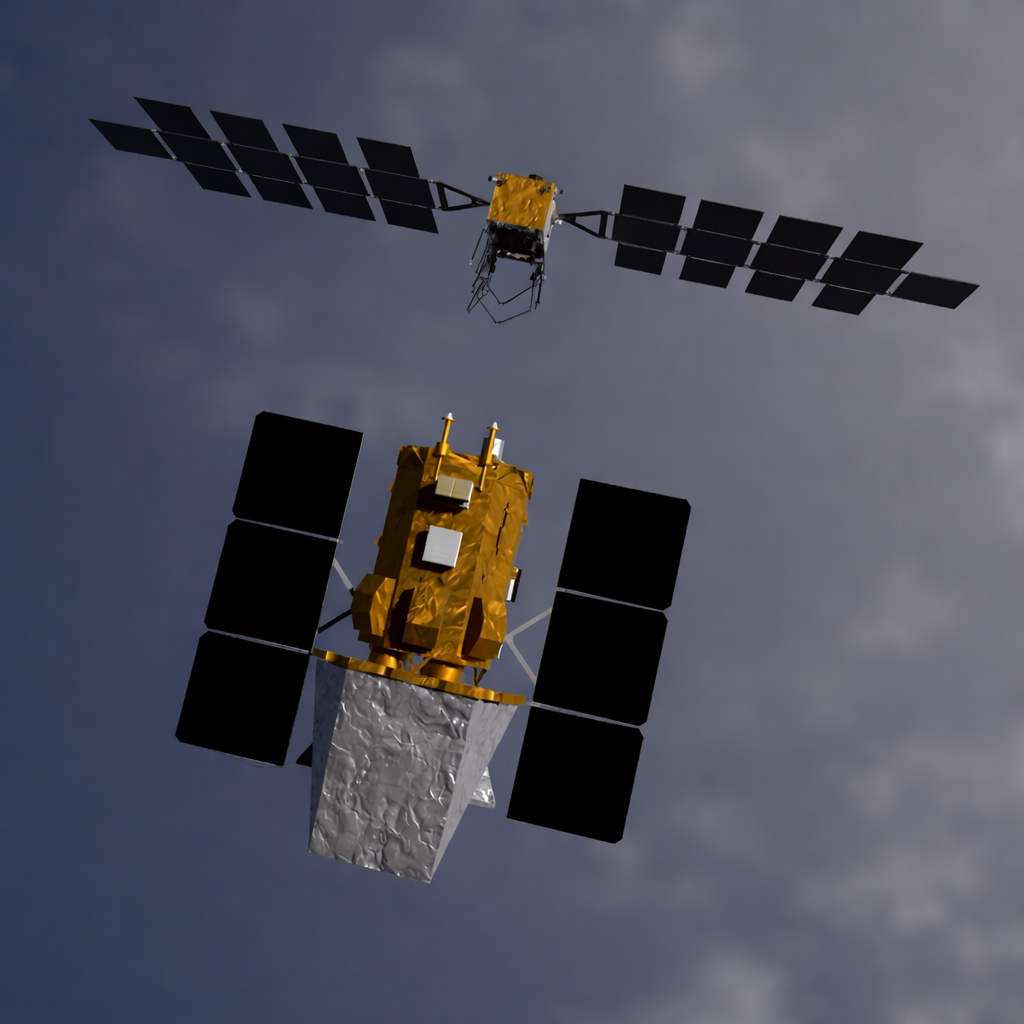
- Launch a robotic spacecraft named Link
- Rendezvous with the Swift satellite
- Dock using robotic arms
- Raise its orbit (reboost)
If successful, this mission could extend Swift’s life and continue its scientific discoveries.
Why This Mission Is Extremely Challenging
This rescue mission is unlike anything attempted before.
Major Challenges:
- Swift Was Not Designed for Docking
The satellite has no docking ports or capture points. - Tight Timeline
Katalyst has just nine months to design, build, test, and launch the mission. - Unknown Satellite Condition
After 21 years in space:- Surface materials may be damaged
- Insulation may be brittle
- Structural integrity is uncertain
- Precision Required in Orbit
Docking two spacecraft in low orbit requires extreme accuracy and coordination.
Cutting-Edge Technology: Robotic Arms in Space
The Link spacecraft will use three robotic arms equipped with gripping mechanisms to capture Swift.
Engineers face multiple uncertainties:
- No complete images of Swift’s current condition
- Degraded materials due to radiation and atomic oxygen
- Risk of surfaces breaking during contact
To overcome this, Katalyst has designed a flexible and adaptive system capable of handling different scenarios.
A New Era of Commercial Space Rescue Missions
This mission represents a shift in how space agencies operate.
Instead of building and launching a new satellite, NASA is:
- Partnering with private companies
- Reducing costs
- Accepting higher levels of risk
This approach is similar to NASA’s commercial partnerships for:
- Cargo missions
- Crew transportation
Only Northrop Grumman has successfully completed a commercial satellite servicing mission before, making this attempt even more significant.
Launch Details: Why Pegasus Rocket Was Chosen
Interestingly, the mission will not use a modern heavy-lift rocket like the Falcon 9.
Instead, Katalyst selected the Pegasus XL rocket, known for:
- Air-launch capability
- Flexibility for unique orbital paths
- Suitability for smaller payloads
The rocket will be launched from an aircraft near the equator, allowing precise alignment with Swift’s orbit.
This may also be the final mission for Pegasus, marking the end of an era in space launch history.
High Risk, High Reward Mission
Katalyst’s CEO, Ghonhee Lee, openly acknowledges the risks:
- No guarantee of success
- Limited time window
- Complex engineering challenges
However, the potential rewards are enormous:
- Extending a valuable scientific mission
- Demonstrating new space servicing capabilities
- Opening doors for future satellite repairs and upgrades
What Happens If the Mission Fails?
If the rescue mission does not succeed:
- Swift will eventually reenter Earth’s atmosphere
- Most of it will burn up
- Its scientific mission will end
However, even a failed attempt would provide valuable data for future missions.
The Bigger Picture: Future of Space Exploration
This mission could mark the beginning of a new space industry focused on:
- Satellite repair and maintenance
- Orbital refueling
- Debris removal
- Extending spacecraft lifespans
Companies are increasingly investing in rendezvous and proximity operations (RPO), a key technology for future space missions.
Final Thoughts
The race to save the Neil Gehrels Swift Observatory is more than just a rescue mission—it’s a test of innovation, speed, and risk-taking in modern space exploration.
With NASA and Katalyst Space Technologies working against the clock, the coming months will determine whether this aging satellite gets a second life—or becomes a fiery reminder of the challenges of space.
Either way, this mission is set to shape the future of how we manage and sustain satellites in orbit.