
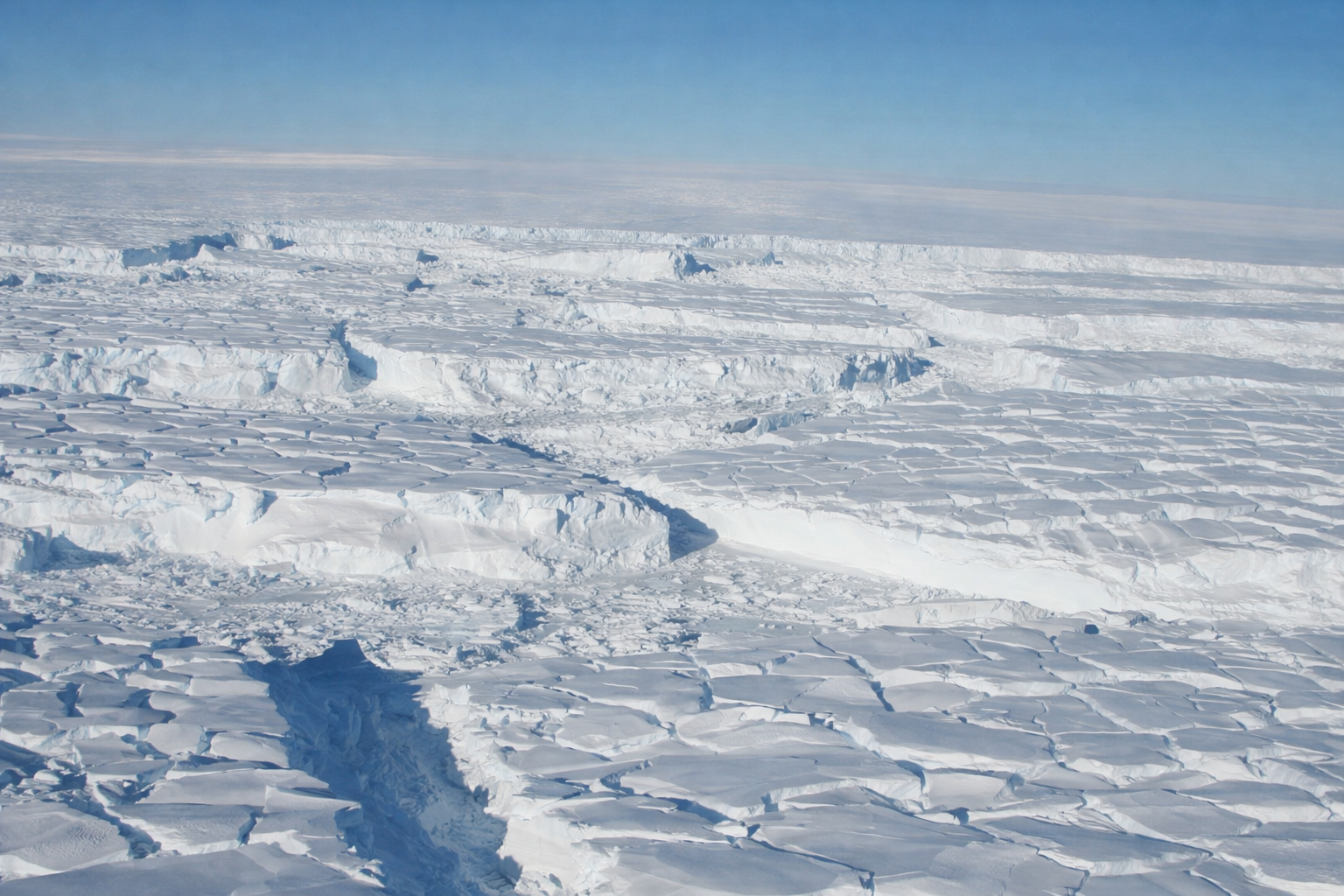
A surprisingly lush and rocky landscape hidden beneath kilometers of ice has been revealed by researchers who have produced the most comprehensive map of the ground beneath Antarctica’s massive ice sheet to date.
Over five million square miles make up the largest single ice sheet on Earth.
The hidden terrain is not simply the flat, featureless base that was long thought to exist; it also consists of mountains, deep valleys, plains, and tens of thousands of previously undiscovered hills.
The results, according to scientists, may aid in forecasting how the ice sheet would react to warming.
In order to predict the geometry of the ground below, the scientists used a technique called Ice Flow Perturbation Analysis, which combines high-resolution satellite images with the physics of ice movement and ice surface properties.
This method enables researchers to deduce subglacial topography in areas that have not yet been directly measured by radar.
“I’m just so excited to look at that and just see the whole bed of Antarctica at once,” said Professor Robert Bingham, a glaciologist at the University of Edinburgh who co-authored the study.
Under the current miles-thick layer of ice, he stated: “Over millions of years, Antarctica’s ice sheet has sculpted a landscape consisting variously of flat plains, dissected plateaus, and sharp mountains.”
“This technique allows us to observe the relative distributions of these highly variable landscapes across the entire continent for the first time.”
Tens of thousands of hitherto unknown hills and ridges have been found using the new technique, which has also given further details about several of those mountains and canyons hidden beneath the ice.
A researcher at the University of Grenoble-Alpes and lead author Dr. Helen Ockenden stated: “I think it’s just really super interesting to look at all these new landscapes and see what’s there.”
It seems unlikely that the study, which was published in the scholarly magazine Science, would offer a conclusive explanation for what is beneath the ice.