
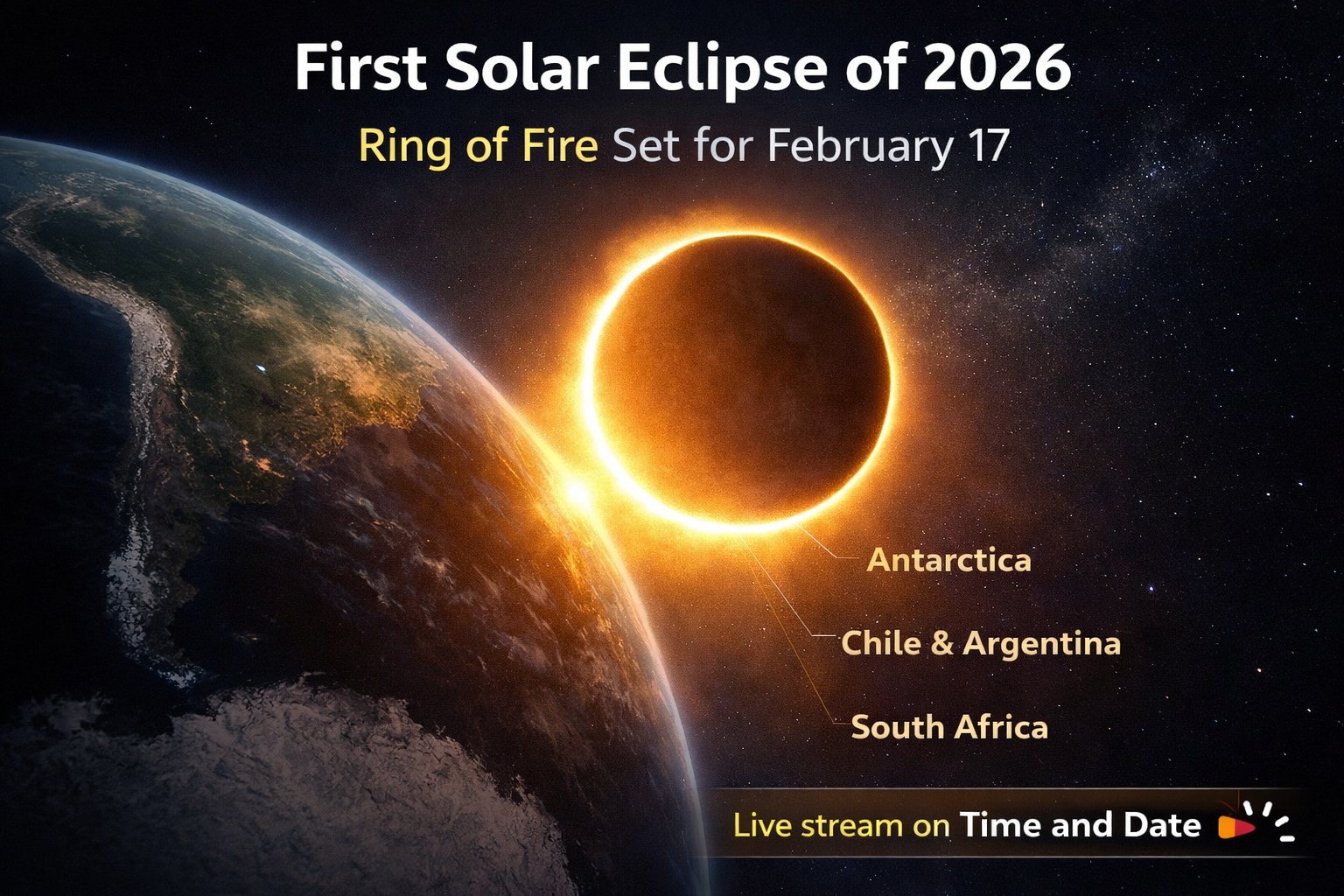
Ring of Fire to Appear on February 17
Skywatchers around the world are gearing up for a spectacular celestial event as the first solar eclipse of 2026 is set to occur on February 17. This eclipse will take the form of a rare and visually stunning annular solar eclipse, often called the “Ring of Fire”, when the Moon partially covers the Sun, leaving a bright circle of sunlight visible around its edges.
Although not visible from every part of the world, the event is expected to attract global attention through live streams and scientific coverage.
What Is an Annular Solar Eclipse?
An annular solar eclipse happens when the Moon moves between the Earth and the Sun while it is at its farthest distance from Earth. Because of this distance, the Moon appears slightly smaller in the sky and cannot completely block the Sun. As a result, a glowing ring of sunlight remains visible, creating the dramatic Ring of Fire effect.
Astronomers explain that during the peak of the February 17 eclipse, nearly 96 percent of the Sun will be covered by the Moon. The most breathtaking phase of the eclipse is expected to last up to two minutes, offering a brief but unforgettable display for those in the right locations.
Where and When Will the Eclipse Be Visible?
According to the official schedule, the solar eclipse will begin at 12:01 pm Pakistan Standard Time (PST) on February 17, 2026. However, visibility will vary greatly depending on location.
- Antarctica will be the only region to witness the full annular “Ring of Fire.”
- Chile, Argentina, and parts of South Africa will experience a partial solar eclipse.
- Most of Asia, including Pakistan, will not have a direct view of the eclipse.
Despite this, viewers in Pakistan and other regions outside the visibility zone won’t miss out entirely. The event will be available via live streaming on the Time and Date website, allowing astronomy enthusiasts to follow the eclipse safely from home.
Safety Precautions for Watching a Solar Eclipse
Experts strongly warn against looking directly at the Sun during a solar eclipse without proper eye protection. Even when most of the Sun is covered, direct viewing can cause serious and permanent eye damage.
To observe the eclipse safely, astronomers recommend using certified solar viewing glasses or approved solar filters. Regular sunglasses, cameras, or telescopes without solar filters should never be used to view the Sun.
A Celestial Event Worth Watching
While the February 17, 2026 solar eclipse may not be visible everywhere, it remains an important astronomical event. Whether viewed in person from the Southern Hemisphere or online through live streams, the Ring of Fire eclipse is a reminder of the awe-inspiring movements of our solar system.