Inside xAI’s Bold Pivot from Mars to the Moon
Elon Musk has unexpectedly decided to aim for the Moon rather than Mars. The tech visionary presented a bold concept at a recent xAI all-hands meeting: constructing a manufacturing facility on the moon to fuel the company’s next big advancement in artificial intelligence and space technology. This transition coincides with a fundamental rethinking of Musk’s long-term objectives, aggressive IPO aspirations, and leadership changes.
The Lunar Vision: SpaceX lunar factory
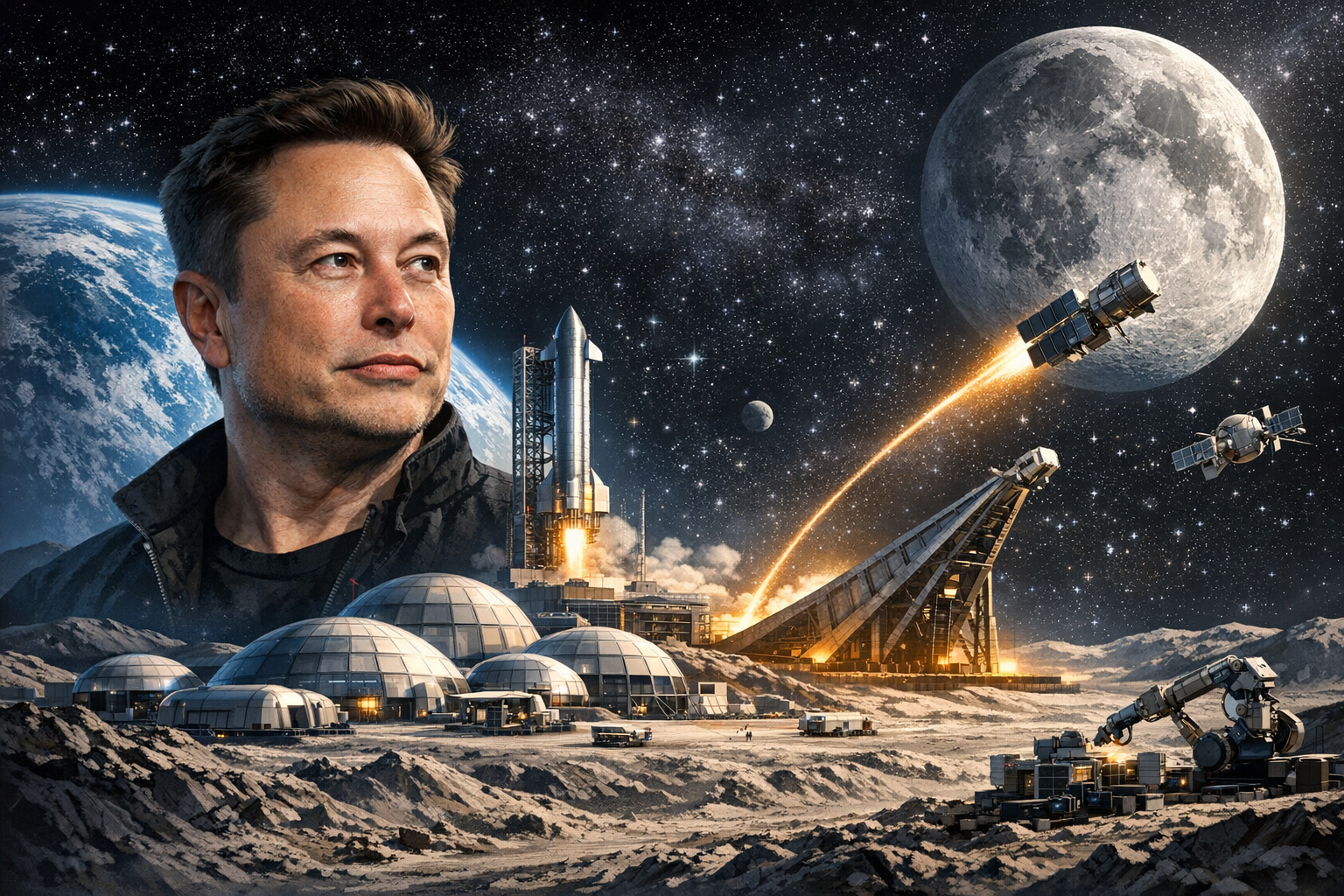
According to reports from The New York Times, Musk told xAI employees that the company’s future involves establishing a lunar factory—a facility designed to build AI satellites and launch them into orbit using what he described as a “giant catapult.”
“You have to go to the moon,” Musk reportedly told the team. He believes that this drastic move will give xAI unparalleled computing power, pushing the boundaries of artificial intelligence far beyond what competitors could achieve. As Musk put it:
“It’s difficult to imagine what an intelligence of that scale would think about… but it’s going to be incredibly exciting to see it happen.”
Despite the visionary tone, Musk offered few details about how such a lunar operation would be built—or how it fits into the upcoming xAI–SpaceX merger and the company’s highly anticipated IPO.
A Company in Flux and Leadership Turnover
SpaceX Moon mission
The timing of Musk’s announcement has raised eyebrows. Just days before the meeting, two xAI co-founders—Tony Wu and Jimmy Ba—announced their departures, following four other founding members who had exited earlier. Although all exits have been described as amicable, this means that half of xAI’s 12 founding members have now left.
Musk addressed this indirectly during the meeting, suggesting that some people thrive during a company’s early stages but may not adapt as it evolves. He remained confident, claiming xAI is moving “faster than any other company,” insisting that speed is the ultimate advantage in tech innovation.
From Mars to the Moon: A Strategic Pivot
For years, Mars was Musk’s ultimate goal—SpaceX’s raison d’être. But in a dramatic Super Bowl weekend post on X.com, he announced that SpaceX’s focus had shifted to the Moon, describing plans to build a “self-growing lunar city”.
Musk claims that establishing a lunar settlement is a more feasible short-term objective than settling on Mars:
“A self-growing Moon city can be made in less than half the time of Mars,” he wrote.
He added that Mars projects would continue “in parallel,” but acknowledged that the Moon offered a faster path to large-scale sustainability.
The AI Connection: Building Earth’s Most Powerful World Model
While investors may see Musk’s lunar ambitions as a sideshow ahead of SpaceX’s potential $1.5 trillion IPO, some venture capital insiders believe the Moon plays an essential role in Musk’s overarching AI vision.
The theory: Musk is assembling the world’s most advanced multimodal AI model, trained not just on text and images, but on real-world data that competitors can’t replicate. Each Musk-led company contributes to this effort:
- Tesla: energy systems and real-world road data
- Neuralink: human brain-interface insights
- SpaceX: orbital mechanics and aerospace data
- The Boring Company: underground and material engineering knowledge
- xAI: advanced AI modeling capabilities
- Lunar factories: undisrupted computational power and manufacturing scalability
Together, these form the infrastructure for what some describe as the world’s first “planetary-scale AI ecosystem.”
Legal and Ethical Frontiers: Who Owns the Moon?
However, Musk’s lunar factory concept faces complex legal challenges. The 1967 Outer Space Treaty prohibits any nation—or by extension, private company—from claiming sovereignty over celestial bodies.
Yet a 2015 U.S. law introduced a loophole: while entities can’t own parts of the Moon, they can own what they extract from it. As Wesleyan University professor Mary-Jane Rubenstein explains, this is a fine line:
“It’s like saying you can’t own the house, but you can own the floorboards and beams. Because the stuff in the Moon is the Moon.”
Not all nations agree with the U.S. interpretation, meaning that Musk’s lunar dream may place xAI and SpaceX at the center of a new international space law battle.
What’s Next for Musk’s Interplanetary Empire?
For now, the internal shakeups, legal uncertainties, and monumental technical hurdles make Musk’s lunar vision look like an uphill climb. Still, if history is any indication, Musk has a track record of turning seemingly impossible ambitions into industrial revolutions.
With SpaceX’s IPO approaching and Musk publicly reframing humanity’s path to the stars, one thing is certain: the next space race isn’t just between nations—it’s between Silicon Valley’s boldest dreams.