Cosmic Predators: How Supermassive Black Holes Suppress Star Formation Across Galaxies
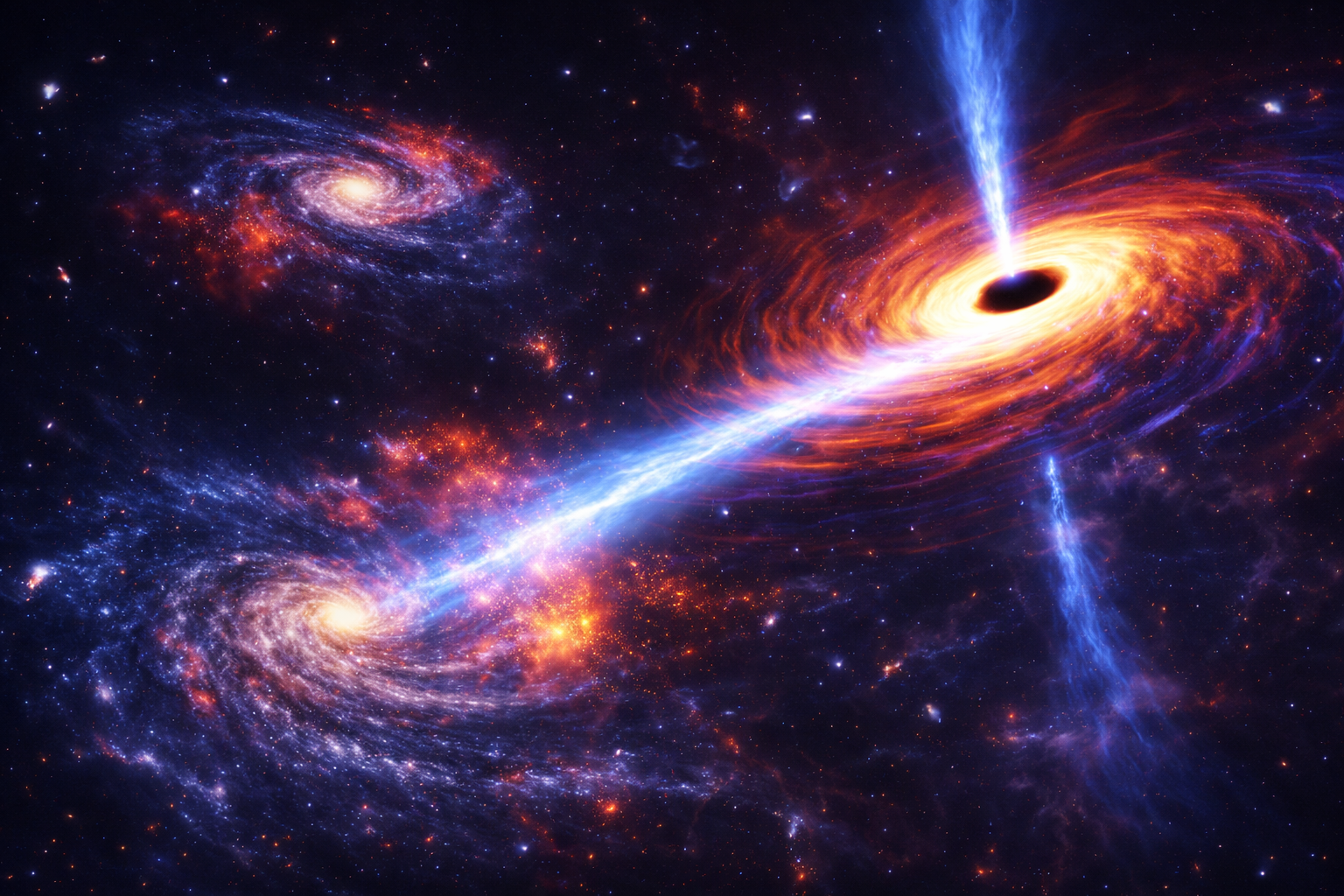
Supermassive black holes are often portrayed as destructive cosmic giants lurking at the centers of galaxies. But new research suggests their influence stretches far beyond their host galaxies—shaping the growth of stars across millions of light-years.
A groundbreaking study led by Yongda Zhu of the University of Arizona reveals that intense radiation from active supermassive black holes can suppress star formation not just locally, but also in neighboring galaxies. This discovery reshapes our understanding of galaxy evolution and introduces a compelling concept: the “galaxy ecosystem.”
A New View of Galaxy Evolution: The “Galaxy Ecosystem”
For many years, astronomers thought that because galaxies are so far apart, they developed mostly in isolation. This recent study, however, casts doubt on that presumption.
Zhu likens the phenomenon to Earth’s interdependent ecosystems. According to this cosmic comparison, an active supermassive black hole consumes matter and modifies its surroundings, acting as a dominant predator.
Galaxies might be a part of an interdependent system where strong quasars control star formation well beyond their own boundaries, rather than functioning independently.
What Are Supermassive Black Holes?
Black holes were first predicted in the early 1900s and remain among the most fascinating and extreme objects in the universe. While regular black holes form from collapsing stars, supermassive black holes contain millions or even billions of times the mass of our Sun.
Nearly every galaxy, including the Milky Way, is believed to harbor one at its center.
Although black holes themselves are invisible, they can become extraordinarily bright when actively feeding on surrounding matter. During this phase, they are known as quasars—some of the most luminous objects in the observable universe.
The Role of Quasars in Star Formation Suppression
When a supermassive black hole enters its quasar phase, it emits enormous amounts of energy. In fact, some quasars outshine their entire host galaxy.
The research team focused on one of the brightest quasars ever discovered:
J0100+2802, powered by a black hole roughly 12 billion times the mass of the Sun.
Light from this quasar dates back to when the universe was less than one billion years old—offering a rare glimpse into the early universe.
How Radiation Halts Star Formation
Stars form from vast clouds of cold molecular hydrogen gas. These clouds must remain cool and dense to collapse under gravity and ignite nuclear fusion.
However, radiation from an active quasar:
- Heats surrounding gas
- Splits molecular hydrogen
- Disrupts cold gas reservoirs
- Prevents the formation of new stars
The study found that galaxies within a million-light-year radius of J0100+2802 exhibited weaker O III emissions—an indicator of reduced recent star formation.
This suggests that the quasar’s radiation suppressed star growth not only within its host galaxy but also across neighboring galaxies.
The James Webb Space Telescope’s Breakthrough Role
This discovery would not have been possible without the James Webb Space Telescope (JWST).
As the universe expands, light from distant objects stretches into longer, infrared wavelengths—a process known as redshift. Previous telescopes lacked the sensitivity to detect these faint infrared signals from early-universe galaxies.
JWST’s advanced infrared capabilities allowed researchers to:
- Detect O III emissions
- Measure ultraviolet light from distant galaxies
- Compare star formation rates near powerful quasars
- Confirm suppressed stellar growth on an intergalactic scale
Early JWST observations had initially puzzled astronomers by showing fewer galaxies near enormous quasars. The new study suggests those galaxies were present—but their recent star formation had been quenched, making them harder to detect.
Intergalactic Impact: A First-of-Its-Kind Discovery
Scientists already understood that quasars could shut down star formation in their own galaxies. What remained unclear was whether this destructive influence extended beyond their galactic boundaries.
For the first time, researchers now have evidence that quasar radiation impacts galaxies at least a million light-years away.
This finding significantly alters models of cosmic evolution. It implies that supermassive black holes may have played a far larger role in shaping the early universe than previously thought.
Did the Milky Way Experience a Quasar Phase?
Our own galaxy likely hosted an active quasar in its early history. Although the Milky Way’s central black hole is relatively quiet today, it may once have emitted intense radiation.
Researchers are now exploring:
- How a past quasar phase may have influenced the Milky Way’s star formation
- Whether neighboring early galaxies were similarly affected
- How widespread this intergalactic suppression phenomenon may be
Understanding these early interactions helps astronomers piece together how galaxies—including our own—came to evolve as they did.
Why This Discovery Matters
This research has profound implications for:
- Galaxy formation theory
- Early universe cosmology
- Dark matter and gas distribution studies
- Supermassive black hole growth models
Rather than being passive cosmic anchors, supermassive black holes may actively regulate star formation across entire galactic neighborhoods.
In essence, they are not just gravitational giants—they are cosmic ecosystem engineers.
The Future of Black Hole Research
The next step is determining whether this phenomenon is common across other quasar regions. By studying additional quasar fields with JWST, astronomers aim to understand:
- How frequently quasars suppress neighboring star formation
- Whether radiation intensity determines impact radius
- What other environmental factors contribute
As observations continue, we may find that supermassive black holes were central architects of structure in the early universe.
Final Thoughts: Cosmic Predators Shaping the Universe
The idea of supermassive black holes as “cosmic predators” offers a powerful new lens through which to understand galaxy evolution.
Far from evolving independently, galaxies may be deeply interconnected—bound not only by gravity, but by radiation, energy flows, and the immense power of quasars.
Thanks to the James Webb Space Telescope and cutting-edge infrared astronomy, we are entering a new era of cosmic discovery—one that reveals a universe far more dynamic and interconnected than we ever imagined.