
Astronomers Unveil New Method to Measure Cosmic Expansion Using Gravitationally Lensed Supernovae
Astronomers have discovered a new method to estimate cosmic expansion using a rare gravitationally lensed supernova, which could fundamentally alter our understanding of the Universe. The ongoing Hubble Tension is one of the greatest mysteries of contemporary cosmology, and this novel approach may help solve it.
A Superluminous Supernova 10 Billion Light-Years Away
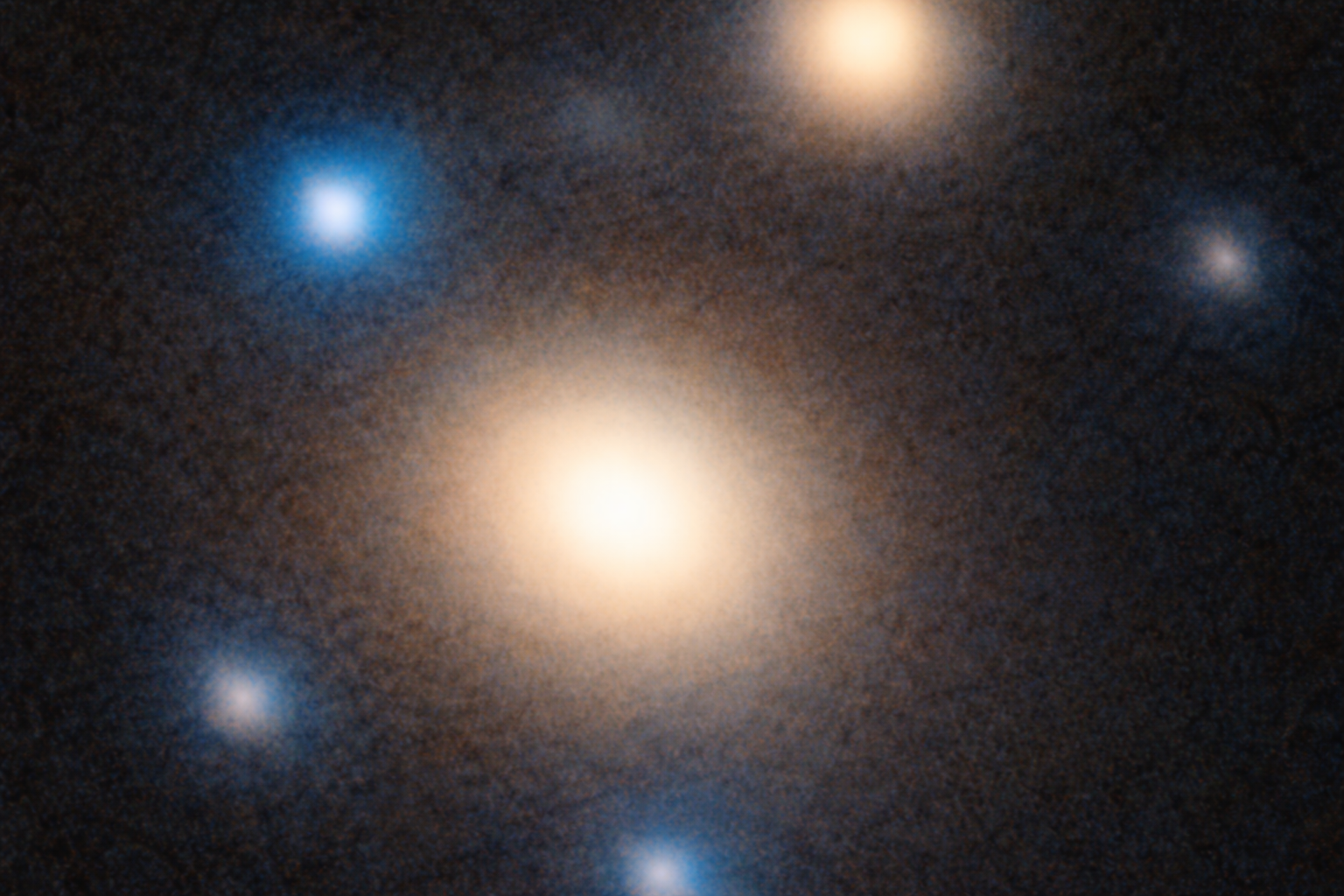
An international research team led by scientists from the Technical University of Munich and the Max Planck Institute for Astrophysics observed a spectacular superluminous supernova located 10 billion light-years from Earth. Using the powerful Large Binocular Telescope (LBT), the team captured an extraordinary phenomenon: the same stellar explosion appearing five times in the night sky.
This rare event occurred due to gravitational lensing, where two foreground galaxies bent the supernova’s light as it traveled toward Earth. Because the light followed different paths of varying lengths, the explosion appeared in multiple positions around the galaxies at different times — creating a breathtaking, fireworks-like display.
Measuring the Hubble-Lemaître Constant in a New Way
By carefully measuring the time delays between the five images, researchers were able to calculate the Hubble-Lemaître Constant, which describes how fast the Universe is expanding. This method differs significantly from traditional approaches.
Currently, astronomers rely mainly on two techniques:
- The Cosmic Distance Ladder, which uses parallax, redshift, and standard candles like supernovae to measure distances step by step.
- Observations of the Cosmic Microwave Background (CMB), the relic radiation from the Big Bang.
- The Hubble Tension is the difference between the two approaches’ somewhat different
estimates of the universe’s expansion rate.
A third, independent method is provided by the gravitationally lensed supernova approach. It is a one-step procedure, in contrast to the cosmic distance ladder. Scientists can directly calculate the expansion rate with fewer systematic uncertainty by modeling the mass distribution of the lensing galaxies.
Why This Discovery Matters
Because gravitationally lensed supernovae are so uncommon, this observation is especially important. Instead of producing five images, the majority of galaxy-scale lens systems only produce two or four. The first comprehensive model of the lens mass distribution was created by junior researchers Allan Schweinfurth and Leon Ecker, enabling accurate computations of the cosmic expansion rate.
Accepted for publication in Astronomy & Astrophysics, the study may offer vital information to settle arguments on the evolution of the universe. This new method is based on direct observational physics, in contrast to CMB observations, which mainly rely on early-Universe theories.
Astronomers worldwide are now closely monitoring the supernova — nicknamed SN Winny — using both ground-based and space telescopes. Their findings may refine our understanding of dark energy, cosmic expansion, and the structure of the Universe.
As new technologies and telescopes come online, more gravitationally lensed supernovae could be discovered. If so, this method may become one of the most powerful tools in modern cosmology — bringing us closer to solving the mystery of how fast our Universe is truly expanding.