Scientists Detect Black Hole Collision That Defies Expectations and Emits Gamma-Ray Burst
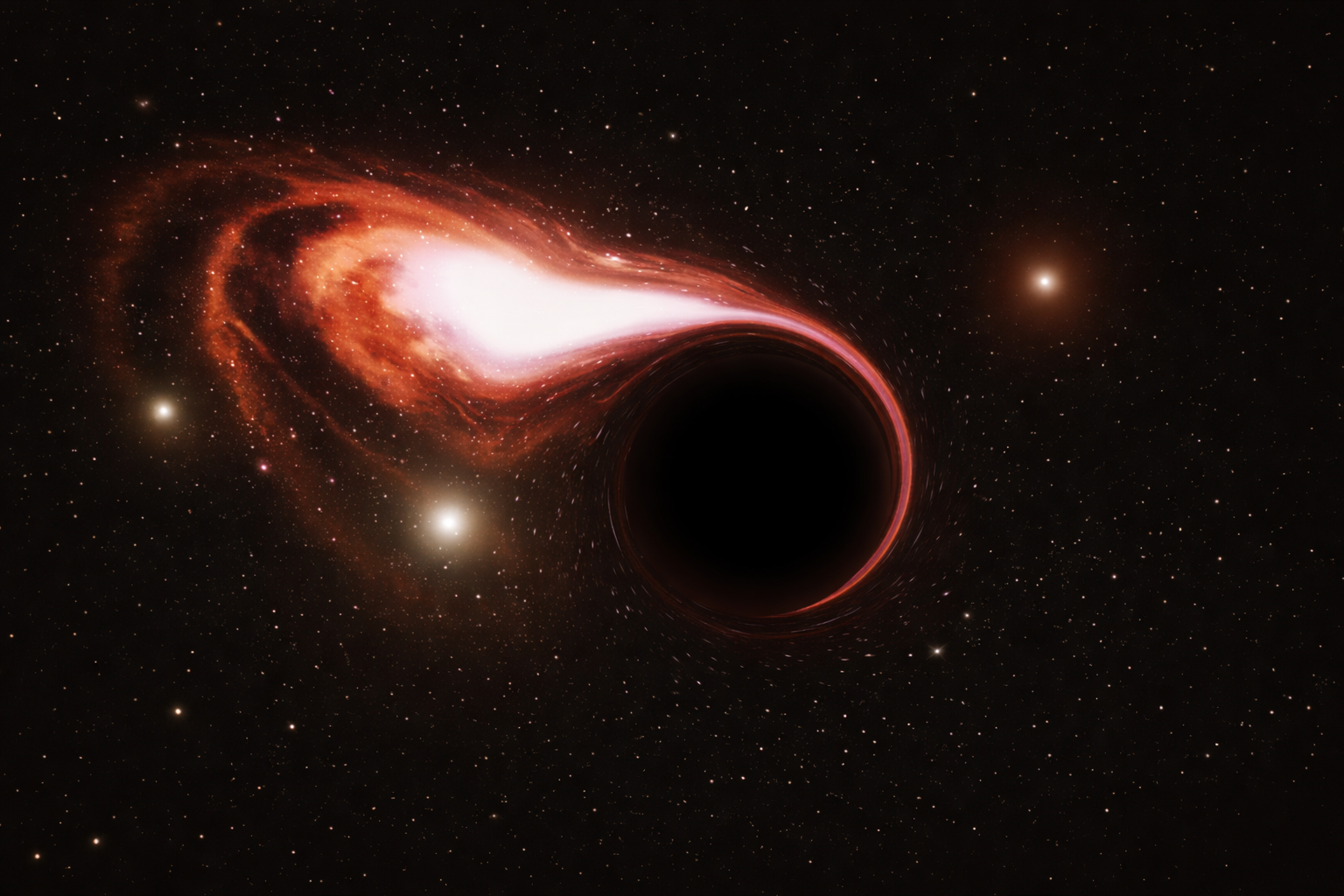
A cosmic event observed by astronomers has the potential to alter our perception of the cosmos. For the first time, astronomers have discovered a black hole collision connected to a gamma-ray burst—a scenario they had previously thought was unthinkable. This innovative finding, which was published in The Astrophysical Journal, represents a significant advancement in multi-messenger astronomy and contemporary astrophysics.
According to the observation, under some circumstances, even the universe’s darkest and most enigmatic objects—black holes—might emit visual signals. The way scientists investigate cosmic occurrences and the extraordinary physics underlying them may change as a result of this unexpected discovery.
A Historic Discovery in Black Hole Astronomy
The remarkable discovery was made by an international team of astronomers using the powerful gravitational-wave observatories: LIGO Scientific Collaboration, Virgo Collaboration, and KAGRA Observatory.
In November 2024, these observatories detected a powerful gravitational wave signal from a massive cosmic event labeled S241125n. Gravitational waves are ripples in spacetime that occur when massive objects like black holes collide.
However, something unexpected happened after the signal was recorded.
Just 11 seconds later, telescopes detected a short gamma-ray burst (GRB) — a brief but extremely energetic flash of radiation. This was astonishing because gamma-ray bursts are normally associated with collisions involving neutron stars, not black holes.
Why This Black Hole Merger Is So Unusual
Traditionally, astronomers believed that binary black hole mergers would produce gravitational waves but no light or radiation detectable by conventional telescopes.
Black holes are known for their intense gravity, which traps everything — including light — inside the event horizon. When two black holes merge, scientists expected the event to remain invisible except for gravitational waves detected by specialized instruments.
But this new discovery challenges that assumption.
The detection of a gamma-ray burst suggests that under certain rare conditions, a black hole merger might interact with surrounding matter or gas, producing a burst of high-energy radiation visible across the universe.
If confirmed through further observations, this would significantly expand our understanding of how black holes behave in complex cosmic environments.
A Breakthrough for Multi-Messenger Astronomy
This event is especially exciting for researchers working in multi-messenger astronomy — a field that studies cosmic phenomena using different types of signals, including:
- Gravitational waves
- Light and radiation
- Particles such as neutrinos
The combination of gravitational wave detection and a gamma-ray burst allows scientists to observe cosmic events from multiple perspectives.
Instead of only “hearing” the collision through gravitational waves, astronomers were also able to “see” it through high-energy radiation.
This dual observation provides much richer data and could help scientists better understand the environments around black holes.
What This Means for the Future of Space Research
The discovery raises several intriguing questions for astrophysicists:
- Can black hole mergers regularly produce gamma-ray bursts?
- What conditions allow radiation to escape such extreme environments?
- Could similar events have been missed in previous observations?
Future observations by facilities such as the LIGO Scientific Collaboration and the Virgo Collaboration may reveal more events like this, helping scientists determine whether this was a rare cosmic coincidence or part of a previously unknown class of astronomical phenomena.
A New Chapter in Understanding the Universe
The detection of a black hole merger accompanied by a gamma-ray burst represents a major milestone in modern astrophysics. It challenges long-standing assumptions about how black holes behave and opens new possibilities for studying the most extreme objects in the universe.
As technology improves and observatories become more sensitive, astronomers may uncover more extraordinary cosmic events like this one — bringing humanity closer to understanding the mysterious forces shaping our universe.