Jensen Huang Warns US AI Chip Policy Is Backfiring
Nvidia China Market Share Drops to Zero Amid US Export Restrictions
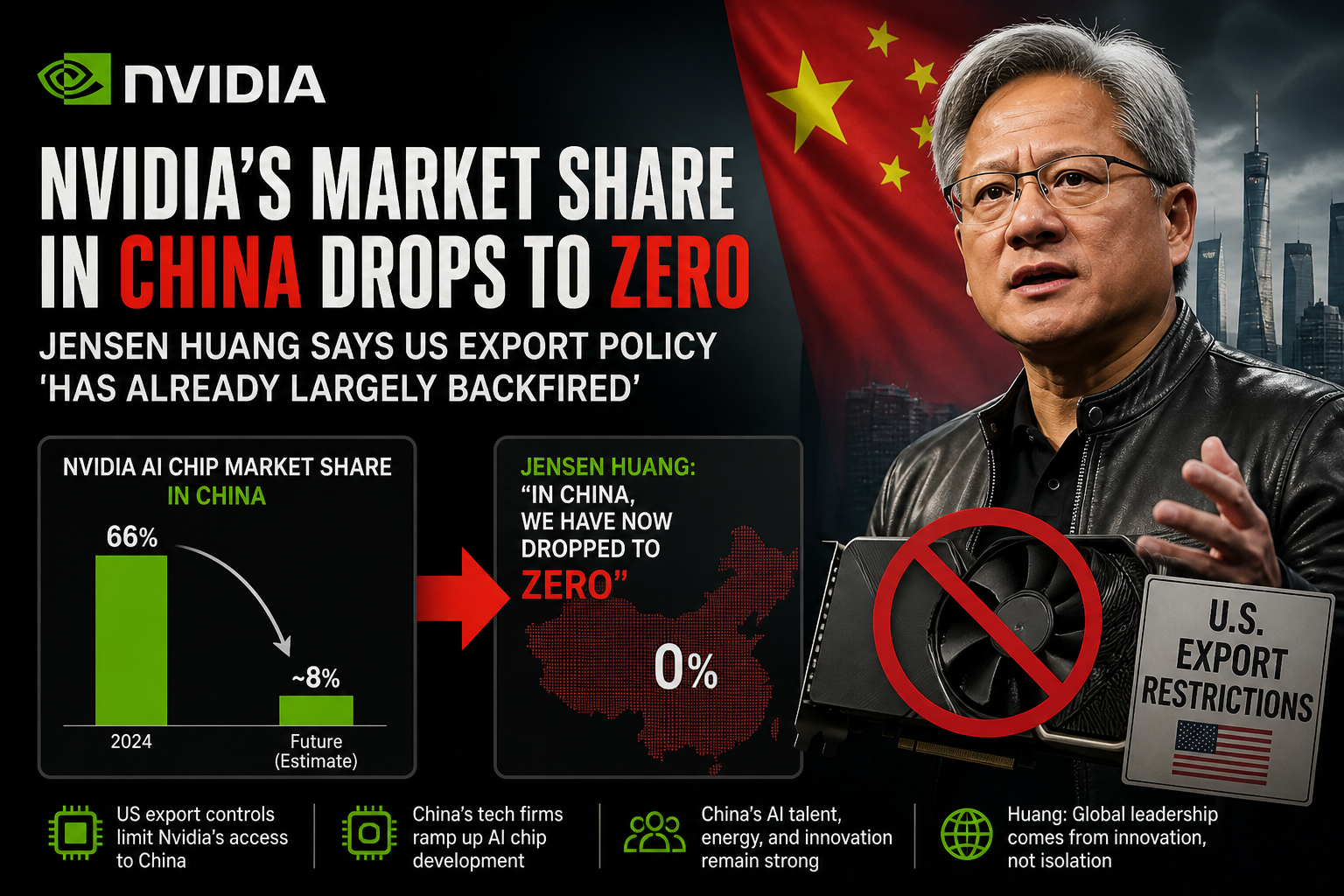
In a surprising and highly significant development in the global semiconductor industry, Jensen Huang, CEO of Nvidia, revealed that the company’s market share in China has effectively dropped to zero. This dramatic decline marks a major shift in the AI chip market, especially considering Nvidia dominated China’s AI accelerator space just a few years ago.
Speaking during an interview with the Special Competitive Studies Project, Huang highlighted how US export restrictions on advanced chips have significantly impacted Nvidia’s ability to operate in China. As a result, the company has lost direct access to one of the world’s largest and fastest-growing AI markets.
US Export Controls on AI Chips: Strategic Move or Costly Mistake?
The US export ban on AI chips to China was initially introduced to limit China’s access to cutting-edge technologies. However, according to Huang, the policy may not be delivering the intended results.
He explained that excluding American companies from China’s massive market may actually be counterproductive. Instead of slowing China’s technological growth, it could be accelerating the country’s push toward self-sufficiency in AI hardware and software.
Huang emphasized that policies must remain flexible and adapt to changing global dynamics. Locking out companies like Nvidia from China could reduce the global influence of American AI technology ecosystems, ultimately weakening their long-term leadership.
China’s AI Industry Rapidly Expanding Without Nvidia
Despite restrictions on companies like Nvidia, China’s AI sector continues to grow rapidly. Domestic companies are stepping up to fill the gap left by American chipmakers.
Key players include:
- Huawei
- Cambricon
- Moore Threads
- MetaX
These companies are investing heavily in AI processors, GPUs, and software ecosystems, aiming to replace foreign technologies. Analysts estimate that local vendors could eventually supply up to 80% of China’s AI hardware demand, significantly reducing reliance on U.S. companies.
Nvidia’s Declining Share in China’s AI GPU Market
According to estimates from Bernstein, Nvidia’s share of China’s AI GPU market was expected to drop from 66% in 2024 to around 8% in the coming years. However, Huang’s latest statement suggests that the situation has worsened even faster than anticipated.
While these figures mainly reflect direct sales to Chinese customers, the broader implication is clear: Nvidia is losing ground in one of the most important global AI markets. This shift could reshape the competitive landscape of the global semiconductor industry.
China’s Strength in AI Talent and Innovation
Even without access to Nvidia’s top-tier AI chips, China remains a formidable competitor in artificial intelligence development. Huang acknowledged that China has several structural advantages that could drive long-term growth.
These include:
- A large pool of science and engineering talent
- Strong government support for AI innovation
- Access to cheaper energy resources
- Rapid expansion of AI research institutions
Huang described China’s AI talent base as a “national treasure,” highlighting the country’s ability to compete at the highest levels of AI model development and deployment.
The CUDA Advantage: America’s Remaining Edge in AI
One area where the United States still holds a significant advantage is in software ecosystems, particularly Nvidia’s CUDA platform. CUDA has long been a critical component of Nvidia’s dominance in AI computing.
While Chinese companies are making progress in hardware, replicating the CUDA software ecosystem remains a major challenge. This “software moat” continues to give Nvidia and other American companies an edge in AI development frameworks and tools.
However, if China successfully develops alternatives, it could further reduce reliance on U.S. technologies and reshape the global AI landscape.
Global AI Competition: A Shift Toward Self-Sufficiency
The ongoing tech rivalry between the U.S. and China is driving both countries toward greater technological independence. For China, losing access to Nvidia’s chips has accelerated efforts to build a fully self-reliant AI ecosystem.
For the U.S., however, the strategy comes with trade-offs. Restricting exports may limit competitors in the short term, but it also reduces the global reach of American companies.
Huang argues that participation in international markets, rather than isolation, is key to maintaining leadership in AI. By staying engaged, U.S. companies can influence global standards and ensure wider adoption of their technologies.
Impact on the Global Semiconductor and AI Market
The consequences of Nvidia’s exit from China extend beyond one company. The entire semiconductor and AI industry could experience long-term shifts, including:
- Increased competition from Chinese chipmakers
- Fragmentation of global technology standards
- Faster innovation cycles in AI hardware and software
- Reduced dominance of U.S. companies in certain regions
As China continues to invest in its domestic tech sector, the global market may become more regionally divided, with separate ecosystems emerging in the East and West.
Jensen Huang’s Warning: Rethinking AI Policy for the Future
Huang’s comments serve as a strong warning to policymakers. He believes that fear-driven regulations could slow the overall progress of AI while allowing competitors to gain ground.
Instead of focusing solely on restrictions, he suggests that the U.S. should prioritize:
- Strengthening its AI innovation ecosystem
- Expanding global partnerships
- Supporting domestic semiconductor manufacturing
- Encouraging international adoption of American technologies
In Huang’s view, long-term success will depend on global leadership, not isolation.
Conclusion: A Turning Point in the AI Chip War
The revelation that Nvidia now holds zero market share in China marks a critical moment in the ongoing global AI competition. What was once a dominant position has quickly eroded due to geopolitical tensions and export restrictions.
As companies like Nvidia navigate this new reality, the focus will shift toward innovation, adaptability, and global strategy. Meanwhile, China’s rapid progress in AI technology suggests that the race is far from over.
The future of AI leadership will not be determined solely by restrictions, but by who can innovate faster, scale globally, and build the most powerful technology ecosystems.