
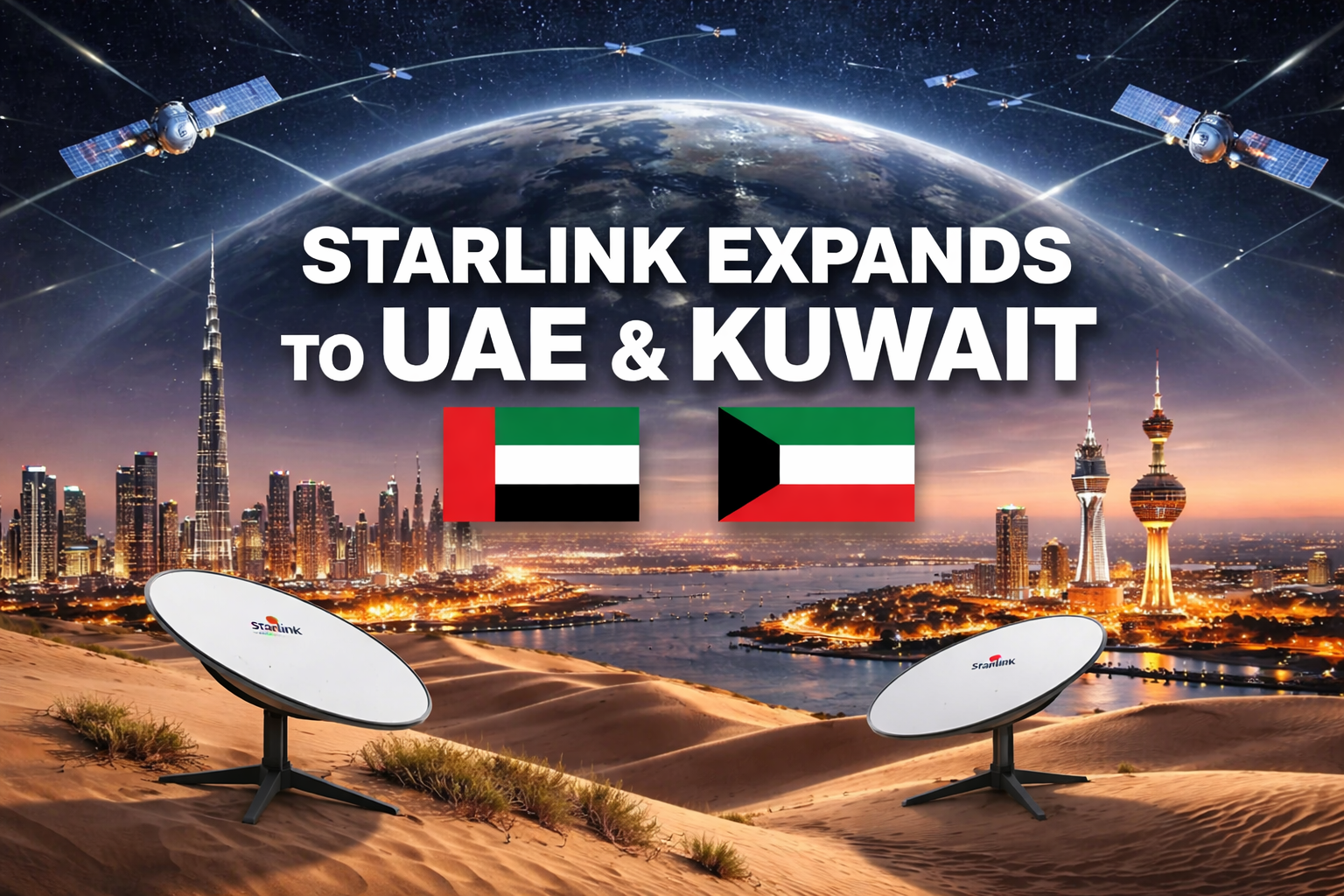
UAE and Kuwait Join the Satellite Internet Revolution
As its satellite internet service, Starlink, enters the Middle East, SpaceX keeps pushing the limits of worldwide connectivity. Starlink is expanding its footprint in a region that is quickly embracing digital transformation with the opening of new operations in Kuwait and the United Arab Emirates.
This growth represents a significant advancement in Starlink’s goal of offering dependable, quick internet access, even in the world’s most isolated regions.
Starlink’s Growing Footprint in the Middle East
Starlink is already operational in several Middle Eastern countries, including Oman, Qatar, Israel, and Yemen. With the addition of the UAE and Kuwait, the company is expanding its reach and reinforcing its position as the world’s largest low Earth orbit (LEO) satellite network.
Since its launch in 2020, Starlink has:
- Deployed over 10,000 satellites
- Reached more than 10 million users globally
- Delivered a network capacity of approximately 450 Tbps
These milestones highlight the rapid growth of satellite-based internet and its increasing importance in global connectivity.
Why Satellite Internet Matters
Unlike traditional broadband, which depends on ground infrastructure like fiber cables and cell towers, Starlink uses a constellation of low Earth orbit satellites to deliver internet services.
Key Advantages:
- Low latency and high speed
- Coverage in remote and rural areas
- Reliable connectivity for moving platforms (ships, aircraft)
- Minimal reliance on ground infrastructure
This makes Starlink particularly valuable in regions with challenging geography or limited telecom infrastructure.
Kuwait Launch Through Sama X Partnership
In Kuwait, Starlink is entering the market through a local partner, Sama X. The collaboration ensures compliance with local regulations and smooth deployment.
Kutayba Y Alghanim, executive chairman of Alghanim Industries, emphasized the significance of this launch. According to him, Starlink will strengthen Kuwait’s digital infrastructure and support essential sectors such as:
- Healthcare
- Government services
- Remote work
- Education
He highlighted that reliable connectivity is now critical for business continuity and national development, especially in an increasingly digital world.
Boosting Digital Infrastructure in the UAE
The UAE already boasts a highly advanced telecommunications sector. However, the introduction of Starlink adds a new layer of resilience and flexibility.
Satellite internet can:
- Support remote areas and offshore locations
- Enhance business continuity
- Enable high-speed connectivity for homes and enterprises
From streaming and gaming to remote work and online education, Starlink offers an alternative connectivity solution that complements existing networks.
Transforming Key Industries Across the Region
Starlink’s expansion is expected to have a major impact on industries that depend on stable internet in hard-to-reach areas.
Key Beneficiaries:
- Offshore energy operations
- Maritime and cargo shipping
- Hospitals and emergency services
- Research stations
- Remote construction and industrial sites
For these sectors, uninterrupted connectivity means improved efficiency, safety, and real-time communication.
Driving Digital Transformation and Innovation
The Middle East is rapidly evolving into a digital hub, and satellite internet is playing a crucial role in this transformation.
Expected Benefits:
- Growth of startups and tech ecosystems
- Better access to cloud computing services
- Expansion of remote learning and telemedicine
- Increased opportunities for innovation and entrepreneurship
By bridging connectivity gaps, Starlink is helping unlock new economic opportunities across urban and rural areas alike.
Competition in the Satellite Internet Market
Starlink is not alone in the race to provide satellite broadband in the region. Other major players include:
- OneWeb
- Project Kuiper by Amazon
As competition increases, consumers in the Middle East can expect:
- More service options
- Improved performance
- Potentially lower prices
This competitive environment is likely to accelerate innovation and adoption.
Challenges to Consider
Despite its promise, Starlink’s expansion is not without challenges:
- Regulatory approvals vary by country
- High initial setup costs
- Infrastructure and distribution limitations
- Market competition
Addressing these issues will be key to ensuring long-term success in the region.
Final Thoughts
The expansion of Starlink into the United Arab Emirates and Kuwait marks a significant milestone in the evolution of global internet connectivity.
By leveraging advanced satellite technology, SpaceX is helping bridge the digital divide—bringing fast, reliable internet to places where traditional networks fall short.
As adoption grows and competition intensifies, the Middle East could become a key testing ground for the future of satellite internet.