The Future of Space Discovery
A New Era in Mars Exploration Technology
Exploring Mars has always been a slow and carefully controlled process. Scientists rely on robotic missions to study the Red Planet, but limitations in communication and safety have restricted how fast these missions can move. Now, a groundbreaking semi-autonomous robotic system is set to change everything. Researchers have developed a new robot capable of exploring planetary surfaces up to three times faster than current rovers, opening the door to quicker discoveries and more efficient missions.
Why Mars Exploration Has Been So Slow Until Now
One of the biggest challenges in Mars exploration is the communication delay between Earth and the planet. Signals can take anywhere from 4 to 22 minutes to travel one way, making real-time control nearly impossible. Because of this delay, scientists must carefully plan every move a rover makes in advance.
In addition to communication issues, limited data transfer capacity and strict safety protocols further slow down operations. Current Mars rovers typically move only a few hundred meters per day. While this cautious approach ensures safety, it also limits the amount of terrain that can be explored and the volume of scientific data collected.
Introducing a Smarter, Semi-Autonomous Robot
To overcome these limitations, researchers have introduced a semi-autonomous robotic system designed to operate with minimal human intervention. Unlike traditional rovers that focus on analyzing one rock or location at a time, this new robot can move between multiple targets independently.
This shift in approach is significant. By handling tasks on its own, the robot reduces the need for constant instructions from Earth. It can navigate, analyze, and collect data in a continuous sequence, making the entire exploration process faster and more efficient.
Advanced Technology Behind the Robot
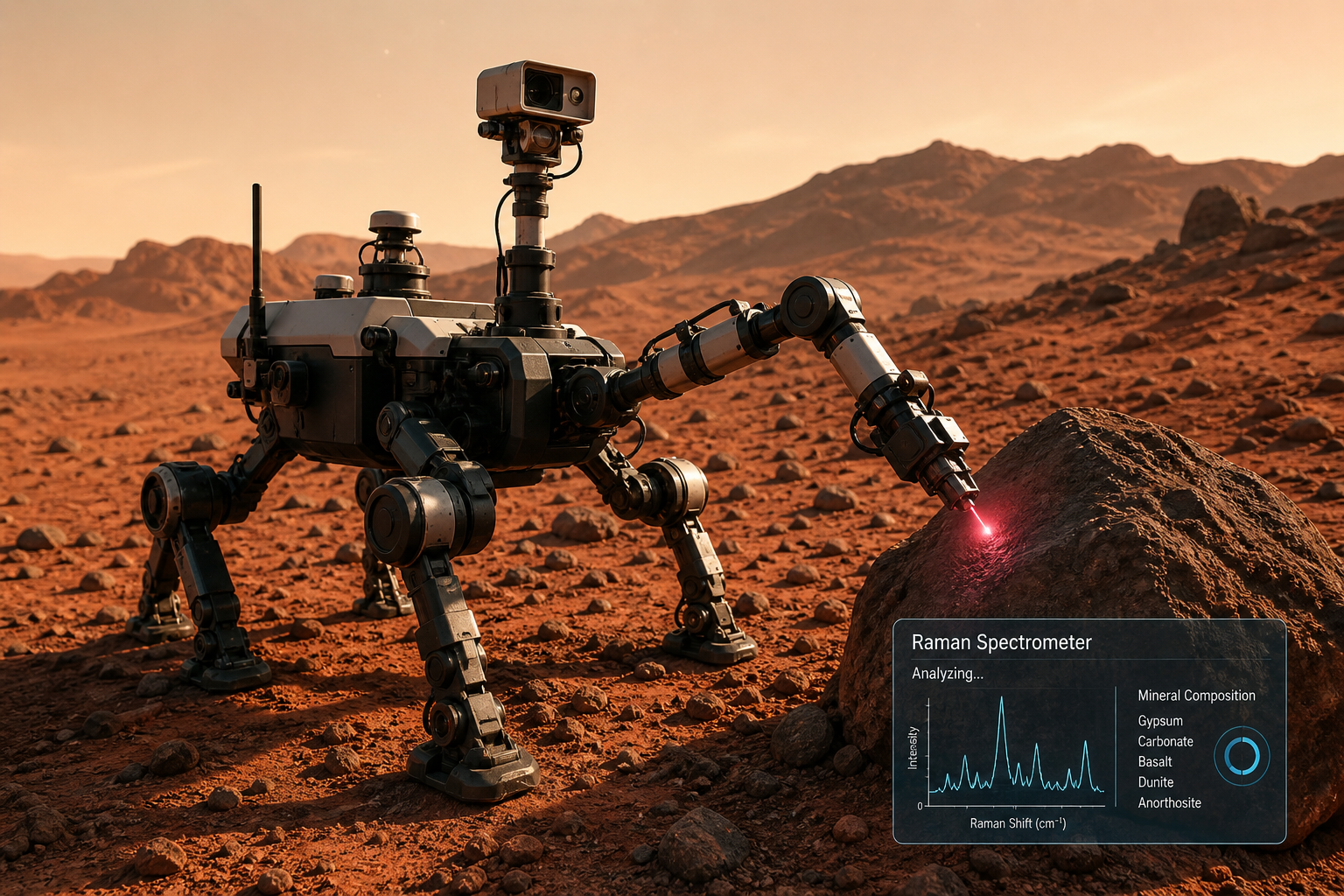
The robot used in testing is called ANYmal, a highly advanced quadruped robot known for its agility and adaptability. It is equipped with a robotic arm that carries two powerful scientific instruments:
- A microscopic imager for capturing detailed surface images
- A portable Raman spectrometer for analyzing the chemical composition of rocks
These tools allow the robot to perform in-depth scientific analysis directly on the Martian surface, similar to what traditional rovers do—but much faster.
Collaboration Between Leading Research Institutions
This innovative project is the result of collaboration between several leading research institutions. Teams from ETH Zurich’s Robotic Systems Lab, ETH Zurich Space, the University of Zurich, and the University of Bern worked together to bring this concept to life.
Testing was conducted at the Marslabor facility at the University of Basel. This specialized laboratory simulates Martian conditions using realistic materials and lighting, allowing researchers to evaluate the robot’s performance in an environment similar to the Red Planet.
Realistic Testing Under Simulated Mars Conditions
During testing, the robot demonstrated impressive capabilities. It was able to autonomously navigate to selected targets, position its instruments accurately, and collect both visual and spectral data.
The simulated environment included various rock types commonly found on Mars, ensuring that the tests were scientifically relevant. The robot successfully analyzed these samples and transmitted the data for further study, proving its ability to operate effectively in challenging conditions.
Speed and Efficiency: A Game-Changer for Space Missions
One of the most remarkable outcomes of the study is the robot’s speed. In comparison tests, the semi-autonomous system completed multi-target missions in just 12 to 23 minutes. In contrast, a similar mission controlled entirely by humans took 41 minutes.
This dramatic improvement highlights the potential of autonomous systems to transform planetary exploration. Faster missions mean more data can be collected in less time, allowing scientists to cover larger areas and make discoveries more quickly.
Maintaining Accuracy While Increasing Speed
Speed alone is not enough—accuracy is equally important in scientific exploration. Fortunately, the new robotic system delivers on both fronts. During testing, the robot successfully identified multiple rock types, including:
- Gypsum
- Carbonates
- Basalts
- Dunite
- Anorthosite
In one test scenario, the robot correctly identified all selected targets, demonstrating that increased speed does not come at the cost of precision. This balance between efficiency and accuracy is crucial for future missions.
Why This Technology Matters for Future Space Missions
The success of this semi-autonomous robot has major implications for the future of space exploration. By combining compact scientific instruments with advanced autonomy, missions can become more flexible and productive.
Instead of relying on constant human control, future robots will be able to make decisions on their own, navigate complex terrains, and focus on the most promising areas for research. This could significantly enhance our ability to study not only Mars but also the Moon and other celestial bodies.
Expanding the Search for Life Beyond Earth
One of the most exciting possibilities opened by this technology is the search for signs of past life. By exploring larger areas more quickly, robots can identify and analyze more potential biosignatures—clues that life may have once existed.
This increased efficiency could accelerate one of humanity’s biggest scientific quests: understanding whether life exists beyond Earth. With smarter and faster robots, we are getting closer to answering that question.
The Future of Autonomous Space Exploration
The development of semi-autonomous robotic systems marks a major step forward in space technology. As these systems continue to evolve, we can expect even greater levels of independence, speed, and intelligence.
Future missions may deploy fleets of such robots working together, mapping entire regions, collecting samples, and conducting experiments without waiting for instructions from Earth. This would revolutionize how we explore space and dramatically expand our scientific capabilities.
Conclusion: A Giant Leap for Robotic Exploration
The new semi-autonomous Mars robot represents a powerful combination of speed, intelligence, and precision. By reducing reliance on human control and increasing operational efficiency, it has the potential to transform how we explore other planets.
With the ability to move faster, analyze more data, and operate independently, this technology could unlock new discoveries and reshape the future of planetary exploration. As researchers continue to refine these systems, the dream of exploring Mars and beyond more effectively is becoming a reality.