Scientists Recreate Conditions Just After the Big Bang
The Large Hadron Collider has provided scientists with their best look yet into the early stages of our cosmos, marking an incredible scientific milestone. Scientists are discovering new details
about how everything we see today originated by simulating the harsh conditions that prevailed just after the Big Bang.
This ground-breaking study focuses on quark-gluon plasma, an enigmatic state of matter that is frequently referred to as the original building block of the universe.
What Is Quark-Gluon Plasma?
Just fractions of a second after the Big Bang, the universe was not filled with atoms, stars, or galaxies. Instead, it existed as an incredibly hot and dense “soup” of fundamental particles called quarks and gluons.
This state, known as quark-gluon plasma, is:
- Extremely hot and dense
- Made of free-moving quarks and gluons
- The foundation from which all matter eventually formed
Understanding this plasma helps scientists answer one of the biggest questions in physics: How did the universe evolve from chaos into structure?
How Scientists Recreated the Early Universe
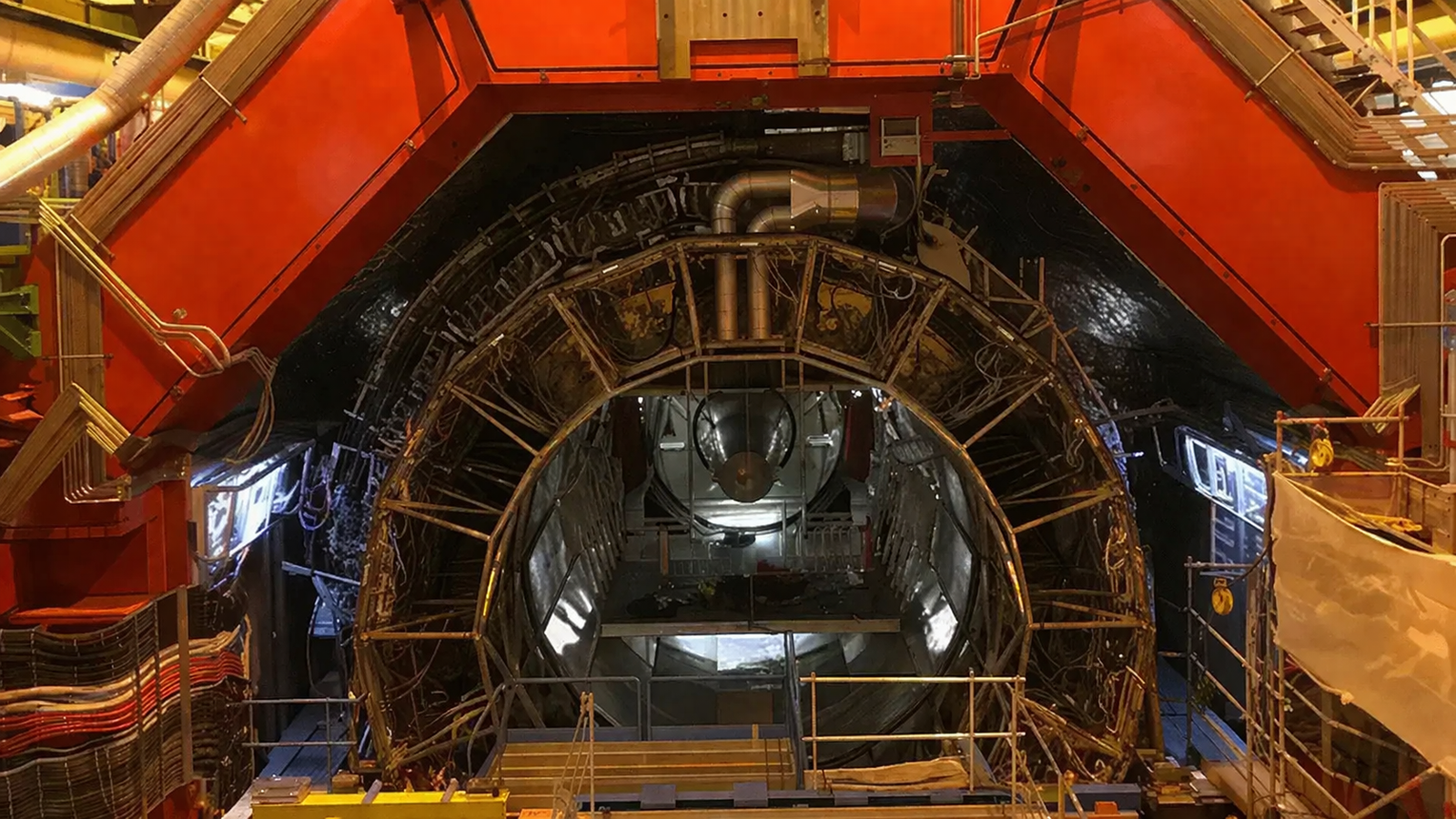
At the heart of this discovery is the CERN, home to the Large Hadron Collider—a massive underground machine stretching nearly 27 kilometers.
Using a special experiment called ALICE, researchers recreated quark-gluon plasma by:
- Smashing atomic nuclei (like iron and lead)
- Accelerating them to near the speed of light
- Observing the resulting particle behavior
These high-energy collisions mimic the conditions that existed right after the Big Bang.
A Surprising Discovery in Smaller Collisions
Previously, scientists believed that only large, heavy-ion collisions could produce quark-gluon plasma. However, new findings challenge this assumption.
The ALICE team discovered similar patterns even in:
- Proton-proton collisions
- Proton-lead collisions
This suggests that quark-gluon plasma can form in much smaller systems than previously thought—a major shift in understanding.
The Key Clue: Anisotropic Flow
One of the most important indicators of quark-gluon plasma is something called anisotropic flow.
What Does That Mean?
Instead of particles flying out randomly after a collision, they:
- Move in preferred directions
- Show organized flow patterns
- Reveal underlying physical processes
This flow provides crucial insight into how particles interact and combine.
Baryons vs. Mesons: A Deeper Insight
The study also examined how different types of particles behave:
- Baryons (made of 3 quarks)
- Mesons (made of 2 quarks)
What Did Scientists Find?
- Baryons show stronger flow patterns
- Mesons show weaker flow patterns
This difference supports theories about how quarks combine to form larger particles—a process known as quark coalescence.
Why This Discovery Matters
This research brings scientists closer to understanding:
- The formation of matter in the early universe
- How fundamental particles interact under extreme conditions
- The transition from quark-gluon plasma to atoms
It also challenges long-standing theories, opening new directions for future research.
What’s Next: Bridging the Gap with New Experiments
While the findings are groundbreaking, some mysteries remain.
Scientists are now looking forward to new experiments involving oxygen collisions, which sit between small and large collision systems. These experiments are expected to:
- Fill gaps in current models
- Provide more precise data
- Improve our understanding of plasma evolution
Final Thoughts
The latest results from the Large Hadron Collider mark a major step forward in our quest to understand the universe’s origins.
By recreating and studying quark-gluon plasma, scientists are essentially peering back in time to the very first moments after the Big Bang.
Each discovery brings us closer to answering one of humanity’s oldest questions:
How did everything begin?Scientists Recreate Conditions Just After the Big Bang
The Large Hadron Collider has provided scientists with their best look yet into the early stages of our cosmos, marking an incredible scientific milestone. Scientists are discovering new details
about how everything we see today originated by simulating the harsh conditions that prevailed just after the Big Bang.
This ground-breaking study focuses on quark-gluon plasma, an enigmatic state of matter that is frequently referred to as the original building block of the universe.
What Is Quark-Gluon Plasma?
Just fractions of a second after the Big Bang, the universe was not filled with atoms, stars, or galaxies. Instead, it existed as an incredibly hot and dense “soup” of fundamental particles called quarks and gluons.
This state, known as quark-gluon plasma, is:
- Extremely hot and dense
- Made of free-moving quarks and gluons
- The foundation from which all matter eventually formed
Understanding this plasma helps scientists answer one of the biggest questions in physics: How did the universe evolve from chaos into structure?
How Scientists Recreated the Early Universe
At the heart of this discovery is the CERN, home to the Large Hadron Collider—a massive underground machine stretching nearly 27 kilometers.
Using a special experiment called ALICE, researchers recreated quark-gluon plasma by:
- Smashing atomic nuclei (like iron and lead)
- Accelerating them to near the speed of light
- Observing the resulting particle behavior
These high-energy collisions mimic the conditions that existed right after the Big Bang.
A Surprising Discovery in Smaller Collisions
Previously, scientists believed that only large, heavy-ion collisions could produce quark-gluon plasma. However, new findings challenge this assumption.
The ALICE team discovered similar patterns even in:
- Proton-proton collisions
- Proton-lead collisions
This suggests that quark-gluon plasma can form in much smaller systems than previously thought—a major shift in understanding.
The Key Clue: Anisotropic Flow
One of the most important indicators of quark-gluon plasma is something called anisotropic flow.
What Does That Mean?
Instead of particles flying out randomly after a collision, they:
- Move in preferred directions
- Show organized flow patterns
- Reveal underlying physical processes
This flow provides crucial insight into how particles interact and combine.
Baryons vs. Mesons: A Deeper Insight
The study also examined how different types of particles behave:
- Baryons (made of 3 quarks)
- Mesons (made of 2 quarks)
What Did Scientists Find?
- Baryons show stronger flow patterns
- Mesons show weaker flow patterns
This difference supports theories about how quarks combine to form larger particles—a process known as quark coalescence.
Why This Discovery Matters
This research brings scientists closer to understanding:
- The formation of matter in the early universe
- How fundamental particles interact under extreme conditions
- The transition from quark-gluon plasma to atoms
It also challenges long-standing theories, opening new directions for future research.
What’s Next: Bridging the Gap with New Experiments
While the findings are groundbreaking, some mysteries remain.
Scientists are now looking forward to new experiments involving oxygen collisions, which sit between small and large collision systems. These experiments are expected to:
- Fill gaps in current models
- Provide more precise data
- Improve our understanding of plasma evolution
Final Thoughts
The latest results from the Large Hadron Collider mark a major step forward in our quest to understand the universe’s origins.
By recreating and studying quark-gluon plasma, scientists are essentially peering back in time to the very first moments after the Big Bang.
Each discovery brings us closer to answering one of humanity’s oldest questions:
How did everything begin?