NASA’s Supersonic Mars Helicopters Could Revolutionize Red Planet Exploration
NASA Breaks the Sound Barrier with Next-Generation Mars Helicopter Blades
NASA has achieved a groundbreaking milestone in the future of Mars exploration by successfully testing rotor blades for next-generation Mars helicopters at speeds faster than the speed of sound. This major advancement could transform the way scientists explore the Red Planet, allowing future aerial vehicles to carry heavier scientific payloads, travel farther, and conduct more advanced missions than ever before.
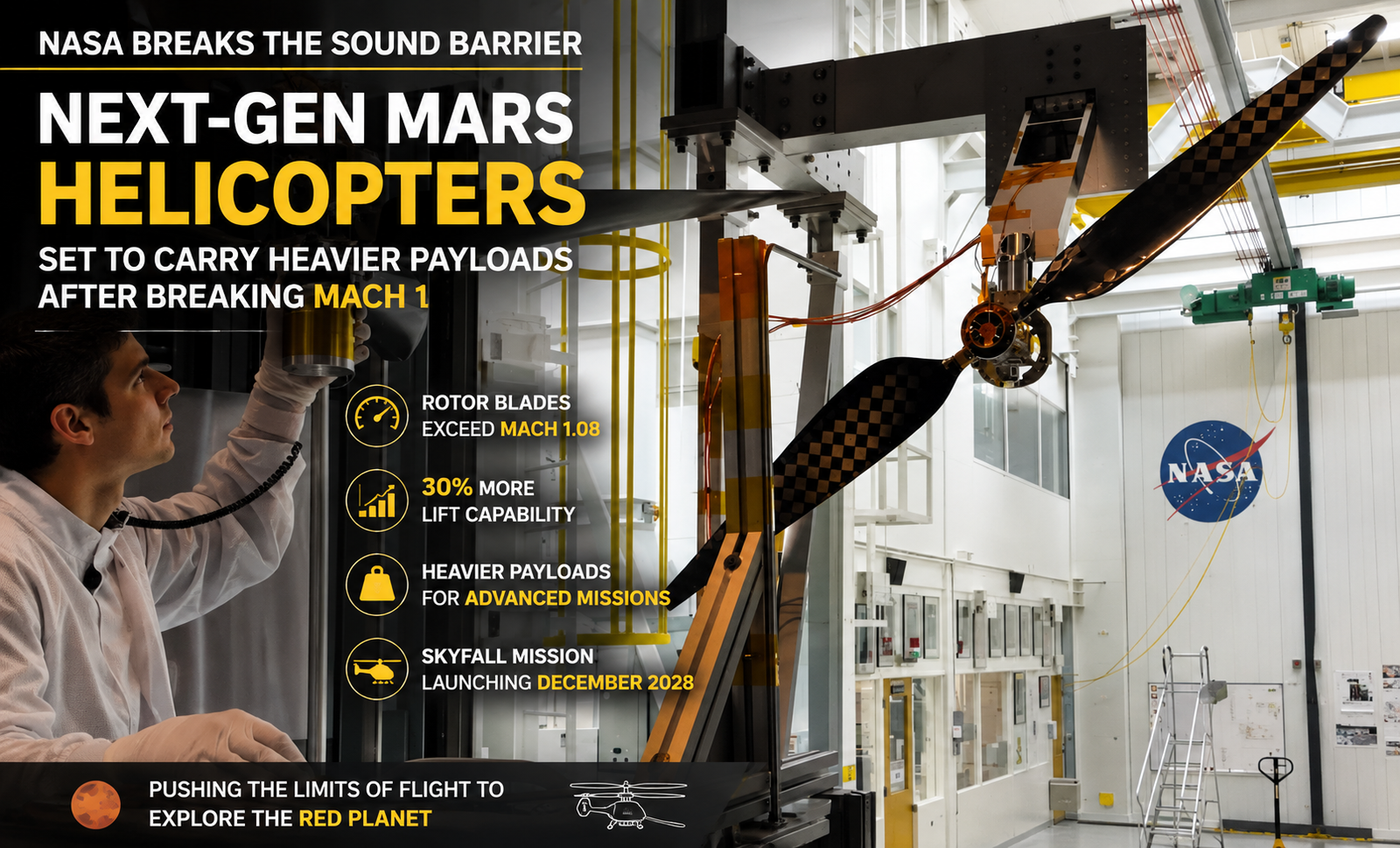
The breakthrough was achieved at NASA’s famous Jet Propulsion Laboratory (JPL) in Southern California as part of the ambitious SkyFall Mars mission project. Engineers tested advanced helicopter rotor blades inside a specially designed chamber that recreated the harsh atmosphere of Mars. During testing, the rotor blades exceeded Mach 1, marking the first time NASA has pushed Mars helicopter technology into the supersonic range.
This achievement is expected to play a crucial role in the future of Mars missions, robotic exploration, and aerial science operations on the planet.
Why Flying on Mars Is Extremely Difficult
The Thin Martian Atmosphere Creates Serious Challenges
Flying on Mars is far more difficult than flying on Earth. One of the biggest challenges is the planet’s extremely thin atmosphere. Mars’ atmosphere is only about 1% as dense as Earth’s atmosphere, making it incredibly difficult for helicopter blades to generate enough lift.
At the same time, Mars still has significant gravity — roughly 38% of Earth’s gravity — which means aircraft still need substantial upward force to stay airborne. Because of these conditions, Mars helicopters must spin their blades much faster than helicopters on Earth.
On Earth, helicopter blades can operate efficiently in thicker air without reaching extreme speeds. On Mars, however, the blade tips must move close to or even beyond the speed of sound to create enough lift for stable flight.
This is exactly why NASA engineers focused on developing high-speed rotor technology capable of handling the extreme Martian environment.
NASA’s Historic Rotor Blade Test at JPL
Supersonic Rotor Blades Unlock New Possibilities
The historic testing took place inside NASA JPL’s legendary 25-Foot Space Simulator, a chamber designed to recreate the atmospheric conditions of Mars. Engineers removed Earth’s air from the chamber and replaced it with carbon dioxide under low-pressure and freezing-temperature conditions similar to the Martian surface.
Inside the chamber, NASA mounted a specially designed three-bladed rotor system and gradually increased its rotational speed. During the experiment, the rotor reached 3,750 revolutions per minute (rpm), causing the blade tips to hit an incredible speed of Mach 1.08.
Crossing the sound barrier was not just a technological achievement — it also produced a major performance improvement. According to NASA engineers, the new rotor design generated approximately 30% more lift capability compared to previous systems.
This increase in lift could dramatically improve future Mars helicopters by allowing them to carry:
- Larger scientific instruments
- Advanced cameras and sensors
- More powerful batteries
- Communication equipment
- Sample collection tools
The success of the tests proves that supersonic rotor technology may become the foundation of future Mars aerial exploration missions.
SkyFall Project Could Transform Mars Exploration
NASA’s Next Mission Will Deploy Advanced Helicopters on Mars
NASA’s breakthrough is directly connected to its upcoming SkyFall project, an ambitious mission designed to send multiple advanced helicopters to Mars.
Unlike the Ingenuity Mars Helicopter, which mainly demonstrated powered flight on another planet, the next-generation SkyFall helicopters are expected to perform far more complex tasks. NASA plans to launch three advanced Mars helicopters in December 2028, each equipped with cutting-edge rotor systems and improved flight capabilities.
The mission aims to support scientific exploration in areas that traditional rovers cannot easily reach, including:
- Deep craters
- Rocky mountain regions
- Steep cliffs
- Ancient riverbeds
- Dust-covered terrain
With enhanced lift and flight endurance, these helicopters may eventually assist in searching for signs of ancient microbial life, studying Martian geology, and scouting landing sites for future human missions to Mars.
The project could represent a major leap forward in NASA’s long-term goal of establishing sustainable exploration on the Red Planet.
How Supersonic Mars Helicopters Could Benefit Future Space Missions
Heavier Payloads Mean More Scientific Discoveries
One of the most exciting outcomes of NASA’s rotor breakthrough is the ability for future helicopters to carry significantly heavier payloads.
Payload capacity is extremely important during planetary exploration because every extra kilogram allows scientists to add more advanced instruments. Future Mars helicopters may carry technologies such as:
- Ground-penetrating radar
- Atmospheric sensors
- High-resolution imaging systems
- Mineral analysis tools
- Autonomous navigation systems
These advanced tools could provide scientists with deeper insights into Mars’ climate, geological history, and potential habitability.
The increased flight performance could also allow helicopters to travel greater distances during a single mission, opening entirely new regions of Mars for exploration.
NASA’s SkyFall Rotor Design Shows Major Improvements
Two-Bladed Rotor System Delivers Impressive Results
In addition to the three-bladed rotor tests, NASA engineers also tested another innovative design known as the SkyFall rotor. This configuration used two slightly longer blades instead of three.
Remarkably, the two-bladed rotor reached near-supersonic speeds at only 3,570 rpm, demonstrating impressive efficiency and aerodynamic performance.
The successful testing of multiple rotor designs gives NASA flexibility for future mission planning. Engineers can now study which rotor systems work best for different types of aerial missions on Mars.
This versatility could help scientists design specialized aircraft for exploration, mapping, cargo transport, and even future support missions for astronauts.
Ingenuity Opened the Door for Advanced Mars Aircraft
NASA Builds on the Success of the Ingenuity Helicopter
NASA’s current success would not have been possible without the groundbreaking achievements of the Ingenuity Mars Helicopter, which became the first aircraft to achieve powered flight on another planet in 2021.
Originally designed for only a few flights, Ingenuity far exceeded expectations by completing dozens of successful flights across the Martian surface. The helicopter demonstrated that aerial exploration on Mars was not only possible but highly valuable for future missions.
The lessons learned from Ingenuity directly influenced the development of NASA’s new high-speed rotor systems and next-generation helicopter technology.
Now, with supersonic rotor blades becoming a reality, NASA is preparing for a future where fleets of autonomous aerial vehicles may explore Mars alongside rovers and eventually human astronauts.
The Future of Mars Exploration Is Taking Flight
NASA’s Rotor Blade Breakthrough Marks a New Era
NASA’s achievement in pushing Mars helicopter blades beyond Mach 1 represents a historic moment in aerospace engineering and planetary science. By overcoming the challenges of Mars’ thin atmosphere, engineers have unlocked the possibility of faster, stronger, and more capable aerial vehicles for future exploration.
As NASA continues developing its SkyFall mission and next-generation Mars aircraft, the dream of advanced robotic exploration across the Red Planet is becoming increasingly realistic.
With heavier payloads, longer flight ranges, and improved scientific capabilities, these futuristic helicopters could fundamentally change how humanity studies Mars in the coming decades.
The future of Mars helicopter technology, NASA space missions, and Red Planet exploration has officially entered a bold new era.