Can Life Begin on a Moon Without a Sun? The Surprising Science of Rogue Exomoons
Typically, when we envisage extraterrestrial life, we picture planets circling blazing stars. After all, sunlight appears to be necessary for biology, liquid water, and warmth. However, what if there was no need for a star in life?
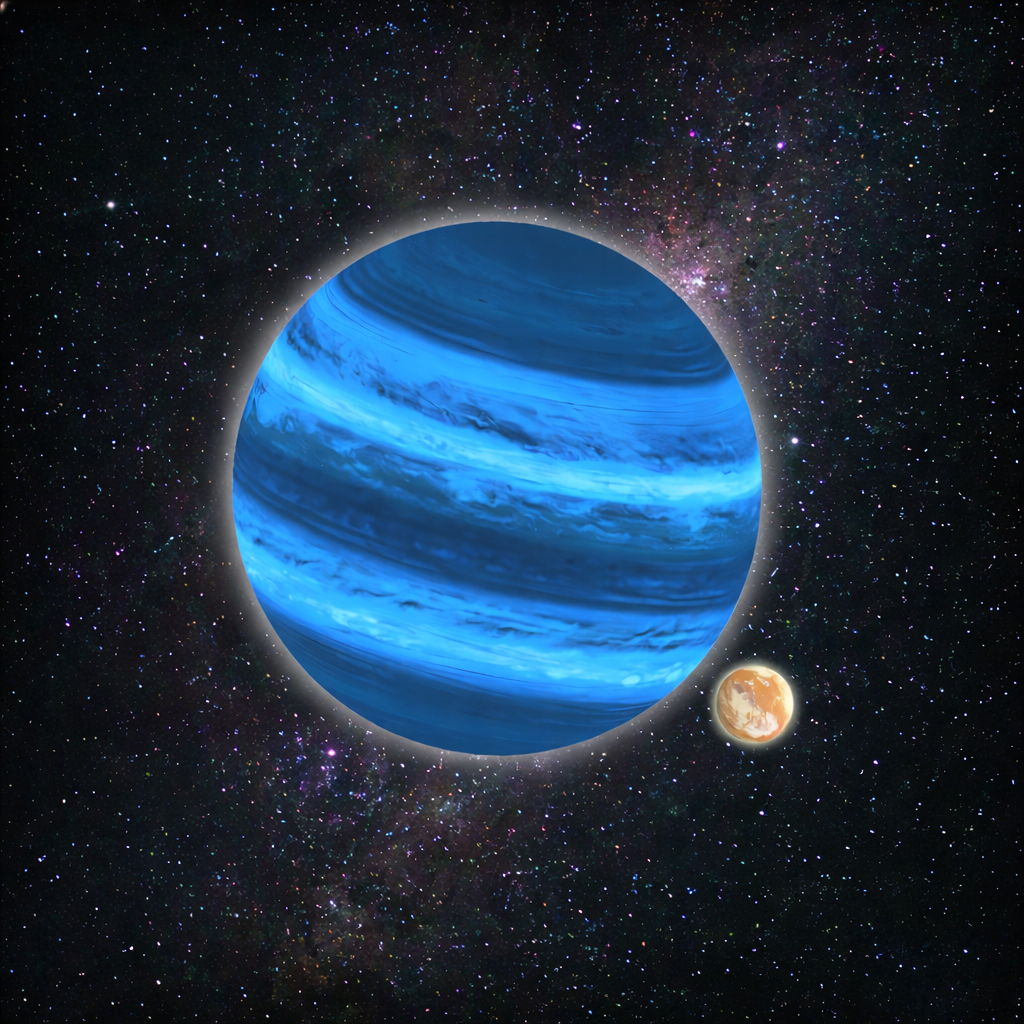
New research suggests that life could potentially begin on a moon without a sun — specifically on moons orbiting rogue planets, also known as free-floating planets, drifting alone through interstellar space.
It sounds like science fiction. But the physics says it might be possible.
What Are Rogue Planets?
Rogue planets are worlds that do not orbit a star. Instead, they wander through the galaxy independently. Astronomers estimate there may be as many rogue planets as stars in the Milky Way — potentially hundreds of billions.
Some of these rogue planets may have moons. And some of those moons could be Earth-sized exomoons.
Until recently, scientists assumed that without starlight, such worlds would be frozen and lifeless. But a new study accepted for publication in Monthly Notices of the Royal Astronomical Society challenges that assumption.
Trending Keywords: rogue planets, free-floating planets, exomoons, life beyond Earth, habitable moons
How Could a Moon Stay Warm Without a Star?
The key lies in something called tidal heating.
If a moon orbits a massive rogue planet in a slightly elliptical (oval-shaped) orbit, gravitational forces constantly stretch and squeeze the moon. This internal friction generates heat — similar to how Jupiter’s moon Io is heated by tidal forces today.
But tidal heating alone isn’t enough. For liquid water to exist on the surface, that heat must be trapped.
Why Carbon Dioxide Doesn’t Work Well
Earlier research suggested a thick carbon dioxide (CO₂) atmosphere might trap heat. However, there’s a problem. At the high pressures and relatively low temperatures involved, CO₂ tends to condense into liquid or ice. When that happens, the atmosphere collapses — and the moon freezes.
That’s where a surprising alternative comes in: hydrogen.
Hydrogen Atmospheres: A Natural Greenhouse Blanket
Unlike CO₂, hydrogen doesn’t easily condense into liquid under these conditions. At very high pressures, hydrogen molecules collide and briefly form tiny electric dipoles in a process called collision-induced absorption (CIA).
This allows hydrogen to absorb infrared radiation — effectively acting like a powerful greenhouse blanket.
With enough atmospheric pressure, this mechanism can trap tidal heat and keep the moon’s surface warm enough for liquid water.
That’s the breakthrough.
Trending Keywords: tidal heating, hydrogen atmosphere, collision-induced absorption, greenhouse effect, liquid water in space
How Long Could Liquid Water Last?
Researchers used advanced climate and chemistry simulations to model different atmospheric conditions and tidal heating levels.
The results were astonishing:
- With an atmosphere similar to Earth’s (1 bar pressure), liquid water could persist for up to 95 million years.
- With an atmosphere 100 times thicker than Earth’s, liquid water could survive for 4.3 billion years — roughly the age of Earth itself.
That’s long enough for life to potentially emerge and evolve.
Given the enormous number of rogue planets believed to exist, it’s statistically possible that at least some moons may have these thick hydrogen atmospheres.
Could Life Actually Form There?
If liquid water exists, the next question is obvious: Could life begin?
Interestingly, the orbital mechanics of such a moon might actually help.
Because the moon’s orbit would likely be highly elliptical, it would experience enormous tidal forces. This would create extreme global tides — far more powerful than Earth’s ocean tides.
These massive tidal cycles could produce repeated wet-dry cycles, which scientists believe were critical in forming early RNA molecules on Earth. On our planet, similar cycles may have occurred in tidal pools billions of years ago.
On a rogue exomoon, these processes could happen on a much larger scale.
And where there’s RNA formation, there’s potential for biology.
Trending Keywords: origin of life, RNA formation, wet-dry cycle theory, alien life possibilities, habitable exomoons
Why Haven’t We Found One Yet?
So far, astronomers haven’t directly detected a rogue exomoon. Observing free-floating planets is already difficult; detecting a moon around one is even more challenging.
However, advances in space telescopes and observational techniques are improving rapidly. Missions designed to detect exoplanets and subtle gravitational effects may eventually uncover these hidden worlds.
If we do find one, searching for biosignatures — chemical signs of life — may become a real scientific priority.
A Universe More Habitable Than We Imagined?
For decades, scientists focused on the “habitable zone” — the narrow region around a star where liquid water can exist. But this new research expands that idea dramatically.
Life may not require sunlight at all.
Instead, it could thrive in the dark, warmed by tidal forces and wrapped in a dense hydrogen atmosphere, orbiting a lonely planet drifting between the stars.
If rogue planets are as common as current estimates suggest, then the galaxy may be filled with hidden, starless oceans — and perhaps even alien ecosystems.
For now, it remains theoretical. But physics supports the possibility.
And sometimes, the universe turns out to be far more creative than we ever imagined.