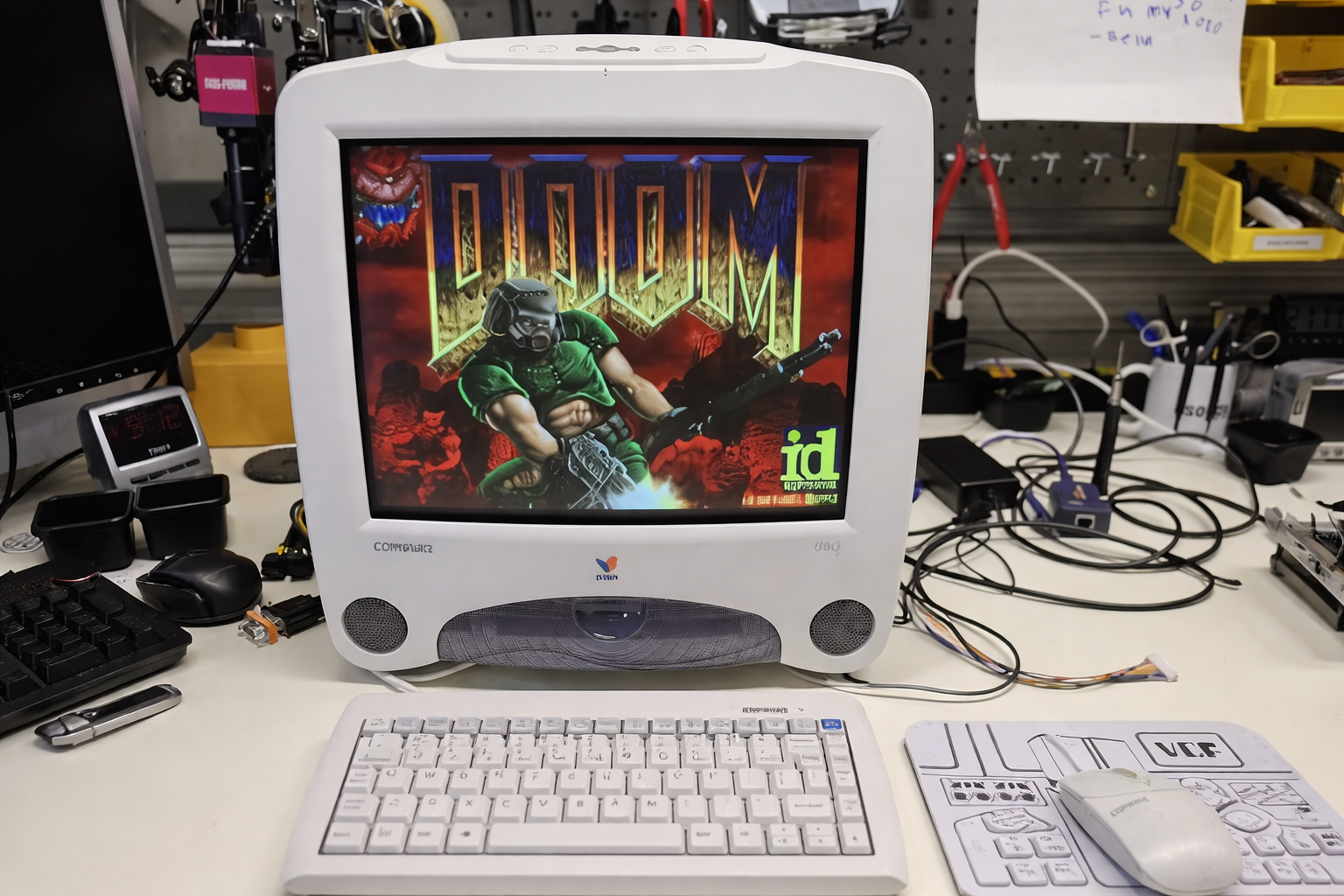
Running Windows 98 and Doom on a Compaq iPAQ IA-2
Reviving a Forgotten Internet Device from the Early 2000s
Early in the new millennium, tech companies thought that basic internet terminals—lightweight devices made mainly for online browsing—would be the center of computers in the future. Due to the era’s fixation with internet culture, these devices were frequently branded with fashionable names that began with a lowercase “i.” However, these constrained gadgets soon became outdated as full-featured personal computers swiftly grew more powerful and affordable.
The Compaq iPAQ IA-2, a small internet device that was introduced circa 2000, is one such artifact. Originally intended to connect via MSN dial-up and run a locked-down version of Windows CE, the device’s capabilities were limited to simple web browsing. However, Dave Luna, a tech enthusiast, saw this restriction as an interesting challenge rather than a dead end.
The Challenge: Breaking Through Hardware Limitations
Luna’s goal was ambitious—transform the outdated terminal into a functional machine capable of running Windows 98 and even playing the classic game Doom. On paper, the IA-2 seemed capable. It featured a 266 MHz Geode GX1 processor, expandable RAM, and IDE connectivity. However, Compaq had heavily restricted the system.
The BIOS refused to boot from standard IDE drives, immediately throwing errors when a bootable device was detected. Even accessing the BIOS settings was not possible. These limitations forced Luna to think creatively and work within the system’s constraints.
A Clever Workaround Using Vintage Hardware
Instead of fighting the restrictions directly, Luna leveraged the device’s original storage system—a tiny 16 MB DiskOnChip module. Using another old internet appliance as a makeshift programmer, he reformatted the flash storage and installed MS-DOS.
This breakthrough allowed the IA-2 to boot into a command-line environment for the first time outside its original setup. While performance was slow due to software-based display scaling, it proved that the device could run alternative operating systems.
Attempts to use larger storage modules failed due to compatibility issues. The solution came in the form of a ZuluIDE adapter, which emulates ATAPI devices. By configuring it to behave like a Zip drive, Luna successfully bypassed the BIOS restrictions and added more storage—enough to install Windows 98.
Overcoming Display Limitations
Another major hurdle was the built-in CRT display, which only supported a resolution of 800×600. This posed a problem for classic DOS games like Doom, which rely on specific graphics modes.
To diagnose and fix the issue, Luna built a custom VGA adapter. After extensive testing, he used Windows 98 drivers to force a compatible video output. This allowed the system to display graphics properly, albeit with some compromises.
The Final Result: Windows 98 and Doom Running Again
After countless tweaks, driver adjustments, and experimentation, Luna achieved his goal. The once-obsolete Compaq iPAQ IA-2 successfully ran Windows 98 on its original screen. Even more impressively, Doom was playable—though in windowed mode and with limited color support.
Why This Project Matters
This project is more than just a nostalgic experiment. It highlights the creativity and persistence of retro computing enthusiasts who continue to breathe new life into forgotten hardware. It also serves as a reminder of how quickly technology evolves—and how even the most limited devices can be transformed with enough ingenuity.