Chinese Lander Discovers Cosmic Ray ‘Cavity’ That Could Transform Lunar Missions
Introduction: A Surprising Discovery in Deep Space
Scientists’ understanding of space radiation between Earth and the Moon is changing as a result of an incredible new finding. A mystery “cavity” of decreased cosmic radiation close to the Moon was discovered by data from China’s Chang’e-4 lunar mission; this discovery could greatly increase human safety on subsequent lunar missions.
This discovery casts doubt on long-held beliefs about space radiation and may have an impact on how organizations like NASA organize future missions, such as the eagerly awaited Artemis II.
What Is the Lunar Radiation ‘Cavity’?
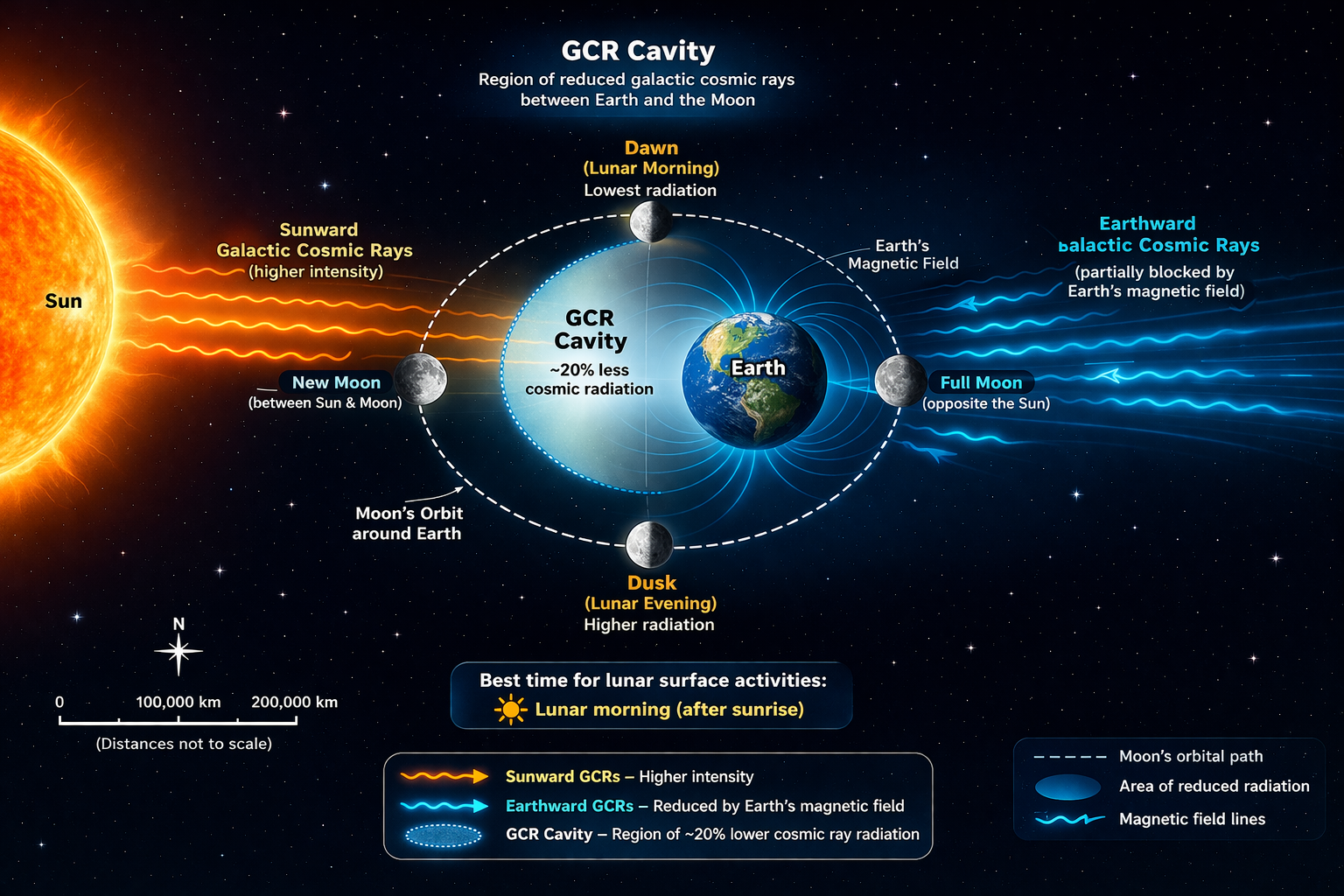
Scientists have identified a region in space near the Moon where galactic cosmic radiation temporarily drops by about 20%. This phenomenon occurs during the Moon’s local morning hours, shortly after lunar sunrise.
Key Highlights:
- Radiation levels decrease during specific lunar phases
- The drop is most noticeable during the waxing gibbous phase
- The effect is consistent and repeatable
This “cavity” acts like a natural shield, offering a safer window for astronauts working on the lunar surface.
Understanding Cosmic Rays and Their Risks
Cosmic rays are high-energy particles that travel through space at nearly the speed of light. They are one of the biggest dangers for astronauts beyond Earth’s protective magnetic field.
Why They Matter:
- Penetrate spacecraft and human tissue
- Damage DNA
- Increase cancer risk
- Pose long-term health threats
Understanding and reducing exposure to these particles is critical for the future of human space exploration.
How Scientists Made the Discovery
The research, published in Science Advances, analyzed data collected over 31 lunar cycles (2019–2022).
The Key Instrument:
- Lunar Lander Neutron and Dosimetry Experiment onboard Chang’e-4
What Researchers Found:
- A consistent drop in low-energy proton radiation
- Energy range observed: 9.18 to 34.14 MeV
- Radiation decreased specifically during lunar morning hours
This pattern confirmed that the reduction was not random—but caused by a real physical phenomenon.
The Role of Earth’s Magnetic Field
One of the most surprising aspects of this discovery is the role played by Earth’s magnetic field.
Traditionally, scientists believed that once cosmic rays passed beyond Earth’s magnetosphere, they spread evenly through space. However, this study suggests otherwise.
New Insight:
- Earth’s magnetic field may extend its influence farther into space than previously thought
- It appears to block or deflect some cosmic rays, creating a “shadow” or cavity near the Moon
This finding fundamentally changes how scientists understand the Earth-Moon space environment.
Why Lunar Morning Could Be the Safest Time
The study suggests a simple but powerful strategy for future missions:
👉 Astronauts should perform surface activities during lunar morning hours
Benefits:
- Up to 20% lower radiation exposure
- Reduced health risks
- Safer conditions for exploration
This timing strategy could become a key guideline for future lunar missions, especially in high-exposure regions like the Moon’s poles.
Implications for Future Moon Missions
With human missions to the Moon on the horizon, this discovery comes at a crucial time.
Potential Applications:
- Smarter mission scheduling
- Safer astronaut excursions
- Improved spacecraft shielding strategies
- Better radiation mapping
Programs like Artemis Program could directly benefit from this research by optimizing mission timelines around safer radiation windows.
A Shift in Space Exploration Strategy
This discovery is more than just a scientific curiosity—it represents a paradigm shift in how we approach space exploration.
What Changes:
- Radiation is no longer assumed to be uniform
- Mission planning can now factor in time-based safety zones
- New models of space weather and cosmic ray behavior will emerge
What Comes Next?
Researchers believe this is just the beginning.
Future Research Goals:
- Map the full size and shape of the radiation cavity
- Study how it changes over time
- Use larger datasets for more accurate predictions
As technology advances, scientists hope to develop real-time radiation forecasting systems for astronauts.
Conclusion: A Safer Path to the Moon
The discovery of a radiation “cavity” near the Moon could play a vital role in making lunar exploration safer and more efficient. By simply timing activities during lunar morning hours, astronauts may significantly reduce their exposure to harmful cosmic radiation.
This breakthrough not only enhances our understanding of space physics but also brings us one step closer to sustainable human presence on the Moon.