
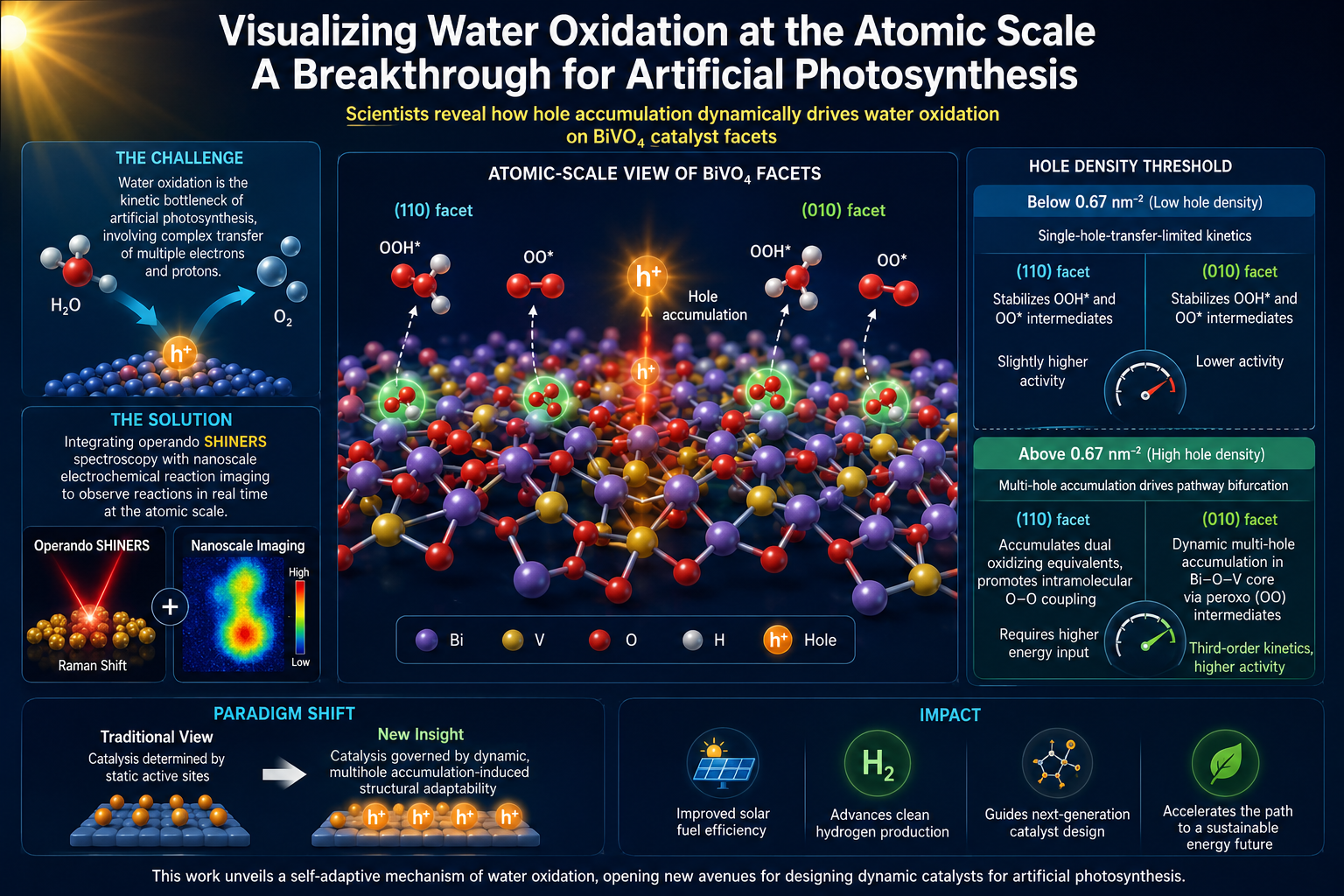
Scientists Finally Visualize Water Oxidation at the Atomic Scale
A Major Leap Toward Clean Solar Fuel Production
The dream of producing clean fuels directly from sunlight has inspired scientists for decades. Artificial photosynthesis—an emerging technology that mimics nature’s ability to convert sunlight into chemical energy—holds the promise of generating sustainable hydrogen and other solar fuels. However, one major obstacle has consistently slowed progress: the water oxidation reaction.
Now, an international team of researchers has achieved a breakthrough that could significantly accelerate the development of next-generation solar fuel technologies. Scientists from the Dalian Institute of Chemical Physics (DICP) of the Chinese Academy of Sciences and Xiamen University have successfully visualized, in real time and at the atomic scale, how water oxidation occurs on catalyst surfaces. Their findings were published in Nature Nanotechnology and represent one of the most important advances in artificial photosynthesis research in recent years.
Why Water Oxidation Matters
Water oxidation is often described as the “bottleneck” of artificial photosynthesis. While capturing sunlight is relatively straightforward, splitting water molecules into oxygen, protons, and electrons requires a highly complex series of chemical reactions.
The challenge lies in the fact that water oxidation involves the transfer of multiple electrons and protons simultaneously. These reactions occur at the catalyst-liquid interface, where tiny positively charged particles known as “holes” accumulate and trigger chemical transformations. Understanding exactly how these holes interact with catalyst surfaces has remained one of the biggest unanswered questions in renewable energy science.
For years, researchers could only infer what was happening through indirect measurements. The dynamic relationship between charge transfer, structural changes, and catalytic activity remained hidden from view.
That has now changed.
The Technology Behind the Discovery
To observe these reactions, researchers combined two cutting-edge techniques:
1. Operando SHINERS Spectroscopy
Shell-Isolated Nanoparticle-Enhanced Raman Spectroscopy (SHINERS) allows scientists to detect molecular-level changes occurring on catalyst surfaces during chemical reactions.
2. Nanoscale Electrochemical Reaction Imaging
This technique enables researchers to visualize reaction activity across different regions of a catalyst particle with nanometer-scale precision.
By integrating these methods, the team achieved something previously considered impossible: direct observation of how charge carriers and reaction intermediates evolve across individual facets of a photocatalyst during water oxidation.
The Role of BiVO₄: A Promising Solar Catalyst
The catalyst investigated in the study was bismuth vanadate (BiVO₄), one of the most promising materials for solar-driven water splitting.
BiVO₄ has attracted enormous attention because it absorbs visible light efficiently and offers favorable electronic properties for photoelectrochemical reactions. Despite years of research, however, scientists have struggled to fully understand why certain crystal facets of BiVO₄ perform better than others during water oxidation.
The new research provides answers that could reshape catalyst design strategies.
The Discovery of a Critical Hole Density Threshold
Perhaps the most significant finding of the study is the identification of a critical surface hole density threshold.
Researchers discovered that when the density of accumulated holes remains below 0.67 nm⁻², two major crystal facets of BiVO₄—the (110) and (010) facets—follow similar reaction pathways.
Under these conditions:
- Water oxidation is limited by single-hole transfer kinetics.
- Hydroperoxo (OOH) and peroxo (OO) intermediates are formed.
- The (110) facet exhibits slightly higher catalytic activity.
However, once the hole density exceeds this threshold, the reaction behavior changes dramatically.
The (010) facet becomes significantly more active and exhibits third-order power-law kinetics driven by the accumulation of multiple holes within Bi–O–V structures. Meanwhile, the (110) facet adopts a different pathway that requires greater energy input.
This finding demonstrates that catalytic activity is not determined solely by static atomic arrangements but also by how charge accumulates and reorganizes the catalyst during operation.
A Paradigm Shift in Catalyst Science
For decades, catalyst research has largely focused on identifying and optimizing static active sites.
This study challenges that traditional view.
The researchers found that photogenerated holes are not simply passive charge carriers moving through the material. Instead, they actively reshape catalytic centers and influence reaction pathways as they accumulate. The catalyst essentially adapts itself dynamically during operation.
This represents a shift from a:
Static Site-Centric Model → Dynamic Charge-Coupled Adaptive Model
Such a transition could fundamentally alter how future catalysts are designed.
Instead of focusing exclusively on crystal structures, scientists may increasingly engineer interactions between charge carriers and catalytic architectures.
What This Means for Solar Hydrogen Production
The implications extend far beyond academic curiosity.
Hydrogen produced through solar water splitting is considered one of the cleanest fuels available because it generates only water when used.
Yet commercial deployment has been limited by low efficiency and high production costs.
The new understanding of water oxidation mechanisms may help researchers:
- Develop more efficient photocatalysts.
- Reduce energy losses during water splitting.
- Improve charge separation and transport.
- Increase solar-to-fuel conversion efficiencies.
- Accelerate commercialization of artificial photosynthesis technologies.
If these advances continue, future solar fuel systems could provide sustainable alternatives to fossil fuels for transportation, industrial processes, and electricity storage.
Industry Impact and Future Research Directions
This breakthrough arrives at a time when governments and industries worldwide are investing heavily in green hydrogen technologies.
The global push toward net-zero emissions requires scalable methods for producing clean fuels. Understanding the atomic-scale behavior of water oxidation catalysts could unlock entirely new classes of materials optimized for renewable energy applications.
Future research will likely focus on:
Designing Dynamic Catalysts
Scientists may create materials specifically engineered to exploit multihole accumulation effects.
AI-Assisted Catalyst Discovery
Machine learning models could predict catalyst architectures that maximize adaptive charge behavior.
Real-Time Imaging of Other Reactions
The imaging techniques demonstrated in this study may be applied to carbon dioxide reduction, nitrogen fixation, and other critical renewable-energy reactions.
Commercial Solar Fuel Systems
Improved catalyst performance could eventually lower the cost of producing green hydrogen at industrial scale.
Suggested Visuals for Your Blog
To increase reader engagement and improve SEO performance, consider including:
Infographic 1: Artificial Photosynthesis Process
- Sunlight absorption
- Charge generation
- Water oxidation
- Hydrogen production
Infographic 2: Water Oxidation Pathways
- Low hole density pathway
- High hole density pathway
- Facet-specific reaction mechanisms
Chart 1: Catalyst Performance Comparison
- Traditional static catalysts
- Dynamic multihole catalysts
Diagram 1: BiVO₄ Crystal Facets
- (110) facet behavior
- (010) facet behavior
- Hole accumulation visualization
Visual content can significantly increase time-on-page and improve user understanding of complex scientific concepts.
Final Thoughts
The ability to directly visualize water oxidation at the atomic scale marks a milestone in renewable energy research. By revealing how charge accumulation dynamically reshapes catalytic activity, scientists have uncovered a fundamentally new way of thinking about catalyst design.
Rather than viewing catalysts as fixed structures, future researchers may treat them as adaptive systems whose behavior evolves in response to charge flow. This insight could help overcome one of the most persistent barriers to efficient solar fuel generation.
As the world searches for sustainable energy solutions, discoveries like this bring us one step closer to realizing the full potential of artificial photosynthesis and clean hydrogen production.
What Do You Think?
Could artificial photosynthesis eventually become a major source of global energy? Do you believe solar-generated hydrogen can compete with fossil fuels in the coming decades?
Share your thoughts in the comments below and join the discussion on the future of clean energy.