
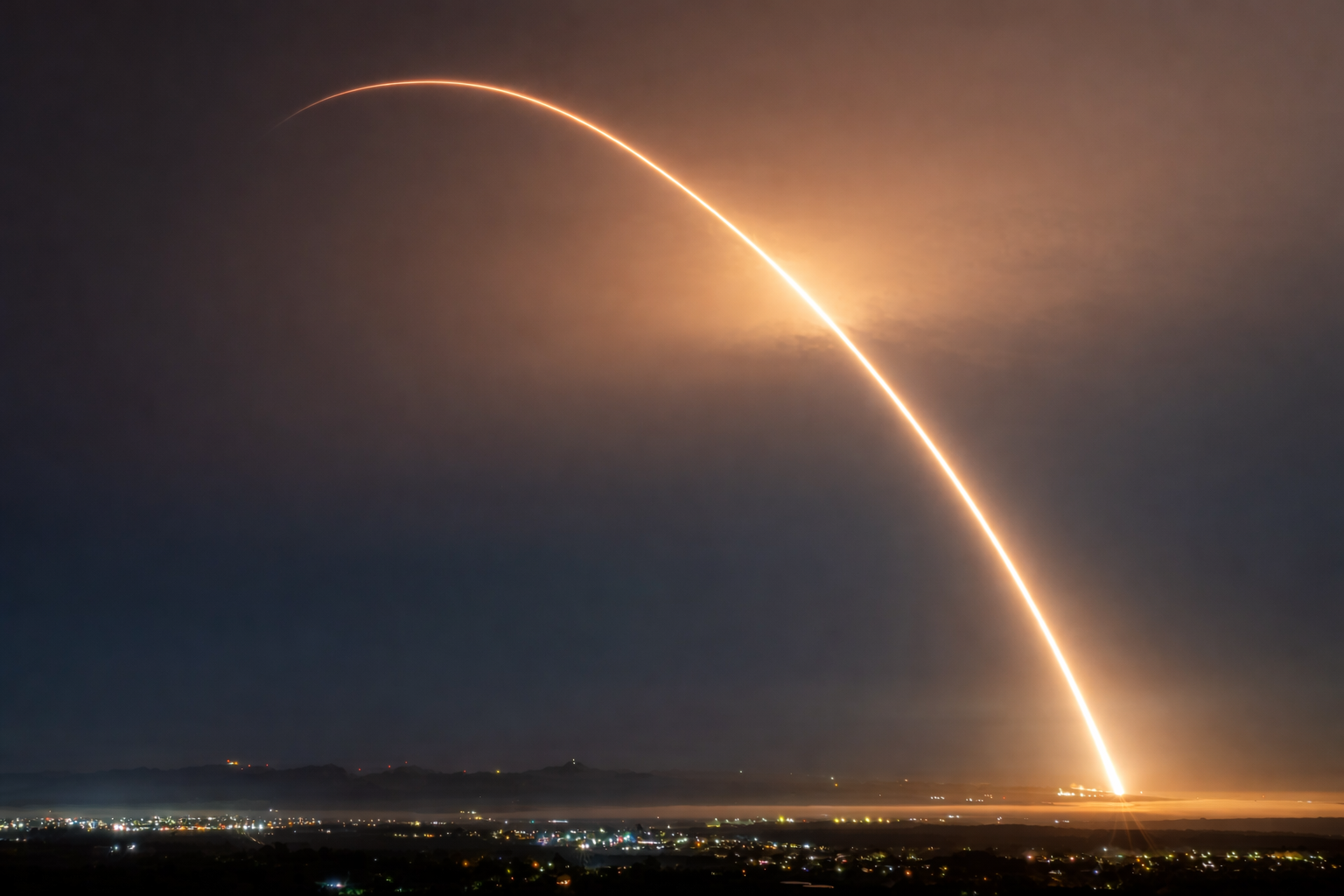
Over 100 Satellites Delivered to Orbit in Historic Rideshare Mission
SpaceX successfully launched their Transporter-16 rideshare mission, launching more than 100 cargo into orbit, marking the most recent milestone in commercial spaceflight. This mission demonstrates how the space business is changing and how there is an increasing need for affordable satellite deployment.
SpaceX Transporter-16 Launch Overview
On March 30, a Falcon 9 rocket lifted off from Vandenberg Space Force Base at 7:02 a.m. Eastern Time. The mission carried 119 payloads, making it one of the most significant rideshare launches to date.
Within just two and a half hours, SpaceX confirmed that all payloads were successfully deployed into sun-synchronous orbit (SSO)—a preferred orbit for Earth observation satellites.
Key Highlights:
- 119 payloads delivered
- Mix of satellites, hosted payloads, and orbital transfer vehicles
- Deployment completed within hours
- Focus on low-cost, high-efficiency space access
Major Payloads and Notable Companies
Transporter-16 included a wide range of payloads from both established and emerging space companies.
Largest Payload: Gravitas Satellite
The standout payload was Gravitas, developed by K2 Space.
- First satellite in the “Mega-class” category
- Generates 20 kilowatts of power
- Funded by the United States Space Force
- Part of a growing push toward larger, more capable satellites
Participating Companies
Several well-known satellite operators used this mission to expand their constellations:
- Capella Space
- HawkEye 360
- Iceye
- Satellogic
- Spire Global
- Unseenlabs
These companies are building advanced satellite networks for Earth monitoring, climate tracking, and communications.
New Missions and Replacement Satellites
Transporter-16 also supported new and replacement missions:
- SatVu launched HotSat-2, replacing its earlier satellite that failed after six months.
- Sierra Nevada Corporation deployed Vindlér RF intelligence satellites, built by Muon Space.
Role of Orbital Transfer Vehicles (OTVs)
The mission included several orbital transfer vehicles (OTVs)—spacecraft designed to move satellites into specific orbits after launch.
Key OTV Participants:
- Momentus launched Vigoride-7
- D-Orbit deployed its ION vehicle
- Exotrail launched its Spacevan
These vehicles aim to provide “last-mile” orbital delivery.
Are Orbital Transfer Vehicles Losing Momentum?
Despite early excitement, OTVs have not fully lived up to expectations.
Industry experts, including leaders from Rocket Lab and Firefly Aerospace, suggest:
Challenges Facing OTVs:
- Limited orbital flexibility (only minor inclination changes)
- High cost compared to dedicated small launches
- Complex logistics
💬 Experts say the market has “spoken,” and the economics may not justify large-scale OTV deployment.
Why SpaceX Rideshare Missions Are Dominating
SpaceX’s rideshare program continues to disrupt the space industry by offering:
Lower launch costs
- Shared payload opportunities
- Frequent launch schedules
- Reliable deployment system
This model allows startups and major companies alike to access space more affordably.
The Future of Satellite Launches
The success of Transporter-16 reinforces several key trends:
- Growth of satellite constellations
- Increasing demand for rideshare missions
- Shift toward larger, more powerful satellites
- Uncertain future for orbital transfer vehicles
Final Thoughts
The SpaceX Transporter-16 mission marks another major step forward in commercial spaceflight. By delivering over 100 payloads efficiently and cost-effectively, SpaceX continues to lead the industry.
While innovations like orbital transfer vehicles still hold promise, the dominance of rideshare missions shows that simplicity, cost-efficiency, and reliability are what truly drive the space economy today.